
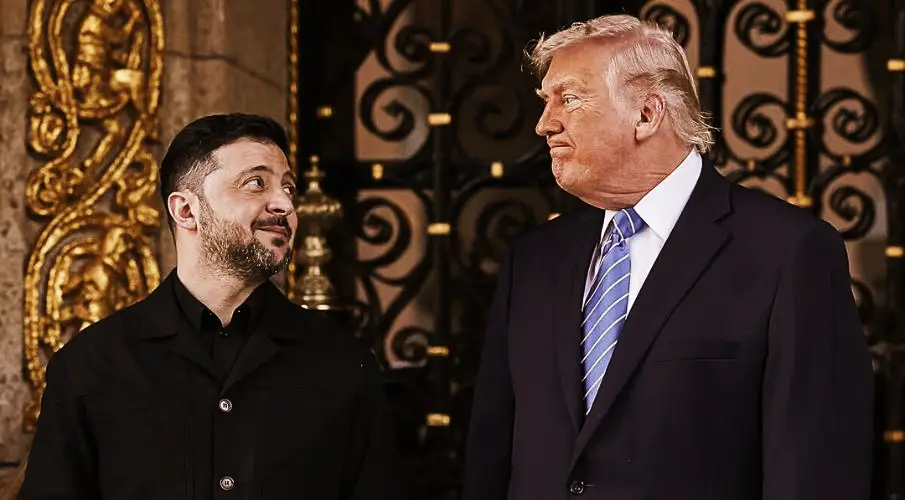
Volodymyr Zelenskyy sat in the White House on August 18 and presented Donald Trump with a briefing. In it, a map of the Middle East. In it, the note that Iran had improved the design of its one way attack drones. In it, a concrete offer: drone barriers in Turkey, in Jordan, in the Gulf states. Radar. Interception systems. Regional hubs. A protective shield for American bases, built on Ukrainian knowledge, financed with American money. Trump instructed his team at the time to work on it. Nothing happened.
Since February 28, since the beginning of the American strikes on Iran, Iranian Shahed drones have killed seven U.S. soldiers. A Shahed costs between 20,000 and 50,000 dollars. Shooting one down often costs several times that amount. Washington is firing multimillion dollar missiles at a cheap, simple weapon that is produced in series and that Ukraine has known for years. Russia deploys them by the thousands under the name Geran. The Ukrainians have adapted. They have developed low cost interceptor drones, built sensors, created a system that does not rely on expensive interceptors but on speed and volume. All of this was in the August presentation.

An American official who saw the presentation at the time describes the mood in Washington like this: People thought it was just Zelenskyy being Zelenskyy - a showman from a client state who did not command enough respect. Someone decided not to accept the offer. Today the same official says that if there was a tactical mistake before this war, it was this one. Last week Washington officially turned to Zelenskyy. Not with an offer. With a request for help. That is the real story. Not that drones kill. Not that Iran is rearming. But that seven months passed between warning and realization, and that in those seven months seven soldiers died.
The Ukrainians had structured their offer like a business deal. Access to production and know how in exchange for American investment. They said they could produce up to 20 million such weapons. They had only been able to use 50 percent of their own capacity because funding was lacking. The United States should finance the other half and participate in production. American drone dominance, the promise went, was possible. No one bought it.
On Friday the United States announced that it would deploy its own defense system called Merops. Army Secretary Dan Driscoll, internally described as the drone guy, is pushing new solutions. Under the Biden administration there had already been a program for rapid drone production under the name Replicator. Defense Secretary Pete Hegseth had announced reforms last year to overtake China and Russia in unmanned aerial warfare. The announcements continued while the drones were flying. The official line from the White House sounds different. Spokesperson Anna Kelly says that Iranian retaliatory strikes have declined by 90 percent because Tehran’s ballistic capabilities are being completely shattered. The accounts of anonymous sources are inaccurate. Hegseth and the armed forces had planned for all scenarios, the success of Operation Epic Fury speaks for itself.
At the same time regional partners are expressing dissatisfaction with the defensive measures so far. One U.S. official spoke of a disappointing response to the Iranian drone attacks. Another admits that the Ukrainian systems would have helped earlier. Images show Apache helicopters engaging Iranian drones with onboard cannons. Britain is sending Wildcat helicopters with Martlet missiles. All of these are responses to a problem that Kyiv had long solved and whose solution lay on Washington’s table in August. In November another U.S. official had said that military leaders had long wanted to travel to Ukraine to adopt technology and tactics directly. The Ukrainians are in an existential crisis. One hundred percent.
What remains is a simple calculation. A Shahed costs 50,000 dollars. A warning that is ignored costs more. It costs everything if one understands human lives as part of the calculation. Washington did not want to be lectured in August by someone whom some in the administration did not take seriously. Now the same city is asking the same man for advice. Seven deaths later. Almost exactly seven months afterward. This is not a failure of ignorance. It is a failure of attitude.
Updates – Kaizen News Brief
All current curated daily updates can be found in the Kaizen News Brief.
To the Kaizen News Brief In English


Diese Leute sind sowas von unfähig, unfassbar. Gerade habe ich gelesen, dass T. Erika Kirk zum Advisary Board der Air Force hinzugefügt hat. 🤦🏻♀️
…es ist schon der wahnsinn, was in den usa abgeht
Wie sagte Trump zu Selensky, „ihr habt keine Karten in der Hand“.
Arrogant und hochmütig.
Ganz Trump.
Und jetzt, jetzt fragt man recht heimlich still und leise und recht kleinlaut um Hilfe.
Und das, obwohl sich Trump weiter an die Seite von Russland stellt und Beendigung von Sanktionen in Aussicht stellt.
Ob Kiew gut beraten ist, sich darauf einzulassen?
Hoffentlich lassen sie es sich gut bezahlen.
Nicht, dass Trump es in ein paar Wochen gegen die Ukraine verwendet.
Diesem Trump ist alles, wirklich alles zuzutrauen.