
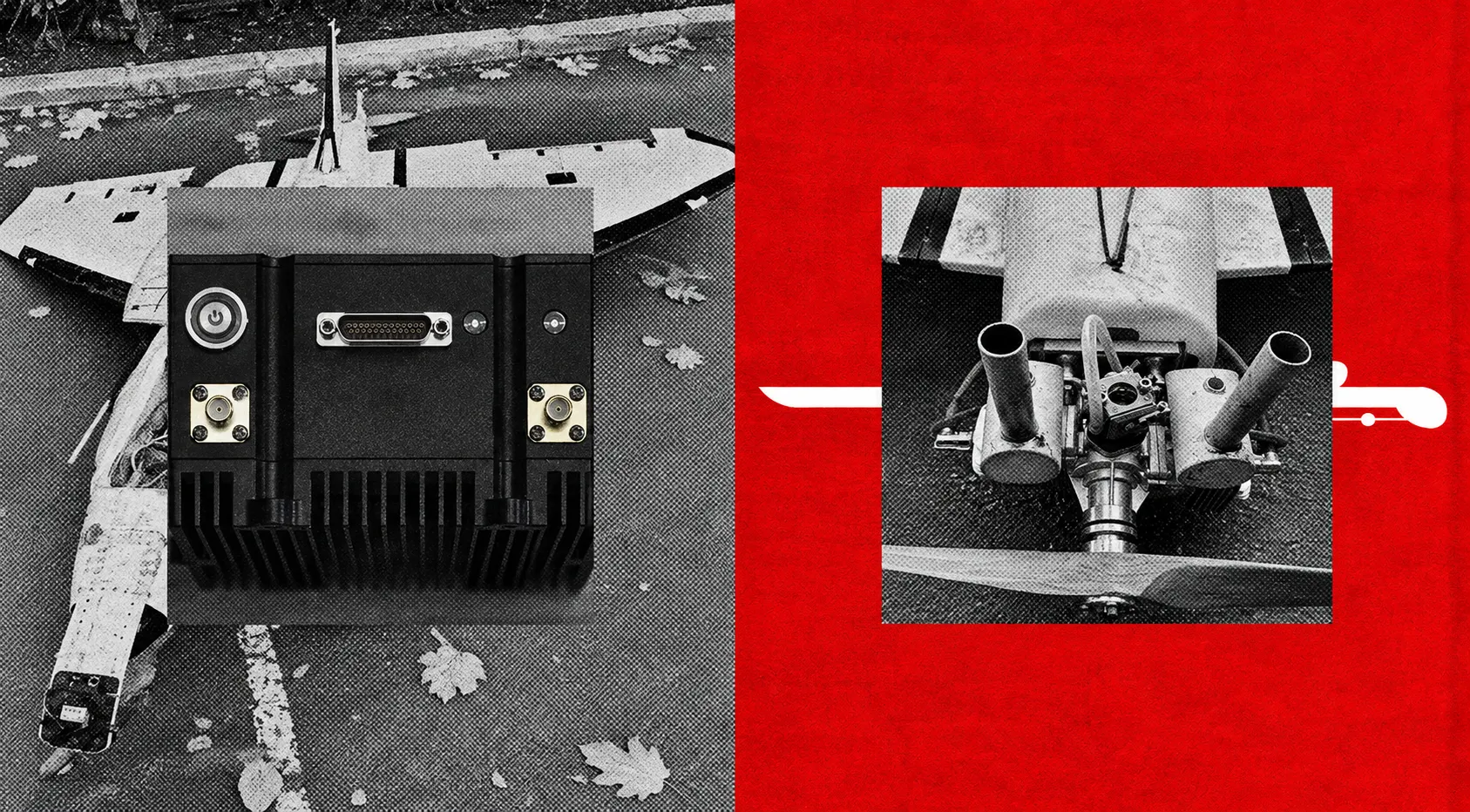
A small box, electronic components, a route through Ukrainian airspace. As Russian drones attack Ukrainian cities, the trail of their communications technology leads to Shenzhen. According to an undercover investigation, Chinese manufacturer Xingkai Technology is offering for sale the very same devices found in Russian Gerbera drones. Even when a prospective customer explicitly stated that the equipment was intended for military production in Alabuga, the company didn't end the conversation. Instead, it issued invoices. War has many supply chains. Some end on an ordinary piece of business paperwork.
Since February 2026, Russian forces have no longer been able to use Starlink terminals to attack Ukraine, according to the investigation's findings. Chinese mesh modems are supposed to fill that gap. They connect drones to one another in a radio network, with individual devices relaying messages. Aircraft near the border receive connections through Russian or Belarusian radio relay stations. Drones flying deeper into Ukrainian territory access that network through other aircraft. This allows attack drones to receive new commands while already in flight and change course to evade Ukrainian air defenses.

Unmarked mesh modem manufactured by Xingkai Technology - This is the XK F-359 model.

The cheaper Gerbera drones play a particularly important role. Their radar signature resembles that of a conventional, non-jet-powered Geran. Ukrainian defenders have to distinguish between targets carrying dangerous weapons and those serving as decoys. At the same time, Gerberas can act as flying radio relays. Their low production costs say little about the military damage they can help inflict. As early as 2024, Ukrainian military intelligence reported finding Xingkai Tech modems inside Gerbera drones. Their use was later discussed on a major pro-Russian website. What remained unclear was whether the manufacturer would knowingly sell directly to Alabuga. An earlier investigation had already documented an invoice for 30 devices destined for Vladivostok.

Although Russia manufactures the Gerbera drone using the simplest materials, this unmanned aircraft contains foreign components. It can carry a warhead as a kamikaze drone and conduct electronic reconnaissance, particularly to identify Ukrainian air defense positions and document strikes by other attack drones.
In 2026, journalists in Ukraine examined a privately obtained modem recovered from a modernized Gerbera with a vertical stabilizer. This design had appeared during the summer. The device carried no recognizable manufacturer's markings. Investigator Nordsint then posed as a Russian military supplier based in Alabuga and contacted Xingkai Technology through its official WeChat account to ask about that exact model. An employee named Jack Jiang confirmed that the company manufactured it and sent over the manual for the XK F-359. Earlier identifications of the device as an XK F-358 were therefore incorrect. At the supposed buyers' request, Jiang even took photos and a video of the device at the warehouse. The component examined in Ukraine matched the product being offered.
Then came the invoice.
For 500 identical radio modems, Xingkai Tech demanded 19.5 million yuan, approximately $2.87 million. Delivery destination: Alabuga, where Russia manufactures a substantial share of its long-range attack drones. According to the offer, payment could be made in US dollars to a company account at DBS Bank in Hong Kong or in yuan to Jiang's personal account at Ping An Bank. After a request to change the address, another invoice followed. This time, Alabuga was explicitly written in Latin letters. The banking details now listed China Merchants Bank, Shenzhen Hongling branch. The account holder was Huang Qiuping, possibly the same person identified as Fenny Huang in the manual. According to company records, Huang left a management position at Xingkai Tech in 2025.

The document shows a pro forma invoice issued by Chinese company Shenzhen Xingkai Technology on September 11, 2026, for 500 XK-F359 mesh radio modems totaling 19.25 million yuan. The recipient is explicitly identified as the Alabuga Special Economic Zone in Russia's Republic of Tatarstan, where attack drones for the war against Ukraine are manufactured. The invoice specifies payment channels through DBS Bank in Hong Kong and China's Ping An Bank, but it does not establish that any payment or delivery actually took place.
The correspondence leaves little room for the idea of an unsuspecting seller. The undercover buyers explicitly identified the end user as a military production facility. According to the investigation, the director raised no objection. He later asked whether the Russian buyer had won the "project," apparently referring to a tender. Jiang also confirmed that the same modems were sold through Shenzhen Sinosun Technology, although Xingkai was their sole manufacturer. Photos of identical devices appear on the intermediary's website. Such devices have sometimes been found among the wreckage of Russian drones bearing an HX-50 label. However, this particular version of the F-359 does not appear in the public catalog. Investigators obtained its manual only after contacting Xingkai Technology directly.

According to this investigation's estimates, Xingkai Tech accounts for approximately half the market for powerful mesh modems used in Gerbera and Geran drones. An estimate whose implications could be enormous given the waves of Russian attacks. The devices are said to support line-of-sight radio links over distances of 100 to 300 kilometers. In theory, just a few drones serving as relays could extend communications during attacks as far as the Kyiv area. The network can also transmit video footage from camera-equipped drones back to their operators. Ukrainian specialist Serhiy "Flash" Beskrestnov had recently reported on such remotely operated variants.


It's hard to imagine that the CIA wasn't keeping an eye on Chinese supply chains for Russian attack drones at all. Cooperation between Chinese electronics manufacturers and Russia's arms industry, in particular, would likely be of considerable interest to US intelligence agencies. Our investigation into this issue is still ongoing.
What matters is the radio network's ability to reorganize itself as the aircraft move. When drones change position, the system can find alternative transmission routes. Operators don't have to constantly manage that process themselves. In its manual, Xingkai Tech describes a mobile network architecture capable of transmitting voice communications and high-definition video. Military applications are explicitly listed first among the intended uses.
The technical controls rely in part on a programmable component known as an FPGA. Jiang identified the part as model XC7Z020-2CLG4001, manufactured by American company AMD. Its origins raise another uncomfortable question. AMD denied having any direct business relationship with Xingkai Technology when contacted. Xingkai Technology was neither a customer nor an authorized partner, the company said. AMD had not sold any products to the Chinese manufacturer and complied with all applicable export controls. Unauthorized shipments to Russia were expressly prohibited.

Jiang, however, refused to provide an AMD licensing agreement. Xingkai obtained the components through an intermediary, he explained. That does not establish any direct violation of the law by AMD. What it does reveal is just how far an electronic component can travel from its original manufacturer before ending up inside a Russian attack drone. The banks, too, require a distinction between a documented offer and an actual payment. The invoices list DBS Bank, Ping An Bank, and China Merchants Bank as payment channels. The documents do not establish that any money was actually transferred.
What is documented, however, is an offer for 500 radio modems intended for military use, complete with payment instructions and Alabuga explicitly named as the delivery destination. The supposed customer had disclosed the military purpose of the purchase. Xingkai Technology kept doing business. The skies over Ukraine are now shaped in part by components listed on ordinary commercial invoices. The seller doesn't have to launch a drone. All he has to do is know where the package is going.
To be continued ...
Updates – Kaizen News Brief
Alle aktuellen ausgesuchten Tagesmeldungen findet ihr in den Kaizen Kurznachrichten.
To the Kaizen News Brief In English


