
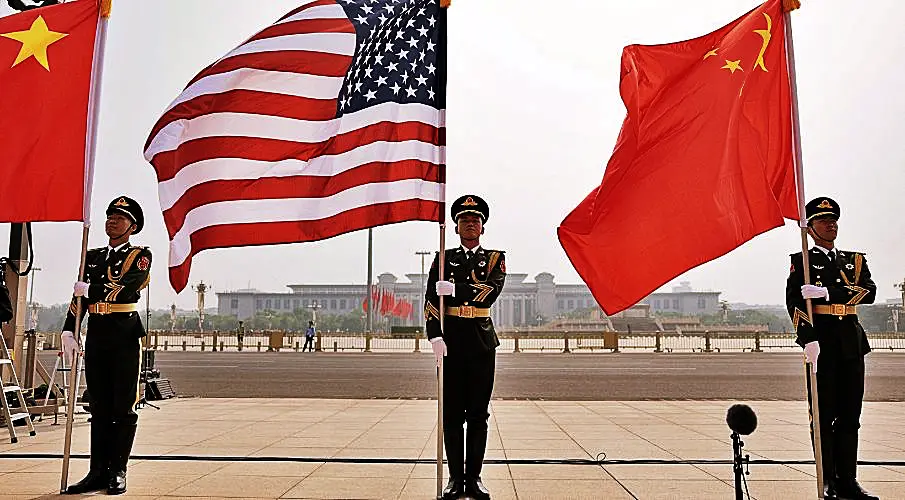
Two monsters born out of the fears of the Cold War are facing each other again, this time without a movie screen. On one side, an American Godzilla, famous and destructive, on the other, a Chinese Rodan, younger and faster. China holds the rocks, the world’s critical minerals, America the chips, the most advanced semiconductors for artificial intelligence. They are not fighting over the planet, this is about their own expansion and greed. While they haggle, the world keeps stumbling further into chaos.
37 years after the fall of the Berlin Wall, that seemingly one-sided victory has turned into a Pyrrhic victory. From within, greed and corruption ate away at the country, carried along by cowardly politicians and would-be tyrants among the wealthy. Twice, it elected a racist, megalomaniacal con man to office who was once nothing more than a joke in New York. The sudden collapse of the Soviet Union is now answered by an American collapse in slow motion, and the younger giant is challenging the wobbling last superpower. The small defeats are piling up. China’s economic giant got around Donald Trump’s tariffs on solar panels through a hastily built 20,000-mile route, through Kenya and across a tiny island off Singapore, worth more than $100 million a month. Just one episode in an endless series.

In mid-May, Trump and Chinese leader Xi Jinping met in Beijing, and the tone turned unexpectedly warm. The tariff war was threatening to spin out of control, and China was worried about the U.S.-Israeli war against Iran and rising oil prices. Both found a common goal, “constructive strategic stability.” For a condominium of superpowers, a G2, Trump delayed arms deliveries to Taiwan and approved the sale of advanced, though not the most advanced, Nvidia chips to China. China promised more purchases, including 200 Boeing aircraft and $17 billion worth of agricultural products annually through 2028. The noise from the press offices hid how little had actually been agreed. Trump did not secure permanent access to the rare earths that America’s high-tech and defense industries need. At least both sides stepped off the path of escalation, and Trump appears to have buried his goal of economically decoupling from China. The fight simply moved elsewhere, into the world of raw materials.
Rare earths are not actually rare, the hard part is extracting the 17 metals from the ore. The United States once led in mining and processing, thanks to a mine in California, back when the material still went into black-and-white televisions. Environmental damage and labor costs pushed the business to China. When rare earths became the basis for the strongest magnets, from wireless chargers to the F-35 fighter jet, China controlled more than 60 percent of mining and 90 percent of processing. It also holds most of the patents, and through the Belt and Road Initiative it reached for mines around the world.

In Tanzania, the Australian company Peak Rare Earths discovered what may be the largest undeveloped deposit in 2010; last year, China’s Shenghe Resources bought the Australians, rights included, for just over $100 million. China also draws ore from Myanmar, develops new deposits in Brazil and is looking at additional sites in Malaysia and Indonesia. Washington is pushing back: California’s Mountain Pass mine restarted in 2012, but could not keep up because Beijing drove prices down. The Pentagon took a majority stake in its owner, MP Materials, which today supplies more than 10 percent of the world’s rare earths.
Trump’s counterattack stretches from the Round Top mine in Texas, which will not begin producing before 2028, to new processing operations and agreements abroad. That reduces dependence, it does not end it. China controls 95 percent of magnesium production and more than 80 percent of tungsten. For graphite and silicon, it is more than 70 percent, for cobalt 75. It refines 19 of the 20 most sought-after minerals and produces 94 percent of the strongest magnets used in vehicles and medical equipment. The race for critical raw materials is intensifying competition across the resource-rich Global South. There, China is seen as a willing source of money, while Trump is seen as the man who called half the continents “shithole countries” and hammered their governments with tariffs. By 2028, America will cover at best half of its need for rare earths; right now, it produces less than 1 percent of those powerful magnets. Before Washington catches up or finds more partners through Pax Silica, Beijing can turn off the tap more easily than Iran can close the Strait of Hormuz.
The other superpower lies in the chips. The heart of Silicon Valley was once silicon, and chips made the valley great. Nvidia went from graphics chips for games to the hardware behind artificial intelligence; the first major platform, ChatGPT, ran on its processors, and Nvidia became the most valuable company in the world at more than $5 trillion. To preserve that lead, Washington blocked the most advanced of those chips from China. The People’s Liberation Army is said to have tried hundreds of times over six years to get hold of them, and the Netherlands restricted exports of the machines that make such semiconductors possible in the first place.

There are two catches to this blockade. The first is Taiwan, which produces more than 90 percent of the most advanced chips, a third monster that can bring both of them to their knees. Out of fear that China could invade the island, the CHIPS Act is bringing production back home, and Arizona is becoming the new Silicon Valley, with Intel and Taiwan’s TSMC among the more than 75 companies building factories there; the plants swallow enormous amounts of water in the desert and leave toxic chemicals behind. After Russia’s failure in Ukraine and the failed overthrow in Iran, Beijing is unlikely to attack Taiwan anytime soon. The second catch weighs more heavily, because since China cannot get the best chips, it is building its own industry into the best in the world.
In January 2025 came the Sputnik moment. The Chinese company DeepSeek introduced a rival to ChatGPT, and the quiet breakthrough was that China achieved comparable results at lower cost using its own chips. America’s private spending on artificial intelligence is still higher, but Trump’s cuts to science and barriers to work visas are slowing progress for years. By 2030, China is likely to have the machines its models demand. By then, Beijing wants to have closed the gap in the most advanced chips.
Both have landed hits. Washington is keeping its export restrictions and put Chinese companies on a blacklist, including automaker BYD and technology company Baidu. Beijing countered with two American and 14 European companies. On top of that, it restricted seven rare-earth metals, with five more set to follow in November. That may look like a tie, and maybe it was 10 years ago. Today, the American Godzilla is wobbling. Trump’s rage against his own government and the unfilled positions undermined enforcement, the Commerce Department failed to enforce the restrictions, and thousands of those coveted chips are probably already in Chinese hands.

China’s real superpower lies in throwing the full weight of the state behind a goal while protecting its own advantages at the same time. The country produces at least 70 percent of the world’s drones and electric vehicles, and its share of batteries and solar cells is similar. Most recently, it unveiled a sodium-ion battery that does without the critical raw materials used in lithium cells, making its own raw-material advantage partly unnecessary. China will build its own chips before America gets its rocks out of the ground. While Washington burns billions in the war against Iran, Beijing is securing ever larger shares of the renewable technology market and tightening the Belt and Road with nearly 150 countries. Many of the shots Washington fires at China are blanks.
Im Film würden sich die Ungeheuer verbünden, sobald ein größeres Ungeheuer auftaucht, King Ghidorah. Der irdische King Ghidorah heißt Klimawandel, und für ein solches Bündnis ist es womöglich zu spät. Trumps Regierung erklärt das Kohlendioxid für harmlos und päppelt die fossile Branche, und China hängt trotz seiner Solar- und Windexporte weiter an der Kohle. Ungeheuer bleiben Ungeheuer. Kämpfen sie nicht gegeneinander, verwüsten sie die Landschaft und vergiften die Orte, die auf den begehrten Rohstoffen leben. Die Welt steht auf Alarmstufe Rot, und die beiden machen weiter mit ihren monströsen Dingen.
Updates – Kaizen News Brief
Alle aktuellen ausgesuchten Tagesmeldungen findet ihr in den Kaizen Kurznachrichten.
To the Kaizen News Brief In English


