
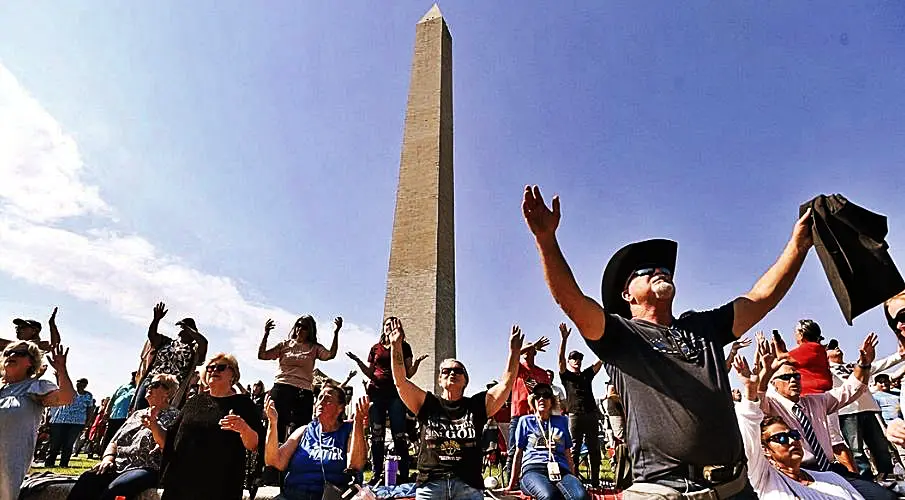
Washington - There are images that say more about the condition of a country than any election analysis, any poll, any political talk show ever could. On Sunday, Washington became exactly such an image. Thousands of people, many dressed in red, white, and blue, streamed toward the National Mall, the place where history is usually made, and transformed the central boulevard of American democracy into one giant evangelical church service. "We welcome Jesus into this place!" one of the first singers shouted from the stage, with ivory-colored columns in the background deliberately echoing the classical architecture of the capital. It was not a church. It was the National Mall. And that was exactly the point.

The event carried the name "Rededicate 250: A National Jubilee of Prayer, Praise & Thanksgiving," organized by the Freedom-250 initiative, a public-private partnership backed by the White House. The event was financed with millions in taxpayer dollars. The occasion was the 250th anniversary of American independence. What was actually being celebrated, however, was something else: the final merger of the state with one very specific form of American Christianity. Not faith itself, but a political, evangelical, white-dominated version personally authorized by Donald Trump.

Among those on stage was Reverend Robert Jeffress, one of the country's most prominent Southern Baptists. He embraced without hesitation the term critics have used for years to describe this phenomenon. "If being a Christian nationalist means loving Jesus Christ and America, then count me in," Jeffress said. In doing so, he simply flipped the term around, wore it as a badge of honor, almost like a medal. What was once an accusation only a few years ago has now become a program.

The list of speakers reads like a family reunion of the evangelical Trump movement. Franklin Graham, head of the relief organization Samaritan's Purse and son of preacher Billy Graham. Jonathan Falwell, son of Liberty University founder Jerry Falwell. Gordon Robertson, president of the Christian Broadcasting Network and son of media empire founder Pat Robertson. It is a succession almost dynastic in nature within a movement that officially claims to answer only to God. Also present were Paula White-Cain from the White House Faith Office, Cardinal Timothy Dolan, Bishop Robert Barron, and actress Sadie Carroway Robertson from the reality series "Duck Dynasty," alongside Jonathan Roumie, star of the Jesus series "The Chosen." It was a mixture of preachers, politicians, and pop culture figures, perfectly assembled for a production that resembled less a worship service and more a political show with heavenly accompaniment.
Almost none of the highest-ranking representatives of the American state were absent. Defense Secretary Pete Hegseth appeared by video and urged the crowd to pray "on bended knees" and turn toward "our Lord and Savior Jesus Christ."
Secretary of State Marco Rubio and House Speaker Mike Johnson were also scheduled to appear. Vice President JD Vance was announced in the livestream, although his name did not appear in the official program. And President Donald Trump himself was expected, as could hardly be otherwise, to address believers through a video message. Hegseth, who has increasingly integrated Christian language and religious services into his role at the head of the Pentagon, had previously prayed openly during a Christian service at the Defense Department for "violence against those who deserve no mercy." When the man commanding the world's largest military apparatus asks for violence during prayer services, it is no longer private devotion. It becomes a political course of action dressed in religious clothing.

Read also our article: America in a Christian Jihad - and in the End America Is Supposed to Belong Again to Those It Never Belonged To
Only a single non-Christian religious leader appeared on the speaker list: Rabbi Meir Soloveichik, an Orthodox rabbi from New York and also a member of the Trump administration's Religious Liberty Commission. On stage he told the story of Irving Berlin, the Jewish immigrant from Russia who once wrote "God Bless America." A beautiful memory. But also a revealing sign of how narrow the religious diversity of this event truly was. No Muslim cleric. No Hindu representative, no Buddhist representative. No voice for Indigenous religions that existed on this continent long before the United States was founded. Muslim participation was not even part of the discussion, despite the fact that the first Muslims were verifiably present in America before the country's founding through the transatlantic slave trade.

Rabbi Jonah Dov Pesner of the Religious Action Center of Reform Judaism put it plainly. He reminded people that early America was religiously diverse: Jews, Muslims, Indigenous peoples. "I want to shine a light on America's history as a nation that welcomes, celebrates, and protects people of all faiths and also those without faith," Pesner said. It was a reminder that the religious reality of this country was never black and white and never exclusively Christian.

And resistance emerged even within Christianity itself. Reverend Adam Russell Taylor, Baptist pastor and head of the progressive Christian organization Sojourners, summarized the concerns of many believers in one clear sentence: "We are deeply concerned that what is really happening here is the rededication of a nation to a very narrow and ideological version of Christianity that betrays our country's fundamental commitment to religious freedom."

History itself also has to be bent in the process. On stage, Pastor Gary Hamrick of Virginia declared that "God has stood at the center of our nation since its founding in 1776." He spoke of a "spiritual war," a battle between good and evil, between truth and lies, between light and darkness. Such words sound grand and dramatic. But they deliberately ignore the fact that the Founding Fathers of the United States defined very precisely in the Constitution what religion may and may not do within government. The First Amendment to the American Constitution states it as clearly as possible: "Congress shall make no law respecting an establishment of religion, or prohibiting the free exercise thereof." Separation of church and state. Not fusion. Not coronation. Separation.
Historian Joseph Ellis, Pulitzer Prize winner and one of the best-known scholars of America's founding era, described the idea that America was founded as a Christian nation in one word: "nonsense." The Founding Fathers, he argued, wrote specifically against the medieval assumption that a state needed a shared religion in order to function. "It is a distortion of the meaning of the American Revolution," Ellis said. But what use are historians when history itself is already being rewritten through viral images, sermons, and networks like the Christian Broadcasting Network?

What becomes interesting is what Americans themselves have to say about it. A recent survey by the Pew Research Center shows that a majority of adult Americans do not want Christianity to become an official state religion. However, the share of those who want exactly that has risen from 13 percent to 17 percent over the past two years. Republican voters favor this merging of religion and state far more often than Democratic voters do. So it is a minority celebrating on the National Mall. But it is a minority represented in the highest offices of government, controlling the Defense Department, the State Department, the House of Representatives, and the White House.
On the other side of the city, resistance was taking shape. The Freedom From Religion Foundation and the Christian group Faithful America organized protests. As early as Thursday evening, the Interfaith Alliance had projected messages onto an exterior wall of the National Gallery of Art. "Democracy, not theocracy," one message read. Another stated: "The separation of church and state is good for both." Only a few blocks from the main event, organizers planned to display a roughly fifteen-foot balloon depicting a golden calf with Donald Trump's facial features. A biblical symbol of the false idol followed by the people of Israel while Moses receives the Ten Commandments. The image could hardly have been sharper. Rachel Laser, president of Americans United for Separation of Church and State, said it plainly: the separation of church and state is "under extreme attack." Her organization has already filed seven lawsuits against the Trump administration, all connected to its movement toward Christianity as a state religion in everything except name.
Distance also exists within the Catholic Church itself. Cardinal Robert McElroy, Archbishop of Washington, warned in an interview that describing America as a Christian nation could be "destructive," particularly when used to build a culture around the exclusion of certain groups. He reminded people that around eighty years ago Catholics themselves were regularly excluded from public life in America. Back then people did not say "Christian nation." Back then they said "Protestant nation." Religious majorities in America have always had a tendency to turn other groups into invisible minorities. Today it affects Muslims, Hindus, Buddhists, atheists, agnostics, and secular people. Tomorrow it may affect others.
Asma T. Uddin, a law professor at Michigan State University who researches Muslims and religious freedom in the United States, summarized the effect of such events precisely. They "draw a sharper line between people who belong and people who do not belong." The idea of America as a Christian nation that had always fundamentally been Christian erases the long history of other religious communities. The United States has roughly 330 million people. Around two-thirds identify as Christian, roughly one quarter as evangelical. Around 30 percent have no religious affiliation. That is the real, lived diversity of a country that was intentionally condensed into a single declaration of faith on the National Mall on Sunday.

And then there are voices showing how deeply this narrative has already embedded itself in everyday life. Lisa Wyzkiewicz, 66 years old, from Jeannette, Pennsylvania, arrived on a charter bus organized by her church. Trump was the "most Christian president" of her lifetime, she said. Abortion and rights for transgender people were, in her view, proof that the nation had gone off course. Through Charlie Kirk and Eric Metaxas she had become convinced that the federal government needed to be influenced much more strongly by faith. "They should almost be connected. I love Jesus, I love my country, and I really want us to return to God." It is an honest sentence, a deeply personal sentence, but it describes a political program that no longer has anything to do with religious freedom as defined by the Constitution.

And so, by the end of this Sunday, what remains in the capital is less a worship service than a political signal. The most important country in the world, or whatever remains of that importance, is currently being publicly shifted, with microphones, stages, lighting systems, and taxpayer money, toward one very specific faith. While Hegseth asks for divine violence, while Johnson claims the separation of church and state has been "misunderstood," while Trump rededicates the nation through video and Vance appears in a livestream without being listed in the official program, an idea is steadily moving into the foreground that America has never been before. A country in which law and constitutional principles no longer determine coexistence, but where a narrow, loud, and highly connected version of Christianity does. History is being rewritten, the Constitution is being reinterpreted, religion is becoming a weapon. The event in Washington was not an exception, not a harmless Sunday prayer, not an innocent worship service. It was another milestone in a movement that has spent years systematically working to dissolve the boundaries between faith and government. And while the world asks how far Donald Trump will go this time, his preachers, his cabinet members, his home-state pastors, and his most loyal voters are already moving forward hand in hand. Anyone who still believes at the end of this day that all of this is religion has missed the trick. It is power. Religion is only the costume.
Updates – Kaizen News Brief
All current curated daily updates can be found in the Kaizen News Brief.
To the Kaizen News Brief In English


Es ist eine riesige Sektenveranstaltung!
Die verklärten Blicke, dieses fanatische Beten…….
Trump hat rund 25% der US Amerikaner da, wo er sie will.
Artig, folgend, nicht kritisieren, nicht hinterfragen.
Trump ist Gottes Prophet.
Der Unterschied zu staaten wir Afghanistan, Iran etc wird immer kleiner.
Eine Autokratie oder Diktatur ist das Eine.
Aber ein Gottesstaat, mit einem Glauben dem gut 25% der US Amerikaner angehören, hat man ein stabiles Fundament.
Politik ist dann eine Frage des Glaubens.
Und Gott stellt man nicht in Frage.
Bei den Bildern denke ich zwangsläufig an die großen Veranstaltungen von Sekten.
Es macht mir Angst.
Und in Deutschland hat der Verfassungsschutz die Beibachtung von Scientology eingestellt.
Sie sind nicht mehr relevant.
Ein großer Fehler in meinen Augen.
Die fliegen derzeit nur unter dem Radar.