
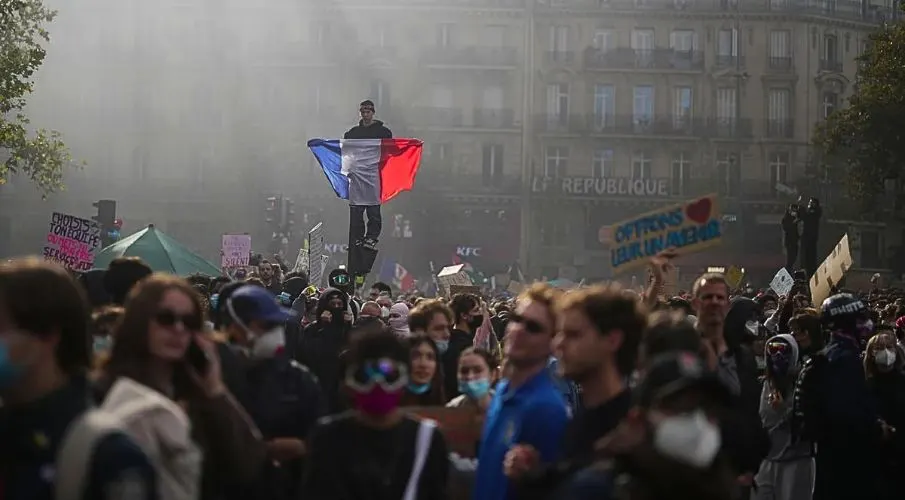
Barricades have a long memory in France. Victor Hugo had a street kid singing on them until the bullets came. Nearly 200 years later, students are standing in front of them again, and once again, the government doesn't know whether to negotiate or send in the police.

On November 5, another wave of protests and street battles swept across France. Contrary to what some political scientists had predicted, it barely changed the political balance. Growing anger over social conditions among young French people has erupted into a serious crisis in the streets, but so far, it hasn't fundamentally changed the presidential election campaign. Neither Marine Le Pen nor Jean-Luc Mélenchon is gaining ground in the polls. After a month and a half of unrest that began with a revolt by high school students and drew in broad sections of society, including radical groups, moderates like Socialist Raphaël Glucksmann are the ones benefiting.

The campaign had barely begun before the streets took control of its direction. On September 17, high school students announced they would blockade their schools. The movement spread quickly and won sympathy because parents and teachers considered the older students' demands justified. Gavroche now carries a backpack with a math textbook. While the government was still trying to decide what to do, clashes with police and isolated acts of arson had already begun. Classrooms were increasingly going up in flames, sometimes entire schools, and it was no longer just trash cans burning. Soon, university students began blockading their campuses as well. Talks between the government and student unions failed to produce a compromise, and the leaders of the youth movement called for the protests to continue.

The last 2 weeks of October were school vacation. Maybe the government hoped the unrest would die down, since there's not much point in blockading schools that are already closed. Instead, the movement gained fresh momentum. Now labor unions and numerous left-wing political and civil society groups called for a nationwide day of action on October 17. They included La France Insoumise and the Yellow Vests, with environmental activists joining in. They made rising living costs and the fundamental lack of social justice the main issues.
October 17 ended in street battles. The historic city hall in Limoges was almost completely destroyed by an arson fire, and the tourist office in Lyon also burned. Numerous government buildings were damaged. Hundreds of small businesses and cafés were vandalized and looted. Offices were hit, too. Organizers claimed 800,000 people had taken to the streets, while police put the number at 550,000. France probably hasn't seen violence on this scale since the Yellow Vest protests.

The country was shaken, its reputation damaged. Even so, the same groups called people back into the streets a week later, on October 24, with the same demands.
This time, police were better prepared. There were fewer clashes and arrests, and no city halls burned. Still, the day could hardly be called peaceful. Organizers again reported 800,000 participants, while police counted 410,000.

Meanwhile, the government promised high school students more funding for particularly troubled areas and an end to Parcoursup, the electronic university admissions system that had become a major target of their anger. Despite these preliminary promises, the unions remained unwilling to back down.
The next nationwide protest was scheduled for November 5. As early as Saturday, October 31, 70,000 security personnel were standing by. The demonstrations were peaceful almost everywhere and attracted fewer people, with only isolated clashes. A small army was guarding a walk in the park.
There are 2 possible explanations. Authorities had previously opened 83 criminal investigations into excessive use of force by police and gendarmes while restoring order, a sign of willingness to accommodate the protesters. Or maybe the timing was simply bad. October 31 fell at the end of school vacation and on Halloween. Many people chose to stick with their personal plans. The revolution took a back seat to the pumpkin.
Les Misérables Watch TV, the Right Does the Talking
Hugo needed an entire book to give a voice to people nobody else listened to. On some evenings, Europe's news media can't even manage it in a single sentence.
In Germany and France, right-wing parties are gaining increasing influence over public debate. Immigration and domestic security dominate the headlines. Social inequality and rising rents are often pushed into the background. So are the economic worries of ordinary people. Studies show that the language and demands of the far right are increasingly finding their way into mainstream news coverage. The language of the fringes quietly moves into the center, and hardly anyone notices the move.
In France, the news channel CNews has repeatedly faced scrutiny from the media regulator, including for violations of journalistic obligations. In Germany, studies show that the AfD can benefit even from critical coverage as long as its preferred issues remain in the spotlight. Even a scathing takedown can serve as advertising when it focuses on the right subject. People outside professional political circles are given too little room to speak in many news outlets. Les Misérables sit in front of their televisions and watch other people talk about them.
Trust in the news is alarmingly low. In France, it stands at 29 percent, and in Germany, at 46 percent. By no means are all established media outlets failing. But newsrooms can't simply blame politicians for their own editorial choices. A newsroom that gives too little attention to the social causes of public discontent leaves a substantial part of the public debate to right-wing parties. Empty space in public life never stays empty for long.
Destruction and looting make for the most powerful images, suggesting that a large share of the demonstrators consists of athletic-looking figures dressed in black, wearing masks and pulling incendiary devices out of their backpacks. That impression is obviously misleading. Mass protests happen only when people from all walks of life interrupt their daily routines to take part. Violent individuals hide among them and use the marches as cover.

The people committing violence can be divided into 2 groups. The first consists of far-left organizations that consider revolutionary violence a legitimate way to fight for their rights. They are few in number but well organized through social media. They appear quickly and in coordination wherever the police aren't expecting them. Just a few dozen can cause considerable damage. Then there are residents of disadvantaged neighborhoods who have little interest in politics but seize the opportunity to empty stores with smashed windows. The 2 groups complement each other. For the past 10 to 15 years, hardly a major left-wing demonstration in France has taken place without violent troublemakers tagging along. Labor unions and Socialists always explicitly distance themselves from them.
Is there a connection between the left's lawful, constitutionally protected forms of protest and the violence on their fringes? Probably not a direct one. Yet at the end of September, Pope Leo XIV came to France for 4 days, holding public Masses and major events attended by hundreds of thousands. There were no riots. Many got the impression that violent troublemakers felt uncomfortable in Catholic France, while in Mélenchon's France they could at least hope for understanding, if not outright support. Even a firebomb has its own liturgy.

Europe's elites talk about rearmament. On Europe's streets, people are talking about rent, food, and energy prices.
From France and Spain to Italy, Portugal, Belgium, and Greece, social protests are increasingly centered on the same problems: rising housing costs, declining purchasing power, austerity measures, and the question of how public money is being spent. In France, labor unions are striking while the government plans higher military spending and cuts elsewhere at the same time. In Italy, anger over budget planning is growing for similar reasons.
Donald Trump bears considerable responsibility for these developments. Under his pressure, NATO countries committed to raising their defense and security-related spending to 5 percent of their economic output by 2035. At the same time, the Iran war started by his administration is driving up energy prices and putting pressure on households and businesses across Europe. While Washington pushes its allies to spend ever more on their militaries, millions of Europeans are left wondering how they're going to pay their next electric bill or rent. European governments are responsible for their own budget decisions. But they can hardly deny the additional pressure coming from Washington.
A Europe that demands ever greater sacrifices from its citizens while offering them less and less security and prosperity is creating its own crisis of legitimacy.
Marine Le Pen has settled at a high level in the polls. In nearly all recent surveys, she is polling at least 35 percent and is considered the favorite in a runoff, regardless of who she faces. Emmanuel Macron's government can't get the violent riots under control. That is also hurting moderate political forces, whose candidates are losing support in the polls.

Throughout her political career, Le Pen has presented herself as the opposite of the leaders of established parties. She accuses them of wanting to negotiate endlessly and buying social peace by giving in to pressure from the streets. Now she insists she would deal with the rioters using the harshest measures. There's no way to test that promise. The more often people see burned-out buildings and looted stores, the more likely they are to put their hopes in the political force promising order. Javert would have voted for her.
Her platform calls for cutting welfare benefits even for immigrants who work and live in France legally. Additional penalties would target people involved in violent riots, along with parents from immigrant families whose underage children commit crimes. Everyone else is promised tax breaks to improve their standard of living. How she plans to pay for them remains unclear. The platform says nothing about the tedious legal and technical obstacles to putting these plans into practice, and many voters don't ask about them anyway. Nor does Le Pen seem particularly bothered by the fact that the overwhelming majority of those arrested during the unrest on October 17 and 24 were French citizens. The measures she proposes for foreigners can't be applied to them. The enemy her platform is looking for carries a French passport.
If France sinks into prolonged protests as it did during the Yellow Vest movement, Le Pen will continue to have the wind at her back. She could comfortably play the part of the only person who supposedly knows what needs to be done and merely has to wait a few more months to do it. All she needs to do is avoid mistakes while her rivals struggle to defend themselves. Patience is a political program, too.

Mélenchon, on the other hand, is too deeply caught up in the turmoil. Constantly in the spotlight and taking the most radical positions, he should be benefiting from the protests. He assigns roughly equal responsibility for the riots to violent protesters and the police. Police did, however, use excessive force. His rhetoric convinces only those who are already convinced. He remains stuck at around 18 percent and, for now, ranks second in the first round of voting.
The moderates are having a hard time. They unequivocally condemn the violence and demand punishment for the looters. They talk about solutions, too. For now, that's all they are: words. Their opponents have a pointed response: You or your party colleagues have governed for years and driven the country into crisis. You've pushed ordinary people to the point of despair. Now get out and let others do what you couldn't.

Taken together, the moderates, from Édouard Philippe to Raphaël Glucksmann, reach Le Pen's level and could compete with her, while Mélenchon would be left far behind. A broad centrist alliance remains unlikely, though. Personal ambitions and the conflicting interests of their potential voters stand in the way. The center is a place where everybody wants to meet, just not with each other. Individual alliances in January and February are conceivable.
Interest rates on 10-year French government bonds have risen above 5 percent. That means the budget requires extraordinary cuts, while almost every demand coming from the streets calls for more money.
The high school students were the first to present their bill, for overcrowded classrooms and missing teachers. Add to that school cafeterias and medical facilities that don't function properly. Fixing all that would immediately cost substantial sums, and not just as a one-time expense. As the protests grew, so did the demands. The slogan against rising living costs alone shows that isolated measures won't be enough. People want cheaper fuel and a higher minimum wage. Better social services are on the list, too, along with tax cuts.

Many French people believe the anger is justified, even if they aren't marching themselves. That support, often invisible but still very real, strengthens those calling for the protests to continue. The government has no good options left. Brussels and the financial markets are pressing from one side, angry demonstrators from the other. Getting deficits and debt under control while handing out money to all sorts of groups is something no government in the world can pull off. The government is also serving out its final months without a majority in the National Assembly. After October 17 and 24, Macron chose not to declare a state of emergency in a speech. He appealed to the French people's sense of civic responsibility: They should temporarily suspend the protests so they could calmly elect a new president. He might as well have asked a flood to hold off until after Election Day.
The streets don't like waiting, and they have no intention of doing so. Macron didn't dare declare a state of emergency. In Hugo's novel, the barricade came to an end at dawn. This time, nobody knows when daylight will come.
Updates – Kaizen News Brief
Alle aktuellen ausgesuchten Tagesmeldungen findet ihr in den Kaizen Kurznachrichten.
To the Kaizen News Brief In English


Leider nutzen die Sorgen der Menschen nur den Rechtspopulisten.
Sie präsentieren einen „Schuldigen“, aber haben keinen Plan, wie man der Bevölkerung nachhaltig hilft.
… das stimmt und passiert einfach zu wenig, viele glauben noch an den weihnachtsmann