
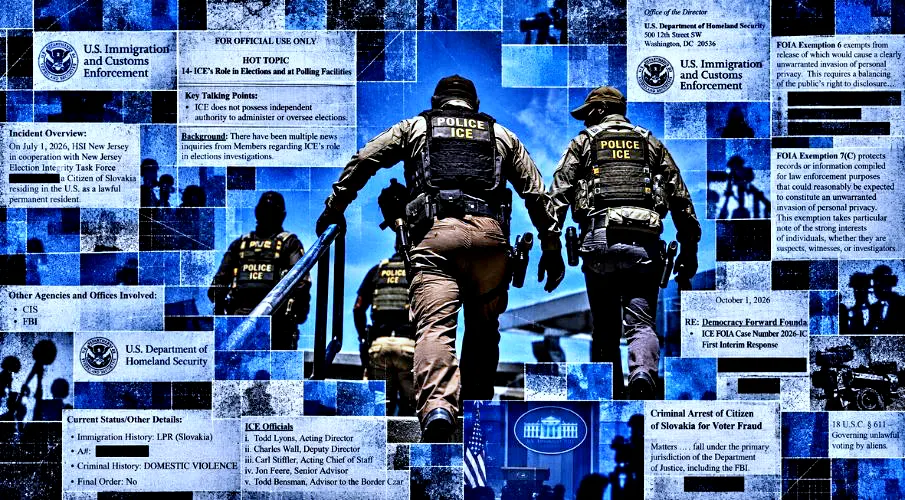
What does an agency that arrests people for immigration violations and deports them want with the voter rolls of 50.6 million Americans? That question goes far beyond the responsibilities of a federal agency. It touches on control over the personal data of millions of people and the intimidation of organizations engaged in political activities. Above all, it raises the question of just how deeply Donald Trump's administration intends to interfere in the country's election administration ahead of the November 2026 congressional elections. With just weeks to go before the vote, that question extends right into election week itself.

Documents from the Department of Homeland Security, all of which are in our possession, show that the investigative arm of Immigration and Customs Enforcement, ICE, has made voter fraud an area of its own operations. That division is called Homeland Security Investigations, or HSI. According to an analysis by the civil rights organization Democracy Forward, HSI received 50.6 million voter registration records from the Justice Department, along with 26,235 records from U.S. Citizenship and Immigration Services, USCIS. An agency whose daily business is deportation now has access to the records listing citizens as registered voters. Such a registry is a democracy's memory of who takes part in it.
Dazu liegen uns interne Vermerke vor, die zeigen sollen, wie ICE die eigene Arbeit gegenüber Politik und Öffentlichkeit erklärt. Darin rühmt sich die Behörde eigener Erfolge beim angeblichen Wahlbetrug. Im selben Papier räumt sie ein, sie besitze keine eigenständige Befugnis, Wahlen zu organisieren oder zu überwachen. Der Widerspruch steht schwarz auf weiß in ihren eigenen Akten, von niemandem hineingeschrieben als von ihr selbst.
An ICE letter dated October 1, 2026, shows just how limited the access it granted really is. According to the agency, it reviewed 808 pages of potentially relevant records. It classified 642 of them as irrelevant or duplicates and released the remaining 166 pages in full or in part. The released pages contain numerous redactions. ICE cites the protection of personal information and ongoing investigations. It also invokes the need to keep certain procedures confidential. How the different datasets were combined and analyzed remains the question on which everything hinges. Millions of people could be affected, yet all they get to see is the outermost edge of what's happening to their data. The more that's blacked out, the bigger the question hiding beneath those black bars becomes.

ICE reviewed 808 pages, classified 642 as irrelevant or duplicates, and released the remaining 166 pages in full or in part.
Two internal documents headed "HOT TOPIC" are particularly revealing. They're meant to prepare ICE for questions about its role in elections and at polling places. One claims that HSI had already made 36 criminal arrests and 56 administrative arrests related to voter fraud in 2026, a total of 92. That number comes from ICE itself. The documents include no breakdown of the cases that would show what each arrest was actually about or whether voter fraud was even involved. The document also says nothing about whether any of those cases ever resulted in a conviction.

Internal ICE document "HOT TOPIC 14": The agency cites 36 criminal arrests and 56 administrative arrests related to voter fraud in 2026. At the same time, it explicitly confirms that it has no independent authority to administer or oversee elections.
An arrest is not a crime, and an administrative arrest is not a conviction. Turning 92 incidents into proof of widespread voter fraud would first require the disclosure of the individual cases. That's exactly what the document fails to provide. Instead, the number is used to justify the agency's own work. That doesn't turn it into evidence of fraud. Politically, that matters enormously. Trump has claimed for years that American elections are threatened by widespread fraud, and those around him keep repeating that people who aren't citizens are illegally voting in massive numbers. The ICE documents provide no evidence of anything on that nationwide scale. They show something else. The deportation agency has long since pulled the issue into its own operations, and it's doing so in the very year when control of Congress is being decided. Every number that appears to support that claim therefore needs to be treated with caution.
The same talking points that boast about the arrests contain an unusually clear statement about the limits of the agency's own power. "ICE does not possess independent authority to administer or oversee elections," the document states. The agency has no independent authority to conduct or oversee elections. Responsibility for federal election law rests with the Justice Department and the FBI, it says. That admission matters because it comes from the agency itself. ICE knows that elections are not its business, yet it is reaching for voter data on a scale that dwarfs any individual suspected case. Bragging and confession appear on the same page.

Internal ICE document "HOT TOPIC 15": The agency explicitly confirms that it has no independent authority to administer or oversee elections. Responsibility for federal election law rests with the Justice Department and the FBI, according to the document.
The authority to investigate and the authority to process millions of people's personal data are two different things. Even if HSI is allowed to investigate a possible crime in a particular case, that doesn't automatically give it permission to use entire voter rolls for other purposes. The administration would have to disclose what legal basis ICE is invoking to access the individual datasets and what internal restrictions apply. So far, it has remained silent. Suspicion in a single case does not justify reaching into the voter registries of an entire country. Between the two lies the boundary drawn by the rule of law.

The authority to investigate and the authority to process millions of people's personal data are two different things. Even if HSI is allowed to investigate a possible crime in a particular case, that doesn't automatically give it permission to use entire voter rolls for other purposes. The administration would have to disclose what legal basis ICE is invoking to access the individual datasets and what internal restrictions apply. So far, it has remained silent. Suspicion in a single case does not justify reaching into the voter registries of an entire country. Between the two lies the boundary drawn by the rule of law.
Another part of the records addresses a concern hanging over these elections. Could ICE officers show up at polling places? That's exactly the question these internal memos were prepared to answer. They say there is generally no reason for such deployments. One document states that no deployment is planned unless a threat arises, but leaves open what would count as a threat. A second document repeats that the agency has no reason to send personnel to polling places. That sounds reassuring, but the most important gap remains.
These are statements about the agency's intentions, nothing more. They don't prove that deployments are being prepared, and they don't guarantee that the policy will hold under all circumstances. The official position becomes clearer in a letter to Jena Griswold, who oversees elections in Colorado. On March 9, 2026, Griswold had requested confirmation that ICE officers and special agents would not appear at polling places or other election administration locations during the election.
Todd M. Lyons, then the acting head of ICE, replied that there was no reason to deploy officers to polling places. In the same letter, he emphasized HSI's importance in investigating voter fraud and announced that the agency would continue that work. So the assurance applies only to the presence of officers on Election Day. It leaves the investigations behind the scenes untouched. The same hand offering reassurance keeps the investigations running. That distinction is decisive. A federal agency can avoid a visible presence on Election Day and still influence the environment surrounding an election through data matching and quiet investigations. Whether such activities intimidate eligible voters or keep them from casting their ballots is not established by the documents. The danger nevertheless deserves attention once a deportation agency is working with the data of millions of registered voters. An agency doesn't have to stand at the entrance to cast a shadow over the atmosphere surrounding an election. It's enough for people to know that it holds the lists.

Official letter from ICE Director Todd M. Lyons to Colorado's top election official, Jena Griswold: ICE states that there is no reason to deploy officers to polling places. At the same time, Lyons explicitly announces that investigations into voter fraud will continue.
HSI itself cites one specific case. In an internal report dated July 1, 2026, HSI Newark describes the arrest of a Slovak citizen with lawful permanent resident status. The man had reportedly stated in his naturalization application to USCIS that he had never voted or registered to vote. Investigators allegedly believed that statement was false. HSI, the FBI, and authorities in New Jersey were involved in the arrest, while the U.S. Attorney's Office for the District of New Jersey was handling the prosecution.

Internal ICE report dated July 1, 2026: HSI Newark reports the arrest of a Slovak citizen in New Jersey on suspicion of voter fraud. The investigation involved the FBI and U.S. Citizenship and Immigration Services, USCIS. The document provides no evidence of a conviction.
The report documents an investigated suspicion and a reported arrest. It does not document a conviction. A single case does not establish a nationwide problem involving millions of illegal votes. That distinction is central to the entire debate. Actual violations of election law can only be alleged on the basis of evidence, and justifying access to vast voter databases requires a far greater burden of proof than one isolated case. A number without a case behind it is a claim on official letterhead. The agency supplies the letterhead but still owes the evidence.
The analysis offers only a rough picture of exactly where the data came from and which states appear in the records. Texas and Pennsylvania are among them. California and New Jersey are mentioned. Minnesota and Michigan are also included. Arizona and Florida appear on the list. Georgia and Ohio are there as well. Several of these states will determine control of Congress. That doesn't prove the data was selected for partisan reasons, but it makes the question of what rules governed its collection and analysis all the more urgent. The fact that closely contested states appear on the list demands an answer.
Even more serious is a possibility raised by Democracy Forward. Voter data from individual states may have ended up in Palantir's ELITE application. ICE uses this software to identify people for deportation and determine their whereabouts. The screenshots reviewed do not establish that specific voter rolls were actually transferred into ELITE, nor do they establish that the system was used against individual voters. If such records did flow into a deportation tool, the question would be what legal authority allowed it and who approved access. A voter registry exists so people can exercise their rights. Using it in a system designed to identify people for deportation would turn that purpose on its head. A blanket appeal to fighting voter fraud isn't enough to justify that. Such a step requires a solid legal basis.
Another incident involves nonprofit organizations in New Jersey. According to Democracy Forward, HSI examined more than 40 organizations there. The result was "No derogatory information," meaning nothing incriminating was found. Nevertheless, the organization says the records suggest that undercover investigations were considered against nonprofits suspected of illegally registering foreign nationals to vote.
There is a difference between considering an operation and actually carrying it out, and that difference matters here. An undercover operation has not been established so far. Still, the question remains why nonprofit organizations continued to be considered potential targets after an examination turned up nothing. Organizations that help people register to vote perform a democratic function. Investigations against them require concrete indications of criminal activity, and if those are missing, the agency must explain why it continues to focus on them. What new findings justified further steps, and who made that decision?
Hart Wood, a senior lawyer responsible for government accountability at Democracy Forward, also sees Heather Honey's fingerprints in the records. Honey became known for supporting claims about irregularities in previous elections. According to the organization, her influence is evident within the Department of Homeland Security and ICE. Honey reportedly worked with political activists and fed nearly 50 million records from independent sources into the department's collection of alleged voter fraud data.

Heather Honey, the new deputy assistant secretary for "election integrity" at the Department of Homeland Security, is the perfect symbol of this perverse meritocracy. Her qualification? She produced lies that Trump liked. Trump repeated her demonstrably false analyses of Pennsylvania's voter data on January 6, 2021, hours before his supporters stormed the Capitol. Now she holds a position from which she can undermine the states' election systems. The Orwellian part of it isn't even surprising anymore: In Trump's America, truth becomes a lie, lies become truth, and the liars are appointed guardians of the truth.
Those nearly 50 million records must not automatically be treated as identical to the 50.6 million entries HSI reportedly received from the Justice Department, according to the organization. The information available so far does not establish whether the datasets are entirely or partially identical or whether they were compiled independently. That's precisely why their origins matter. If political activists helped provide data that later formed the basis of government investigations, the administration would have to show how that data was verified and what possible sources of error were considered. A name appearing in a database of alleged fraud is not yet grounds for a credible suspicion. False entries from a private database don't become accurate just because a government agency adopts them.
The documents reveal a dangerous attempt by the Trump administration to influence American elections. The records known so far demand a thorough investigation while also setting clear limits on what can be concluded. What has come to light so far may be only the beginning of this investigation. Documented are internal memos claiming arrests for voter fraud while simultaneously acknowledging the agency's lack of authority over election administration. There is also a letter stating that ICE will not deploy officers to polling places while explicitly promising to continue its investigations. And there is a report of an arrest in New Jersey. The figures concerning 50.6 million voter records and the examination of nonprofit organizations come from Democracy Forward's analysis. The same applies to the information about Palantir's ELITE. Until the original pages have been examined, these claims remain attributed to the organization. Making that distinction doesn't lessen the significance of what's happening. It makes clear what the administration can already answer and what it has so far left unresolved. That lack of clarity is no exoneration.
The questions that matter remain unanswered. Why does the investigative arm of a deportation agency need voter data on this scale? What specific suspicion justifies obtaining it? How many of the 92 arrests resulted in criminal convictions? And why did the agency continue pursuing organizations where it had found nothing incriminating?
In November 2026, Americans will elect a new Congress. The administration demands trust in its claim that it is fighting voter fraud. Its own records show just how far ICE's activities already extend into election law and voter data. No citizen should have to justify their vote to a deportation agency. But the administration must justify why that agency has access to their data.
Updates – Kaizen News Brief
Alle aktuellen ausgesuchten Tagesmeldungen findet ihr in den Kaizen Kurznachrichten.
To the Kaizen News Brief In English


