
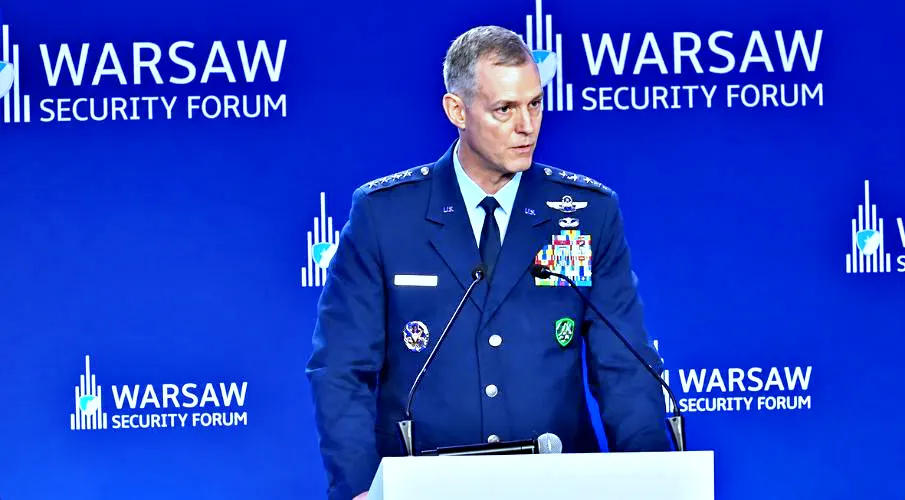
The commander of NATO forces in Europe says the alliance is ready to fight tonight. In the very country that holds this alliance together, the president is buying diesel from the enemy and talking about pulling out his troops. General Alexus Grynkewich, the American commander, appeared at the Warsaw Security Forum on Monday and laid out what he called his "Theory of Victory." War was neither imminent nor inevitable, he said.
The best way to keep the peace was to prepare for war while keeping communication channels open to clear up misunderstandings. The statement carries its own contradiction, and that's the everyday reality of deterrence. His theory was simple, Grynkewich said. "We will block the initial attack. If the attack persists, we will blunt it and prevent any enemy advance. And if required, we will break the enemy's forces and the operational war-fighting system arrayed against us."
He offered no specifics, neither where an attack might happen nor what kind of attack it might be. A response would target more than just the attacking troops. It would also target everything that supports and directs them. With all branches of its armed forces, NATO would prevent Moscow from seizing territory and holding it. A threat without a location reaches everywhere. The backdrop is a series of covert strikes across the continent. In Estonia, a defense company caught fire, and authorities suspect Russia was behind it. In Germany, an explosives-laden drone was supposed to strike a Ukrainian aircraft at Leipzig Airport, but the plot was uncovered. Outside London, British authorities foiled a Russian plot against a drone factory. Western governments count at least 211 such incidents since the Russian invasion began, and the Kremlin denies responsibility. Governments and intelligence agencies across Europe have been warning for weeks that Russia could test the alliance with more covert attacks or a limited military incursion.
While the general talks about resolve, his own president is shaking the alliance's foundations. Donald Trump has agreed to buy Russian diesel to bring down prices back home ahead of the midterm elections. Earlier this year, he announced plans to withdraw American troops from Europe. His war against Iran has also left the continent short of advanced air defense missiles. The hand that's supposed to lead the alliance is reaching into the enemy's cash register at the same time. To the outside world, the alliance raises its fist. Inside, it leaves itself wide open.
Grynkewich didn't want to comment on that out loud. Where troops are stationed is ultimately a political decision, he said, but nobody should question America's commitment to the alliance. The allies needed to respond to Moscow's activities with one voice and make clear where the red lines were. The right response to the sabotage was to step up support for Ukraine even further. Polish Prime Minister Donald Tusk warned that Russia was planning to escalate with drone and missile strikes against Europeans supporting Ukraine. Other European capitals urged calm. Denmark's military intelligence service sees a low but growing risk that Russia could launch a limited strike against a NATO country on its border. Such tactics, according to the warning, could also split NATO apart.
Especially treacherous is the idea both sides are considering. Russia could acquire Ukrainian drones and use them to attack Europe, covering its own tracks. Moscow would likely pass off such strikes as "accidental," Tusk suspects, to paralyze the allies' willingness to come to the defense of a country under attack. The goal would be to pull European resources away from Ukraine and drive a wedge through the alliance. An accident that isn't an accident would be the most convenient weapon, because nobody would be held responsible for it. The lie is already built into the act.
Especially treacherous is the idea both sides are considering. Russia could acquire Ukrainian drones and use them to attack Europe, covering its own tracks. Moscow would likely pass off such strikes as "accidental," Tusk suspects, to paralyze the allies' willingness to come to the defense of a country under attack. The goal would be to pull European resources away from Ukraine and drive a wedge through the alliance. An accident that isn't an accident would be the most convenient weapon, because nobody would be held responsible for it. The lie is already built into the act.
Grynkewich's spokesman, Colonel Martin O'Donnell, acknowledged that the network connecting the sensors to the weapons meant to shoot down drones was still under construction. It hadn't shot down a single drone yet. Russia would have a hard time launching a full-scale attack on NATO anyway while it's still fighting its war in Ukraine, both the Danish intelligence service and the colonel said. That statement is reassuring as long as the war there continues, and it sounds very different on the day that war ends.
Updates – Kaizen News Brief
Alle aktuellen ausgesuchten Tagesmeldungen findet ihr in den Kaizen Kurznachrichten.
To the Kaizen News Brief In English


