
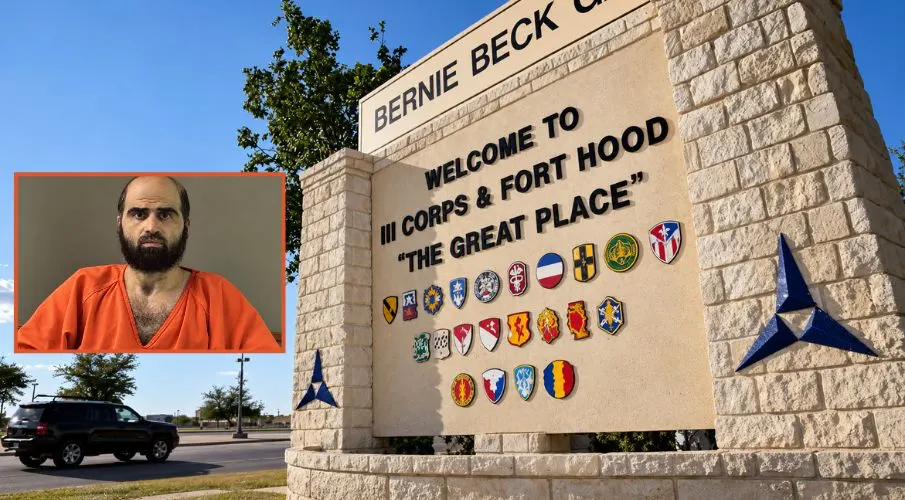
The United States will broadcast the shooting of a man in real time. Nidal Hasan, who killed 13 people in 2009 with a laser-sighted handgun inside a clinic at Fort Hood, is to be killed in front of a running camera by an Army firing squad, the Defense Department announced. Never before has an execution been broadcast in the United States. The U.S. military has not executed anyone by firing squad since 1945. Donald Trump approved the execution on the recommendation of his secretary. Death becomes programming, and the audience is invited.
December 3 was chosen, not found. Pete Hegseth had the execution scheduled for a Thursday at 1 p.m. at Fort Hood, at the hour and in the place of the 2009 massacre. That had been a “no-brainer,” he said. They would make sure people could watch it and that it would be public, “because people need to understand that there are serious consequences for these types of things.” Hegseth himself had pushed through the firing squad as the method. A department official, who did not want to be named, said only: “It will be livestreamed. Details will follow.” That is how the government announces a killing, like a broadcast time. The repetition of the crime as a ceremony, the camera where the crowd once stood. A state puts death on display and calls it a lesson.

Asked whether Hasan had made a final request, the secretary replied: “Don’t care. We’ll see him on December 3.” Hasan, now 56, a former Army psychiatrist, has been in a wheelchair since his arrest, partially paralyzed by police bullets. The massacre happened just weeks before he was scheduled to deploy to Afghanistan. A military court sentenced him to death in August 2013 on 45 counts of completed and attempted murder. What he did was monstrous. What the state is making of it is a separate matter.
According to experts, no other country broadcasts a legal execution. Public executions have almost disappeared worldwide, surviving in places ruled by Iran and Taliban-run Afghanistan. America is placing itself in that company. The last legally sanctioned public execution in the United States was in 1936, when thousands watched the hanging of a young Black man convicted of raping a white woman. Well into the 20th century, the lynchings of Black people by white mobs were public spectacles. Putting killing on display has always been a tool of rule by fear, from the mob’s execution ground to regimes that declared the gallows a lesson for the people. Fascism perfected that art.
Even the lawyers are uneasy. It would be “extremely, extremely strange,” said Eugene Fidell, a military law expert at Yale Law School. He knew of no televised execution in America, and Hasan would have to go to federal court if he wanted to stop the public display of his own death. Earlier attempts to televise American executions were blocked by the courts. Whether today’s Supreme Court would put on its originalist hat and decide that if it was allowed in 1790, then what the hell, remains an open question. Jonathan Lurie, a historian of military justice, could find no reasonable justification for the spectacle. “What’s the point of it? Who would want to see that?”
Execution by firing squad is one of several methods of killing that Trump’s government recently allowed again for the most serious federal crimes, alongside the electric chair and gas asphyxiation. The list was expanded because the drugs used for lethal injection are becoming harder to obtain and because lethal injection itself often fails. At least 5 states have firing squads on the books, and South Carolina carried out the first such execution in 15 years in 2025. It would be the military’s first execution since 1961, when a man was hanged. The last execution by firing squad dates back to 1945.

Tennessee showed last week just how well the state knows how to kill. For the first time in more than 200 years, the state was supposed to execute a woman, but prison staff failed to administer the lethal injection properly. Christa Pike survived, seriously ill, shackled to a hospital bed. She woke up “angry and confused,” her lawyers reported. A machine that cannot even kill cleanly now wants to film its killing. The White House would not say whether Trump supported broadcasting it and referred questions to the department. The president signs the death warrant and ducks away from the camera he switched on.
A broadcast reaches beyond the condemned man. It turns millions into spectators of a state killing and gets the eye used to the sight. A people summoned to the screen to watch a person die is not being taught the law. It is being taught fear. That was always the purpose of public execution, from the despots of antiquity to the dictatorships of the last century that turned death into a display of their power.
Public execution by firing squad does not belong to some distant, brutal age. This government has brought it back. A democracy that once again puts killing on display in front of everyone leaves the ground it stands on. It is 2026, and the state is setting up the camera where the gallows crowd once stood. The only difference from 1936 is that no one has to go outside anymore. The dying now comes into every home. The condemned man is not the one being told to watch. Everyone else is.
Updates – Kaizen News Brief
Alle aktuellen ausgesuchten Tagesmeldungen findet ihr in den Kaizen Kurznachrichten.
To the Kaizen News Brief In English


