
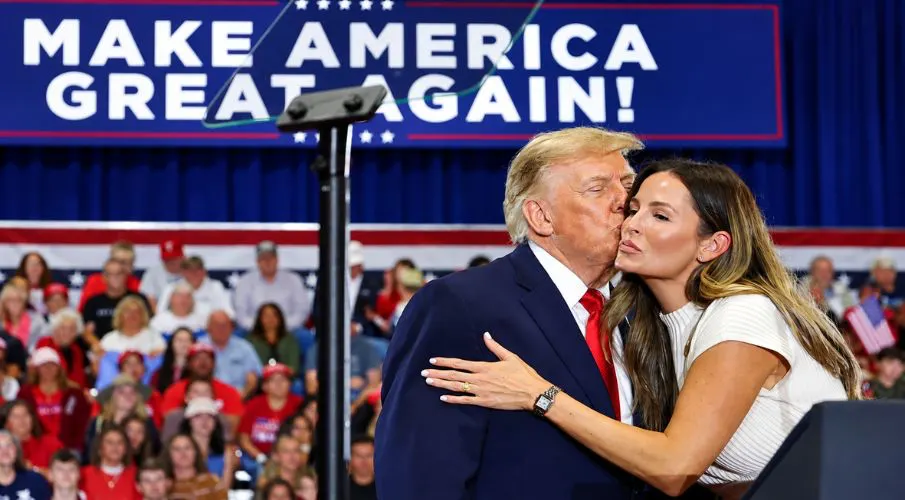
On Thursday, Donald Trump traveled to Texas and Oklahoma, two of the safest Republican strongholds in the country, and asked for votes from people who have long been his. “Pretend I’m running, please,” he said in Durant. “If we don’t win, they’ll end up impeaching me.” A president asking his most loyal supporters for help against impeachment reveals more about his situation than any poll ever could.
“Pretend I’m running, please. Just pretend. ’Cause I am on the ballot. And if we don’t win, they’ll end up impeaching me.”
He no longer has to win anything for himself, his name is not on any ballot. Still, he is touring as if everything depended on it. “We have to win in those 35, maybe you could even say 40 places, 40 races,” he admitted, and almost in the same breath: “I feel a little silly. I keep saying go vote, and they’re going to win by a landslide anyway.” Claiming danger and certain victory at the same time requires an audience that does not recognize reality.
The centerpiece of the appearance was a Donald Trump brand promise: $5,000 for every adult American if Republicans hold their majority in November. It got the loudest applause of the night and produced the most expensive line. Those checks would cost the country more than $1.3 trillion. Where would the money come from? From “investment returns,” Trump mumbled before jumping to the next image. “Republicans can do it. Democrats can’t.”


Earlier that day in Denton, at a truck factory, he played the economic savior. “Factories are being built all over the country. Manufacturing is coming back.” Rising wages, tens of thousands of new jobs, a surge in heavy-truck production, he took credit for all of it. Peterbilt, founded in 1939 and the largest manufacturer in the county, had recently hired 1,000 people, while parent company Paccar had hired another 2,000, according to the White House. Company executives dutifully said the growth was thanks to his tariffs.
Last November, Trump imposed a 25 percent import tariff on medium and heavy-duty trucks, against the explicit advice of the U.S. Chamber of Commerce. The country’s 5 largest truck suppliers were all allies and posed no security threat, it had warned. Trump still called the tariff protection from “unfair foreign competition.” To celebrate loosened fuel regulations, he poured a cup of water onto the floor in front of the audience to show how little was lost. “I did it for the trucking industry.”
His numbers only knew one direction. “We have literally the greatest numbers.” More people working than ever before, the lowest poverty in history. That sits badly with the fact that most Americans disapprove of his performance in office, especially because of rising gas and food prices, which are widely blamed on his tariffs and the war against Iran. His presentation ranged from the military operation in Venezuela to the data centers fueling fights over electricity and water in Texas. “These things make a fortune,” he raved, while local residents are expected to shoulder part of the cost.
That evening in Durant, inside a casino hall, the campaign turned into a variety show. He played news clips, showed charts about the success rate of his endorsements and brought former basketball star Dennis Rodman to the front. He pulled a young White House aide toward him, praised her looks and loyalty, looked at her parents and said: “She’s a beautiful woman inside and out. Look at this. Her mom and dad are here. Hello, mom and dad. I see why she’s good looking actually, you know, I believe in the racehorse theory. Fast horses, right?” The most powerful man in the country, classifying a woman like breeding stock in front of running cameras. (The video above is 2:14 minutes, be patient or skip ahead)
Dennis Rodman on Trump’s campaign stage: of all people, the former NBA star who has personally known Kim Jong Un for years, publicly called him a friend and even held Kim’s daughter Ju Ae as a baby in 2013. Trump himself said in Denton that Rodman “knows Kim better than anybody.”
Trump had avoided appearances like these for a long time. Between wars abroad and the construction of a White House ballroom, there no longer seemed to be any reason, and his advisers saw no election left for him personally to run. He still goes looking for the applause, as if he needs it like a drug, and the tighter things get, the more urgently he seems to need it.
Trump was most open when talking about one of his own. He called Ken Paxton, his Senate candidate in Texas, “one of the most loyal people” and, to be honest, “a pain in the ass sometimes.” “Is he here, by the way? Oh, there he is. Good. I didn’t even know if he’s here. I don’t care!” In Durant he went further, saying Paxton was “a little controversial, just slightly,” but “the best attorney general in the entire United States of America.” The condescension only gets its flavor from the background. A leaked recording had recently surfaced in which Paxton complained that the Republican midterm convention on September 9 and 10 in Dallas had hurt his numbers. “All the numbers dropped. Right now, not good.” His camp blasted the reporting as “manipulated nonsense.”
Trump: “We will win the war on corruption and fraud.” (Then he should resign - Editor’s note)
“These people came out of Somalia. They stole billions. They robbed us like we’re a bunch of fools. They robbed our country blind.”
He is still needed. Trump’s committee MAGA Inc. has already put $20 million into Paxton, another committee close to Senate leadership plans to spend at least another $100 million, while fellow Republicans such as Senator John Cornyn are refusing to help the scandal-plagued candidate. In the polling average, Paxton trails Democrat James Talarico 45 to 48 percent, and the race is considered open. To paper over the private attacks, Trump played a clip in Durant from a right-wing network in which two supporters said they did not care about Paxton’s comments, then brought the two “studs” onstage. You just wanted to give them a kiss, he added, though of course he was not physically attracted to them.
„The two guys that came up here, I wanted to give them a big kiss, and I’m not at all physically attracted to them, although they’re very handsome people.”„
For the rest of his endorsements, the enthusiasm did not extend all the way through his own ranks. Mike Mazzei, his candidate for Oklahoma governor, got reviews from attendees like “a little goofy” and “a little shady,” held together only by the sentence: “But if Trump trusts him, I have to trust him.” Mazzei himself had previously distanced himself from Trump’s beef imports. Trump nevertheless took credit for getting him into the runoff, saying he “was down by 22 points, and he ended up winning.” For Oklahoma’s open Senate seat, he campaigned for Representative Kevin Hern against Democrat N’Kiyla Jasmine Thomas, whom he smeared as a “socialist.” He endorsed 4 congressional candidates by name. He left out Representative Stephanie Bice, whose district is considered vulnerable and who has also been caught on recordings criticizing the war against Iran and mocking “Trump fatigue.”
In between, Trump sprinkled in local issues. For a planned aluminum smelter in the town of Inola, which has raised environmental concerns locally, he promised a fortune in jobs and went after Canada, which has been “ripping us off for years.” He greeted oil magnate Harold Hamm and the outside group Club for Growth, which had poured money into ads against Mazzei rival Gentner Drummond during the primary. “Where the hell is Byrd?” he shouted, looking for his candidate for state treasurer. “She’s fantastic.” That is how small politics can get when the big issue is missing.

Trump left the harshest rhetoric to his Homeland Security secretary. Markwayne Mullin, a former Oklahoma senator, told the overwhelmingly white crowd that Democrats wanted to destroy the country by letting immigrants in. “They have to create chaos” and “change the demographics.” “That’s how you end up with a communist country.” The response was chants of “USA, USA, USA.” The fact that this administration’s deportation machinery has turned deadly did not come up inside the hall. Immigration officers have shot people across the country, and reports of inhumane conditions are coming out of detention centers. Voters see it anyway. In one poll, most likely voters disapproved of Trump’s immigration policy, including 64 percent of independents, while 52 percent said they trusted Democrats more on the issue.
Trump sold his visit as a thank-you to Oklahoma, which he said had voted for him in all 77 counties three elections in a row. The host was the Choctaw Nation, a major Republican donor that said it had merely rented out the hall. Outside stood Elisa Standridge, a Choctaw citizen. “He’s already been convicted of serious crimes and is being investigated for more,” she said. “We’re red with rage, not Republican.”
The reality outside fell short of the words. Trump claimed another 20,000 people were waiting to get in, the kind of exaggeration that has become routine for him. The 4,900-seat hall was full, but there were no tens of thousands standing outside. Inside, some had spent 9 hours on their feet, one attendee called the evening disorganized and disappointing. Another said everything Trump said was honest and that he loved it. The entire evening sits between those two sentences.

Im Publikum stand Teri Tulane, 60, pensionierte Lehrerin, seit dem frühen Morgen im Regen. Sie zahle mehr fürs Rindfleisch, freue sich aber über billigere Eier, und beim Iran wünsche sie sich weniger Rücksicht. „Macht sie platt.“ Genau diese Stimmung bediente Trump, rühmte das Ende der Steuer auf Trinkgeld und Überstunden und verkaufte Zölle und Krieg als Gewinn für kommende Jahre.
Für das Militär lobte er sich selbst, es habe „dem Iran die Hölle heiß gemacht“, der Krieg sei bald vorbei. Die 1.776 Dollar, die er Soldaten als Scheck zukommen ließ, kosteten rund 2,6 Milliarden und stammten aus Mitteln für deren Unterkünfte. „Ich lasse die Leute nie im Stich. Ich liefere immer.“ Von der alten Regierung sprach er wie von einem Loch, in das man nie zurückkehre, an der Grenze sei aus der schwächsten die stärkste geworden.

Am Freitag ging die Reise weiter, nach Mobile in Alabama, zum ersten Mal seit 2016 und dorthin, wo vor über einem Jahrzehnt seine erste Massenkundgebung stattfand. Rund 30.000 Menschen sollen damals in ein College-Footballstadion gekommen sein, der Beweis, dass aus dem Promi-Bewerber ein ernster Kandidat werden konnte. Den Grund für die Rückkehr nannte Trump beim Abflug selbst. „Man muss diesen Staaten danken, die zu 1.000 Prozent hinter einem stehen“, sagte er. „Ich gehe dorthin, weil sie mich sehen wollen.“ Ein Präsident, der nur noch reist, wo er geliebt wird, hat die Hälfte des Landes schon abgeschrieben. An Bord der Air Force One saß die rechte Aktivistin Laura Loomer.
Trump, Harp und Loomer steigen in Marine One ein. Laura Loomer, eine Frau, die offen Verschwörungstheorien über 9/11 verbreitet, George Soros mit antisemitischen Klischees überzieht und Kamala Harris rassistisch attackiert, ist zu einer der mächtigsten Frauen Amerikas aufgestiegen – nicht durch Wahlen, nicht durch Kompetenz, sondern durch die perfekte Fusion von Fanatismus, Erpressung und digitaler Gewalt. Sie geht im Weißen Haus und im Pentagon ein und aus. Die Demokratie stirbt nicht unter Kanonendonner, sondern unter dem Geklacker von Smartphone-Tastaturen. Im Zentrum dieses Mahlstroms sitzt Laura Loomer, die gescheiterte Journalistin aus Westchester, deren Rassismus so unverhohlen ist, dass selbst ihre Anhänger manchmal erschrecken.
Trump: „Eine großartige republikanische Strategin, ein großartiger Mensch, eine Killerin. Wenn sie wütend auf dich ist, ist das eine sehr schlimme Situation. Laura Loomer. Danke. Sie ist großartig.“
Read also our article: https://kaizen-blog.org/en/die-hexenmeisterin-aus-westchester-laura-loomers-aufstieg-zu-einer-der-gefaehrlichsten-frauen-amerikas
Die Rechnung mit der Menge ging auch hier nicht auf. Das Mitchell Center der University of South Alabama fasst etwa 10.000 Menschen, gezählt wurden rund 4.500, oben blieben Reihen leer. Während das Publikum wartete, lief ausgerechnet „Time to Say Goodbye“, ein Abschiedslied, bevor „God Bless the USA“ ihn schließlich nach vorn rief. Dass dieser Mann, der sich an großen Zahlen berauscht, in einer Hochburg eine halb volle Halle bespielt, verrät mehr über seine entzauberte Zugkraft als jedes Wahlkampfvideo.
An jeder Auffahrt, an jeder Brücke zwischen Sherman, Oklahoma und Durant standen Highway-Patrol-Beamte bereit, als zöge kein Politiker durch die Region, sondern ein Staatsakt auf Rädern. Selbst der Regen hielt die Anhänger nicht fern. Der volle Parkplatz wurde zur Falle jener politischen Verehrung, in der Absperrungen, Eskorte und Lügen längst zum Bestandteil der Inszenierung gehören.

Während sich in Alabama sich die MAGA-Jünger versammelten, um Trump zuzujubeln, protestierten in Mobile die Gegener von Trump: „Ihre Zeit geht zu Ende.“
Vor der Tür standen Hunderte, mindestens 300 Studenten und Demonstranten. Der frühere Senator Doug Jones hielt zur selben Stunde eine eigene Kundgebung in der Stadt. Drei Studenten der Universität wurden festgenommen, weil sie online Drohungen gegen Trump ausgesprochen haben sollen. Ein 22-Jähriger nannte den Auftritt einen „letzten verzweifelten Versuch“, die Moral der republikanischen Wähler zu heben.

Zwei Busse mit Polizisten in kompletter Einsatzausrüstung waren auf dem Campus der University of South Alabama eingetroffen. Noch bevor Donald Trump dort erschien, hatte sich der Staat auf Protest eingestellt. Wer für einen Wahlkampfauftritt derart aufrüsten musste, lieferte das Bild gleich mit: politische Inszenierung hinter Polizeiketten.
Drinnen hing die Treue an Sätzen, die ihre eigene Logik verrieten. Ein 27-Jähriger aus Huntsville sagte, höhere Preise störten ihn nicht, solange seine Kinder sicher seien und der Iran keine Atombombe bekomme. Ein 73-Jähriger von den „Bikers for Trump“ sagte es noch offener. „Wir diktieren ihm nichts und ziehen ihn nicht zur Rechenschaft, selbst wenn etwas schiefläuft.“ Treue ohne jede Rechenschaft, genau darauf baut dieser Präsident. Selbst unter den Getreuen nagte der Preis. Ein 64-Jähriger aus Citronelle berichtete von Freunden, die der Rekordpreis für Diesel hart treffe. „Sie lieben Donald Trump. Sie wollen nur, dass der Dieselpreis sinkt.“ Trump müsse ein wenig nervös gewesen sein, meinte er, sonst käme er kaum dorthin, wo man ihn ohnehin noch sehen will.
Trump: „Das brandneue Brückenprojekt, das Mobile mit der Eastern Shore verbindet … Vielleicht benennen sie die verdammte Brücke nach mir. Dann sage ich: Habt so viele Kostenüberschreitungen, wie ihr wollt. Macht sie einfach, macht sie zur großartigsten Brücke der Welt.“
Die Wahl des Ortes ist ihr eigenes Geständnis. Eine Tournee, die in den tiefroten und kaum umkämpften Staaten beginnt und die engen Rennen in Ohio und Texas aufschiebt, sucht keine Stimmen. Sie sucht Applaus. Die Zahlen stützen den Verdacht. In einer Umfrage dieser Woche billigten nur rund 3 von 10 erwachsenen Amerikanern seine Amtsführung, die Mehrheit gibt ihm die Schuld an den steigenden Preisen. Die Sorge um Kosten und Benzin wischt er beiseite, während sein unpopulärer Krieg gegen den Iran sich hinzieht.
In der Halle besorgte der Abgeordnete Barry Moore, der auf Tubervilles Senatssitz zielt, die Liturgie. Er fragte, wer schon 2015 dabei gewesen sei. „Steht ihr heute noch zu ihm? Lasst ihn wissen, dass wir ihn lieben, dass wir ihn brauchen, dass wir ihn nicht im Stich lassen.“ Worum es wirklich geht, zeigt die Landkarte. Mobile grenzt an den 2. Kongresswahlbezirk Alabamas, in dem der demokratische Abgeordnete Shomari Figures einen von Trump unterstützten Herausforderer abwehrt. Die Grenzen des Bezirks wurden röter gezogen, Teil eines größeren Versuchs, das Repräsentantenhaus zu halten. Möglich machte das ein Urteil des Obersten Gerichtshofs aus diesem Jahr, das den Schutz des Wahlrechtsgesetzes schwer beschädigte. Figures war 2024 gewählt worden und hatte Alabama zum ersten Mal in seiner Geschichte zwei schwarze Abgeordnete beschert.
Trump fantasiert während einer Tirade darüber, „die Schwulen“ nach Palästina zu schicken. „Ich will nicht einmal sagen, was sie dort mit ihnen machen. Schicken wir sie hin.“
Die Namen wechseln, das Prinzip bleibt. Tommy Tuberville will Gouverneur werden und tritt gegen Doug Jones an, Moore möchte in den Senat nachrücken. Jenseits der Bucht hofft Floridas Panhandle auf Rückenwind, etwa für den Abgeordneten Byron Donalds, der ebenfalls nach dem Gouverneursamt greift. Der frisch bewilligte Bau einer Brücke über den Mobile River, mit 3,2 Milliarden Dollar das größte Verkehrsprojekt der Landesgeschichte, soll nach Moores Vorschlag „Donald-J.-Trump-Brücke“ heißen. Die Huldigung steht, bevor der Beton trocken ist.
Tuberville: „Könnt ihr euch vorstellen, euer Kind kommt eines Tages nach Hause und sagt: ‚Ich nehme diese Medikamente. Und ich bereite mich auf eine Operation vor, weil meine Lehrer und mein Schulleiter sagen, dass ich das darf.‘“
Bis zum 3. November will Trump 35 Orte abklappern, fast täglich, wie seine Stabschefin Susie Wiles den Senatoren der Partei ankündigte, als Nächstes Grand Island in Nebraska.
Das musste er noch einmal in Alabama loswerden: Trump: „Der Typ in Texas, der Veganer ist, aber jetzt Fleisch frisst wie ein Schwein. Er ist Veganer. Er trägt eine Maske. Er mag Salat. Gib ihm ein kleines Stück Salat und er ist glücklich. Der kleine Kerl.“ Gemeint war der demokratische Senatskandidat James Talarico aus Texas.
Was von diesen Tagen bleibt, ist ein Mann, der durch die sichersten Staaten zieht, weil die unsicheren ihm nicht mehr zuhören. Er verspricht Geld, das der Haushalt nicht hat. Er zählt Menschenmengen, die nicht da sind. Und er wirbt um einen Sieg für jemanden, der gar nicht auf dem Zettel steht. Hinter dem Jubel steht ein einziger nüchterner Satz, den er selbst ausgesprochen hat. Verlieren sie, setzen sie ihn ab. Alles andere an dieser Reise war Lautstärke gegen diese eine Angst.
Updates – Kaizen News Brief
Alle aktuellen ausgesuchten Tagesmeldungen findet ihr in den Kaizen Kurznachrichten.
To the Kaizen News Brief In English


