
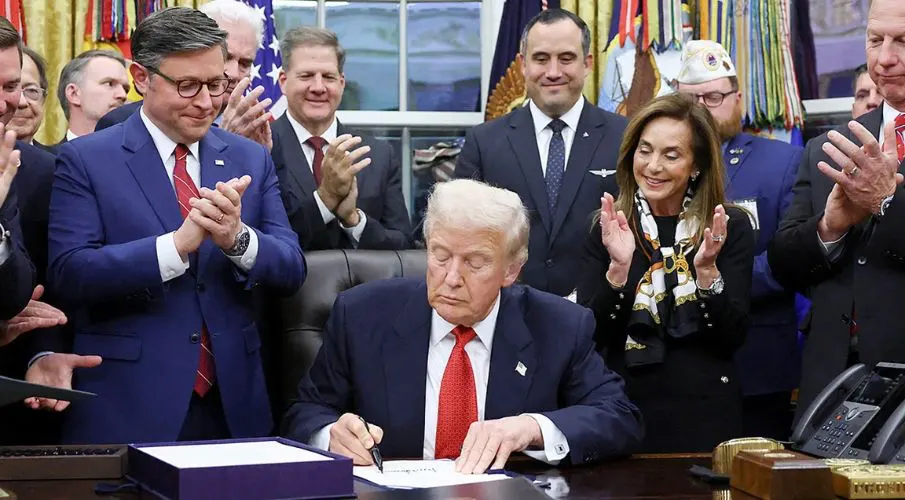
On Friday, the president of the United States put his signature on a law at the White House that is supposed to hit Russia harder than anything before it, and that very same text hands him the door through which he can escape every single measure. Donald Trump can suspend any measure against Moscow on national security grounds, provided the White House notifies Congress. A weapon with the safety on.
The law bears the name of Lindsey Graham, the Republican senator from South Carolina who died in July. It allows the president to impose tariffs of up to 100 percent on countries that buy Russian oil and gas. He can slap tariffs of up to 500 percent on all Russian imports into the United States. He can go after the "shadow fleet" of oil tankers and the country's banking sector more aggressively. At the same time, the law directs the administration to enforce sanctions that have already been enacted, including those against Vladimir Putin.

Moscow warned that the sweeping new law would backfire and destroy Trump's efforts to achieve peace, while at the same time counting on Trump to brush aside the hawks in Congress and find ways around the toughest provisions. Kremlin spokesman Dmitry Peskov called the law "an unfriendly act" on Thursday, after its passage and before Trump had signed it. Any additional US sanctions would make a peaceful solution in Ukraine more difficult, he said, adding that the Russian government was closely following developments. The Russian Embassy in Washington declared that the law would do a "disservice" to the administration's efforts to "Make America Great Again." Rarely has a foreign power defended a president's campaign slogan with such concern.
The Kremlin initially remained silent after the signing. Among Russia's hawks, however, anger was stirring. Dmitry Medvedev, a former president who now serves as deputy chairman of the Security Council and is known for statements that depart from the Kremlin's official line, called the law a "Russophobic abomination." Moscow should respond with "the language of direct military deterrence," he wrote on Telegram on Saturday.

Whether Trump will use even a single one of these powers against Putin remains an open question. Just over a year ago, he stood beside him on the tarmac in Anchorage. Alexander Gabuev, director of the Carnegie Russia Eurasia Center, was already expecting Trump to find a way out before the law was signed. Trump had so far shown little inclination to put pressure on Putin and Russia; he would sign the law and grant exemptions, perhaps applying some pressure overall. Russian officials apparently share that expectation. Grigory Karasin, chairman of the Foreign Affairs Committee in the upper house of Russia's parliament, told a state-controlled media outlet that signals were coming from Washington indicating a desire to further develop relations with Russia. "I am convinced that these sanctions will have little impact on the negotiations, because serious matters are at stake," Karasin said.
EUROPE IN THE CROSSHAIRS OF THE NEW US SANCTIONS POWERS
We took a very close look at this and found that the law could put Europe under brutal pressure. A sword drawn toward the east suddenly cuts toward the west as well. A country that buys Russian oil or gas or gets involved in sanctions evasion falls under the same tariffs of up to 100 percent, whether it sits in Moscow or in a European capital. Hanging over all of this is the national security exemption, which Trump can hand out as he pleases. This gives the White House a weapon to use against individual governments. One gets spared, the next gets shown the tariff. The weapon forged against the Kremlin becomes a tool for extracting concessions from friends that it was never meant to target.
Things get even darker if Moscow is spared while European partners are left carrying the burden of the tariffs. Trump can extend a hand to the Kremlin while tightening the screws on America's allies. Whether he will do so remains to be seen. The law does not allow him to target every EU country at once, but within its conditions, he still has plenty of room to maneuver, and with this president, room to maneuver is already half the threat. The danger was on the table long before he signed the law. Whether the European Commission and the governments concerned went to Washington in time and came away with anything binding is something nobody knows to this day. Congress has handed him the authority. This man has never hesitated when someone handed him a weapon to apply pressure, and Europe should not kid itself into believing he will go any easier on it this time.

Volodymyr Zelenskyy thanked Trump for signing the law. Graham had never doubted that America was strong enough to stand up to dictators and achieve results when it took the right path, the Ukrainian president wrote. The best way to honor his memory would be to implement the law fully and swiftly. That is precisely where the contradiction lies. While lawmakers from both parties in Congress are demanding more pressure on the Kremlin, the administration is considering the opposite. According to reports, the White House is weighing business deals with Russia this week as an incentive for peace, even before Moscow agrees to a ceasefire. The law prohibits US investments in Russia, but an exemption could open the way for them, leaving Congress merely to be notified. Trump's special envoys Steve Witkoff and Jared Kushner visited Putin in Moscow earlier this month, then representatives in Ukraine, on a trip intended to revive efforts to bring the war to an end.
The president has reasons to hesitate, and they lie in his own country. The war against Iran is driving oil prices above $100 a barrel, while rising food prices are fueling inflation. A 500 percent tariff would also hit America's own supplies. Direct imports from Russia are small, but when it comes to fertilizer, Russia is the United States' second-largest supplier, behind Canada, and such a tariff would cost America more in the short term than Moscow, which sells its products around the world. Trump's pressure was already limited last year. In his most notable effort, he imposed sanctions on 2 major Russian oil companies and tariffs on India for buying Russian oil. India briefly reduced its purchases but began buying more again after the American-Israeli war against Iran started. He left China, the largest buyer of Russian energy, untouched. Beijing has the upper hand as a supplier of critical raw materials. He is likely to shy away from any measure that would drive prices at home even higher.

That is Russia's lifeline, Gabuev says. China will shrug off American restrictions, just as it did during the operation announced as an "economic D-Day" that was supposed to isolate Iran, and evade their enforcement. Beijing already demonstrated during the fierce trade war that it can withstand Trump's pressure. That would give Beijing even greater leverage over Moscow, which would then have to sell its oil at a steeper discount. Daniel Fried, a former sanctions coordinator at the State Department who is now at the Atlantic Council, recalled that under Barack Obama, Washington had gradually pushed China and India away from Iranian oil through patient pressure. Doing the same with Russian oil would be harder, but possible. The Senate passed the law in August by a veto-proof vote of 86 to 11, a decision that reveals Congress's distrust of its own president. Congress did not have to sit around hoping that the Oval Office would do the right thing, Fried said. It could act on its own.
The weapon is ready, loaded, and fully at hand. What is missing is the will to use it. A punishment left to the discretion of the person who is supposed to impose it becomes a bargaining chip for the person being punished. Congress forged the weapon, but someone else has his finger on the trigger. The law has been signed. The only question left is whether the man holding it will ever use it to hit Putin.
Updates – Kaizen News Brief
Alle aktuellen ausgesuchten Tagesmeldungen findet ihr in den Kaizen Kurznachrichten.
To the Kaizen News Brief In English


