
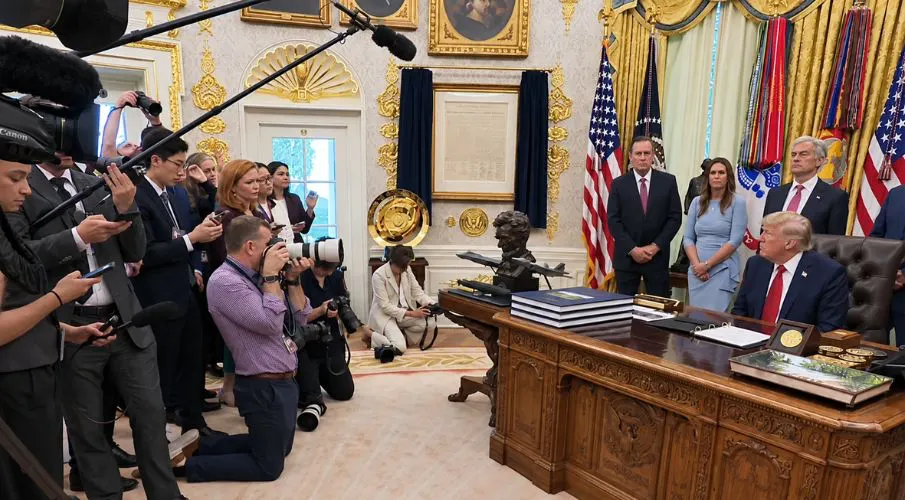
On Friday, the president of the United States declared 3 news outlets unwelcome at the White House, effective immediately. In the Oval Office, Donald Trump called his own move a "ban on the free press," according to White House Correspondents' Association president Jacqui Heinrich. A few hours after the order, the affected reporters were still working on the grounds, at the stand-up position used for TV hits, while he was inside railing against them. An order that is not enforced remains, for the moment, a wish spoken out loud.
CNN and MS NOW were targeted. Politico is supposed to stay out as well. On his Truth Social platform, Trump wrote that he was banning the outlets because of their constant "reporting" of "FAKE NEWS," with Trump himself putting quotation marks around the word reporting. News organizations should not be allowed to constantly spread "fiction and lies" when writing about the president and his country, he said, adding that more outlets would follow. The country needed "honest news."
Question: You posted that you intend to ban CNN, Politico, and MS NOW from the White House. Every president takes an oath to uphold the Constitution, which includes the First Amendment. How do you justify this?
TRUMP: Because they're fake news. There may be others to join them.
Minutes earlier, at an event on health policy, he had stated the reason more plainly. "There's something wrong with a country that allows people to purposely write negative stories." He said this was not about a single report, but about "the collection of stories over the last 2 years." He was getting tired of them. In front of the cameras, he repeated the attacks, saying CNN was "just fake" and that its ratings were bad because of it. The New York Times was "so fake" as well, and the Washington Post was "disgusting." He called a journalist who pointed to the First Amendment "terrible," while saying that what he wanted was an "honest press."
How the exclusion would actually be enforced remained unclear. Trump called it a "very simple ban." "I don't want them in my office, I don't want them here," he said, adding that the ban would go "as far as it can." The outlets were "very dishonest people" who wrote "in a dishonest way." A court should not allow "Fake News" day after day, he said, and someone had the right to keep such outlets out. He had not yet thrown out the New York Times or the Washington Post, but he did not rule it out. Nobody described any formal process, while the people supposedly banned were still standing out on the lawn. In Trump's language, the line between false and unwanted gets blurry. "Fake" rarely means disproven when he uses it. Most of the time it means unwelcome. "Honest news" means news that agrees with him. If an outlet improved, maybe it could come back, he suggested, as though newsrooms were schoolchildren who had to earn admission through good behavior. Criticism gets declared a lie so suppressing it can be dressed up as protecting the truth.
He has failed at this before. During his 1st term, Trump revoked the White House pass of then-CNN reporter Jim Acosta, and a court ordered it restored. Asked why it should work this time, he said only: "We'll see." The right he claims to exclude reporters whose coverage he dislikes appears nowhere in the Constitution. CNN, of all outlets, was traveling with Vice President JD Vance to Iowa that same Friday as 1 of the 5 television networks that document every step taken by the country's top leadership for voters back home and for the world. Take 1 of them out, and the oversight that belongs to the public, not the officeholder, starts to fray. Its purpose is to show the governed what is being done with their power when they cannot be there to see it themselves.
The law has been clear for decades. In Sherrill v. Knight, a federal appeals court ruled in 1977 that the White House did not have to open its doors to the press, but once it granted access to accredited journalists, it could not deny that access based on the content of their work. An exclusion had to serve a compelling government interest. The person affected had to be told the reason in advance and given a chance to respond. The decision had to be made in writing. Lawyers call excluding individual outlets because of their editorial position viewpoint discrimination. Jameel Jaffer of the Knight First Amendment Institute called the move simply unconstitutional, while Bruce D. Brown of the Reporters Committee for Freedom of the Press called it a textbook case.
The decree fits into a long series of actions. Last year, Trump banned the Associated Press from the Oval Office and Air Force One because it would not rename the Gulf of Mexico the "Gulf of America," and that lawsuit is still pending. The news agency said it would note going forward that the renaming had been ordered. Its photographers are still allowed into the Oval Office, while its writers rarely are. Lawsuits are underway against the New York Times and the Wall Street Journal, and he has sued the BBC as well. His administration is fighting with ABC over broadcast licenses. At the Defense Department under Pete Hegseth, reporters may now move around only when escorted, and their workspace was shut down. At the military newspaper Stars and Stripes, its leadership lost their positions after resisting interference. The New York Times went to court over the Pentagon restrictions. FBI investigators showed up at journalists' homes to serve subpoenas, in 1 case with an order allowing devices to be seized. Other reporters lost access because they refused to sign statements restricting their work. Regulatory agencies used their powers to pressure outlets over their content. The government cut off funding for public broadcasting. The independent press pool that follows the president is now controlled by the White House, which decides for itself who gets to travel.
Anger at the press is as old as the presidency. Historian Harold Holzer, who wrote a book about presidents and the press, points out that even the 1st president complained about false reporting. George Washington spoke of "false news." Theodore Roosevelt kept reporters he disliked away from his morning shave. Presidents have always been unhappy with the press, Holzer says. But a complete ban on an entire news organization has no precedent.

The pushback came immediately. CNN called the threatened ban an "unlawful attack" on a constitutional right and retained constitutional lawyer Ted Boutrous. It had the right to do this work without government obstruction or interference, the network said. If the ban were imposed, it would violate a fundamental right protected by the Constitution. Politico said it would continue to cover "this White House and future ones fairly" and rejected the claim that it had improperly received government money. It said it would vigorously defend its First Amendment rights. The New York Times, which marked its 175th anniversary that very day, called the threat "retaliatory and unconstitutional." Its spokesman Charlie Stadtlander said the combined effect of such actions was to limit Americans' ability to know what their own government was doing. Jacqui Heinrich said press freedom does not depend on whether the president likes the coverage or the questions reporters ask. Her association stood behind all 3 outlets.
Press freedom groups responded more sharply. Mark Schoeff of the National Press Club called exclusion based on presidential preference an open attempt to decide which voices are allowed to witness the exercise of power. Tim Richardson of PEN America said somebody should explain to the president how the First Amendment works. For this administration, he said, the issue was never whether a report was accurate. It simply lacked the strength to be scrutinized. Clayton Weimers of Reporters Without Borders said press access was not a privilege for journalists. It was a right that allowed citizens to receive independent information. Seth Stern of the Freedom of the Press Foundation said it was hard to imagine throwing a news organization out of the people's house because it criticized the government. "These attacks only show how much an informed public frightens him."
At the same place, Trump is hosting Chinese President Xi Jinping. He shuts out his own press while welcoming the leader of a country that persecutes journalists. When confronted with the fact that China ranks among the harshest countries for journalists, Trump replied: "Well, I don't know. I think we're repressive too. We don't repress, but they write fake news." Kelly O'Donnell, a longtime White House correspondent and former president of the association, reminded him that every president takes an oath to the Constitution, including the First Amendment. "I uphold it too," Trump said, "much more than you." His former press secretary, Arkansas Governor Sarah Huckabee Sanders, defended the exclusion. In the Oval Office, she said, reporters had the privilege of questioning the leader of the free world. The president supported the First Amendment but demanded honesty. A ban on the press, justified in the name of press freedom.
The White House belongs to no administration. It belongs to the people who elected that administration and can vote it out again. The camera at the entrance helps determine what the public learns about the power exercised in its name. A president who fears witnesses fears scrutiny of his own actions. The Constitution does not protect the press because its reporting is pleasant. It protects it precisely when the reporting gets in the way. The order that was supposed to take effect immediately remained, on Friday, a sentence. Defense Secretary Pete Hegseth mocked the situation on his page, saying the "Department of War" supported putting the 3 outlets "out the door" so they could spread their fake news from outside. That evening, the president drove to his golf club in Virginia for a dinner held by his super PAC. After that, he headed to Camp David, 1 of the few places reporters cannot follow him. Where nobody is watching, nobody has to be banned.
Updates – Kaizen News Brief
Alle aktuellen ausgesuchten Tagesmeldungen findet ihr in den Kaizen Kurznachrichten.
To the Kaizen News Brief In English


