
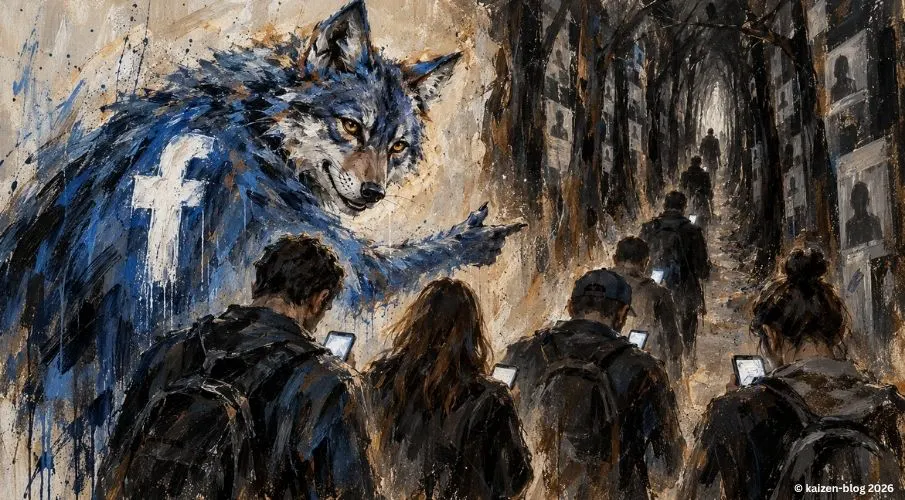
The easiest path to information today often starts with a flick of the thumb. Open Facebook and swipe down. Then wait and see what shows up. A war next to a family photo, an ad next to an accident. Then politics, then entertainment. Everything sits on the same surface, as if significance and triviality carried the same weight. There is barely any sense of direction left. What takes its place is habit.
Facebook has trained millions of people to expect information to be delivered to them. The reader no longer necessarily goes looking for a newsroom or a subject. They wait for whatever gets put in front of them. If an important article does not appear, even the thought of checking for it yourself is often missing. The article does not disappear from the internet. It disappears from awareness. Facebook trains its users to confuse selection with reality. Back in 2015, “Reasoning about Invisible Algorithms in News Feeds” by Motahhare Eslami and her team showed that 62.5 percent of the 40 Facebook users studied did not know their News Feed was being algorithmically preselected. In 2020, Deepti Singh Apte described in “Explicit Autonomy, Implicit Control” how Facebook leaves autonomy visible while steering behavior through an architecture she described as “implicit soft-control.”
In 2024, “Asymmetric Consumptive News Feed Curation?” examined 1,525 participants and looked at how users keep feeding the algorithm through their own behavior, shaping what they will encounter next. A 2026 study published by Samantha M. Jones and Erin A. Heerey of Western University showed that these kinds of algorithms can narrow people's choices so far that they end up seeing almost nothing beyond what the system has already sorted out for them. Behind that lies a dangerous development, with many people simply unlearning how to search for information themselves. More and more users just open their feed and wait for whatever gets served to them instead of actively looking for information. The less they search for themselves, the more the algorithm determines what even enters their field of vision. That increases control over the individual reader and, at the same time, over the media, whose reach increasingly depends on what a platform makes visible and what it lets disappear into the stream.

The dangerous part happens long before the first click: The table has already been set, and the user mistakes the menu for the world. They scroll through a preselected reality and call it choice. Their sense of direction is handed over piece by piece, often before they even notice that something is missing. That is exactly where the power of these platforms lies. They do not have to ban content. Often, all they have to do is distribute visibility. One post gets shown constantly, another barely at all. Those decisions are made inside a technical system whose rules outsiders only partly understand. To the user, the result looks harmless. They open Facebook and are presented with a world that has already been sorted for them.
Investigative journalism lives on the opposite side of that convenience. It goes looking where somebody wants something hidden. It follows files and statements, sometimes for years. It drags connections back into the light that would never volunteer themselves. But after publication, a second hurdle begins: Part of the audience now expects even that kind of work to show up conveniently between a cat photo and a birthday greeting. If it does not, it remains invisible to many people.
That is dangerous for independent newsrooms. Reporting costs time and money. Then a foreign platform gets to help decide how many people actually see the result. The newsroom owns the article. It only partly owns the road to the reader. A private company sits in between and distributes attention according to criteria that may have very little to do with journalistic relevance.
The loss of orientation weighs even more heavily. A good news site shows you at a glance what is there. Major stories sit alongside smaller updates. The reader can see the subject areas and choose for themselves. They can jump back at any time. They can see connections because several pieces of information exist side by side. A Facebook feed breaks that order into individual pieces. The next piece replaces the one before it.
That changes the way people read, too. Choice turns into reaction. The user encounters whatever appears in front of them and reacts to it. A comment here, a heart there. Then it is on to the next thing. The movement continues while the context evaporates. A complicated political development suddenly sits between a private photo and an ad for shoes. The format keeps whispering: This matters for as long as it is on your screen.

Orientation, by contrast, needs quiet. It needs a place where information can exist side by side without pushing each other out of sight within seconds. Investigative journalism needs exactly that kind of space because its work rarely fits into a single sentence. Documents and backstories need context. Anyone who simply waits for whatever Facebook puts in front of them often gets fragments. Fragments are convenient. Building a picture of reality from them is much harder.
The social danger begins when that convenience becomes normal. People give up part of their ability to choose and barely notice the loss because everything still seems to work. The screen is full. News is there. The feeling of being informed remains. Only the question of what is missing gets asked less and less.
Investigative work, in particular, lives off that question. What is missing? Why does statement A not match document B? A newsroom can spend months exposing exactly those gaps. Then, at the audience end, all that work can run into a ridiculously simple barrier: The article was not automatically placed in front of them. Years of trained convenience can become stronger than the curiosity journalism depends on in the first place. A newsroom can investigate the most powerful player and publish the cleanest proof. If that reporting fails to reach readers because the platform favors other content, the better information does not automatically win. The stronger distribution does. That is bad news for any public that considers itself informed.
Where Facebook decides what becomes visible and what disappears, populism gets a built-in advantage. Anger moves fast. Enemy images move even faster. The line about the “betrayed people” or the “dangerous foreigner” slips effortlessly between a vacation photo and a cat video and draws more reaction than any calm explanation. Right-wing demagogues have figured that out. They do not need lengthy proof. Often, a trigger word and 8 seconds of attention are enough. At the same time, many people are unlearning how to search for themselves. They wait for the stream. That is how orientation slips out of the reader's hands and into the platform's fingers. Reach then follows loud anger more and more often, and better information less and less.

The newer research makes Facebook far more than a neutral distributor for right-wing populism. Thomas R. Davidson and Jenny Enos of Rutgers University examined more than 400 parties in 30 European countries in a study published in 2024. On Facebook, populist parties received more reactions than other parties. The researchers found that widespread advantage exclusively among right-wing populist parties. Mihai Mutascu, Cristina Strango and Camelia Turcu then examined all 27 EU countries and concluded in 2025 that politically focused communication on platforms such as Facebook could contribute to electoral success for right-wing parties. They did not find the same advantage for left-wing populist parties. In 2026, Jakob Linaa Jensen, Anders Olof Larsson, Melanie Magin and other researchers analyzed 2,700 Facebook posts from the European election campaign in Denmark, Finland and Sweden. In Sweden, they found indications that radical right-wing rhetoric could spill over into the broader political debate. Facebook did not invent right-wing populism, it promotes it. But the research is making it clearer and clearer just how well its language works on this platform.
Facebook has made this relationship convenient.
That is its greatest success and, at the same time, its most dangerous one. Nobody has to force users to stop searching for themselves. The platform does enough of the work for them until taking initiative starts to feel like effort. Typing in a website address directly takes seconds. Yet to many people, that step now seems bigger than 20 more swipes. The damage therefore does not show up only in reach numbers. It shows up in a changed attitude toward information. People wait and receive. The hope is that anything important will surely show up. The citizen who goes looking for information slowly turns into a recipient who expects delivery. That sounds convenient. Democracy and investigative journalism, however, have never been delivery services.
Investigative journalism can only break through this mechanism to a limited degree as long as it reaches its audience almost entirely through outside platforms. That is why direct use matters more again. An independent news site gives the reader their choice back. It shows what was published instead of showing only what a technical system currently prefers. Most of all, it gives orientation back. That orientation is not some nice extra. It allows the reader to see important things next to other important things and assign weight for themselves. They can read a long article, then open a short update. They decide when to move on. No invisible clock is already sliding the next thing under their thumb.
The difference looks small: Open Facebook or go directly to a journalism site. In reality, that choice says something about intellectual independence. On the platform, the user waits for a selection. On the news site, they make it themselves.
A free public sphere sometimes starts with something astonishingly unspectacular: looking for yourself.
Updates – Kaizen News Brief
Alle aktuellen ausgesuchten Tagesmeldungen findet ihr in den Kaizen Kurznachrichten.
To the Kaizen News Brief In English


