
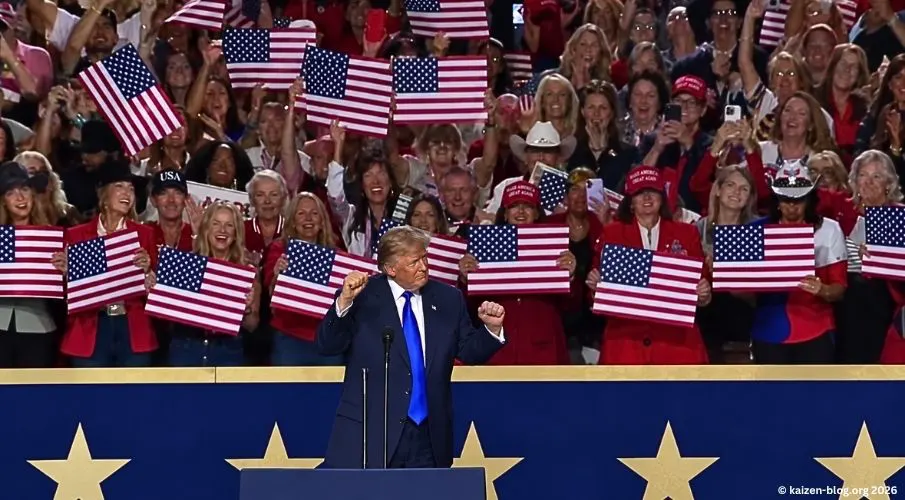
Dallas, Texas (KB) - In the Dallas Mavericks arena, the upper level remained largely empty that evening, while down below the most loyal supporters waited in glitter and cowboy hats, many wrapped in the colors of the flag. A party convention in the middle of an election cycle is a rarity, one Trump had demanded from his party, expensive and without the usual purpose, because there was nothing to nominate. Normally, a gathering like this would be the rare opportunity to reach undecided voters beyond the party’s own base; it is never cheap, and the party paid for it. The many empty seats answered the question of what the point was before the first speaker even took the stage. To warm things up, Treasury Secretary Scott Bessent stepped up to the podium and mocked former President Joseph Biden over the autopen he had used to sign thousands of pardons. In 15 months, Bessent said, they had gone from that autopen into high gear, and he warned about the radical leftists who wanted to turn America into a socialist hellscape. The tone was set long before the main speaker appeared.
The convention had also prepared a gift of its own. A 65-second appearance by Pennsylvania Senator John Fetterman played on the screens, and it sparked anger among Democrats. Former Congressman Conor Lamb, whom Fetterman defeated in the 2022 primary, called the video about as convincing as a North Korean news broadcast. Many in his party see Fetterman as a turncoat since he became the loudest supporter of Trump’s war against Iran and defended Israel in the Gaza conflict.
Fetterman: “Yes, I’m Senator John Fetterman from Pennsylvania. Yes, I’m a Democrat. Why am I standing here today talking to you? Because I’m, well, a common-sense Democrat. I will always stand with America ... We will work with President Trump to fight for and defend the steel industry way of life here in the Steel Valley.”
In Washington, he stopped attending meetings of Democratic senators a long time ago, and together with Republican David McCormick, whom he introduced in the video, he even created a joint fundraising pool. A poll from the previous month showed his popularity collapsing among his own supporters and rising among Republicans. He has ruled out switching parties, he said, and when questioned that evening, he remained silent. Congressman Chris Deluzio said Fetterman was making things harder for Democrats because he was creating the appearance of bipartisan support for Trump; if Republicans wanted him, they should have him, and he would not be a senator after 2028. Lieutenant Governor Austin Davis called the timing wrong and said anyone who willingly went along with it was part of the problem. Several Democrats, including Lamb, are considering their own runs in 2028. The appearance by a renegade Democrat was supposed to demonstrate bipartisanship, and that was exactly where his former friends saw the damage.

Then Lee Greenwood sang “God Bless the U.S.A.,” just as he had in 2024, and introduced the president. Vice President JD Vance came in with Health Secretary Robert F. Kennedy Jr. and other prominent figures, with a sign for the “Front Row Joes” right up front, those supporters who have followed the president around the country for years. Trump entered the arena to applause and hugged the singer while the crowd chanted U.S.A.
But the upper levels remained deserted, entire sections without a single person, even though before leaving Washington he had announced a sold-out arena and a massive crowd. “This place is packed,” he said into the half-filled rows. The claim and what people could see contradicted each other from the very first sentence.
Trump claims the Republican midterm convention arena “is packed,” even though hundreds of seats in the audience are empty.
“Trump on Democrats: They have more bullshit than any human beings on the planet.”
Trump began with a warning to his own people, saying that under the radical left the country would need a decade to recover, while with Republicans it would leave everyone else in the dust. Unlike the speakers before him, who mostly attacked Democrats and only briefly touched on tax cuts and border security, he preferred talking about his own accomplishments. He mocked Biden and in the same breath asked people to let him finish the job, a slogan Biden himself had used before dropping out in July 2024. People should remember him in four or five years when the country was booming, he said, because he had set everything in motion. He had won the presidency 3 times, he shouted, and the crowd cheered; in reality, he won in 2016 and 2024 and lost the 2020 election. The audience celebrated the statement as though it were true.
Then he asked voters to imagine that he himself was on the ballot, an attempt by his advisers to get the hard-to-reach voters from 2024 back to the polls. He said he wanted to travel through every battleground state for that purpose, even though he has done little so far for the candidates in this election. The cheers over that are double-edged, because many Democrats also want more Trump on the campaign trail because of his weak poll numbers. In those very states, Republicans are carefully weighing how closely they want to tie themselves to a man whose war against Iran is unpopular and whose prices are squeezing people. So a president who is not on the ballot asked people to think of him as if he were.
The numbers that night rarely held up under scrutiny. He claimed he had brought more than $20 trillion into the country from abroad, more than any country had ever seen. The White House itself counts a little over $11.2 trillion, and more than half of that consists of loose commitments that experts consider unrealistic. Qatar and the United Arab Emirates each promised more than $1 trillion, more than the entire size of their economies, and back in 2017 a Saudi commitment of $450 billion was never fulfilled. The largest tax cut in history, which he also claimed credit for, was no such thing, because his big tax law from last summer ranks only 6th according to a conservative tax think tank. He knew the ranking, but the bigger number sounded better.
On immigration, a decline became zero. Nobody had come in for 16 months, he said, while 25 million people had flooded into the country under Biden. Border Patrol counted more than 200,000 apprehensions from February 2025 through July, compared with more than 2 million in each of the two previous years, and the figure of 25 million is far above every serious estimate, even above his own figure of 21 million from the previous year. Among those who came in, he shouted, were “gang members, human traffickers, child molesters.” He also cited 11,888 murderers, a number that includes people from 4 decades, including his own first term; he offered no evidence for the other allegations. Nothing supported the claim, but once said, it was out there.
On oil, he promised that prices would fall once the war against Iran was won and joked that he wanted to rename the Strait of Hormuz the “Trump Strait.” He praised House Speaker Mike Johnson and Senate Majority Leader John Thune, but Thune was met with boos.
Trump: “John Thune is here” ... “Loud boos from the audience”
In between, he played with words, saying he wanted to change New Mexico to “New America” after previously renaming a lake and the Gulf of Mexico, and amused himself with the fact that the English word dumb has a B in it. One of his numbers was actually right: The murder rate was as low as it had been since 1900, he said, and it did in fact fall in 2025 to the lowest recorded level; the FBI has collected this data since 1936 and says it is as low as it was in the 1950s, although experts warn against comparisons with very old figures.
Trump: “You have a neighboring state, New Mexico. We think it should be called New America. People love the idea.”
And so the speech rolled on as a long list of numbers, most of which did not hold up under scrutiny and some of which did. The room made no distinction, applauding what was true just as it applauded what was false, and that offered the most reliable information of the night about this movement’s relationship with reality.

Much of what sounded like a gift came with an expiration date. The tax exemption on tips and overtime that he celebrated is a temporary deduction for the years 2025 through 2028, capped and phased out for higher incomes, and the deduction for seniors expires in 2028. He portrayed opposition to a law requiring proof of citizenship and imposing penalties on election workers, using profanity, as nothing more than a desire to cheat, even though criticism of the law centers on fears about access to voting; Four Democrats in the House even voted for the measure. Then he joked about the controversial trade of basketball player Luka Doncic, calling it the worst trade in sports history; he left out the fact that the Mavericks are owned by major donor Miriam Adelson. He called “tariff” his favorite word, then shortly afterward only his fifth-favorite word, after harassment by the press. His favorite word changed rank depending on who happened to be listening.
What actually concerns people barely came up. The cost of living is considered the Republicans’ biggest weakness heading into this election, but the speaker preferred to linger on the topics he likes. After almost an hour, he got to the White House ballroom, which the public would get for free, even though millions in taxpayer money have been allocated for it. Then came the promise of the night: $5,000 for every adult American if Republicans held both chambers of Congress, without a single detail. The money would have to be spent in the United States, he added; how the government would track that, he did not say. A payment tied to the outcome of the election whose use no one could monitor remained a promise with no mechanism for carrying it out. It was supposed to be called the “Trump Dividend.” He had previously promised $2,000 checks from tariff revenue. People had asked about those $2,000 earlier in the year; they were supposedly coming maybe by the end of the year, and that deadline is getting closer.
Trump: “Only I can make you this promise: If Republicans win the House and the Senate, I will pay every adult citizen of the United States a $5,000 dividend.” (Trump turns the election into an open deal: First give his party the majority, then every adult gets $5,000. This is vote buying, pure and simple.) (Trump macht aus der Wahl einen offenen Handel: Erst die Mehrheit für seine Partei, dann 5.000 Dollar für jeden Erwachsenen. Das ist Stimmenkauf in Reinkultur)
Trump: “The tariffs are making us much richer than we ever thought - we’re taking in trillions of dollars.”
The math behind it doesn’t hold up. He talked about trillions in tariff revenue, but in reality, just under $300 billion came in, and after the Supreme Court struck down the tariffs and refunds began, around $132 billion remained. He wanted to pay for the dividend the same way, with tariffs the Court had thrown out, forcing the government to refund $160 billion plus interest. The promise itself would likely cost the country more than $1 trillion. Tying money to the prospect of an election victory raises legal questions, because spending money to influence elections is prohibited; he packaged it as a reward to be paid afterward. The year before, Elon Musk had offered $1 million checks during a campaign for a seat on Wisconsin’s Supreme Court and backed down after facing resistance. The fact that Republicans this year had already sent out larger tax refunds, deliberately structured so they would arrive as one-time payments before the election, went unmentioned. Paying such a sum to every adult would blow through any budget his tariffs had ever filled. A gift from a pot of money that a court ruling had already sealed shut remained the biggest offer of the night to voters.
There was little new about any of it. Other politicians use events like this to announce a proposal or win over the undecided; Trump gave the same speech he gives at every rally, only this time at the party’s expense. He announced that he would also deliver the keynote address the following evening and left open what would be different about it. It wasn’t a big deal anyway, he said about the next appearance, he would just step out briefly and wish his people good luck. For a convention he himself had forced on the party, that was a pretty thin return.
Trump: “James Tala-freak-o. The guy looks really strange. Something’s missing.”
As he worked his way through the list of candidates and attacked their opponents, including James Talarico, whom he falsely accused of being a vegetarian, the rows of seats kept thinning out. Outside, people streamed toward the exits, while inside he insisted the arena was full and nobody was leaving, both of which were untrue. The longer he spoke, the thinner the crowd became. At the same time, the new football season was underway, with the Patriots-Seahawks game already in the fourth quarter tied 10-10. The president was also fighting for people’s attention, and he was losing it row by row. He mocked candidate Ken Paxton over his appearance while at the same time calling him the greatest attorney general in Texas history. The praise was more generous than the turnout. The crowd gave a standing ovation to Erika Kirk, the widow of right-wing activist Charlie Kirk, who had been shot and killed at a college in Utah a year earlier.
The speech was made for the faithful, for a room that barely reached the undecided; whether anyone beyond his most devoted supporters was even watching remained unclear. After more than an hour and a half, he returned to the request he had made at the beginning and again asked people to imagine that he himself was on the ballot. Good luck, he said, we love you all. In the thinned-out upper deck, the promise of $5,000 still echoed, a promise whose funding he had not said a single word about all evening. - September 10, 2026 8:10 AM U.S. excludes French MAGA groups from millions in grant funding The U.S. government wants to support pro-Trump organizations in Europe with grants of up to $3 million, but is apparently excluding applicants from France. Washington fears that funding MAGA-aligned groups could be seen as foreign interference ahead of France’s 2027 presidential election. France had already issued a clear warning against attempts at foreign interference and is currently tightening its laws against disinformation and election interference. Particularly explosive: The Trump administration openly supports right-wing and far-right forces in Europe, but apparently wants to draw a line in France because of the political and economic consequences.
Updates – Kaizen News Brief
Alle aktuellen ausgesuchten Tagesmeldungen findet ihr in den Kaizen Kurznachrichten.
To the Kaizen News Brief In English


dieser John Fetterman „Ja, ich bin Demokrat. ..“ gemahnt mich an den schweizer Daniel Jositsch. Er suhlte sich über Jahrzehnte in der sp. Nicht ihm wurde Mitgliedschaft entzogen, nein: „Die SP Kanton Zürich nimmt mit Bedauern zur Kenntnis, dass Daniel Jositsch aus der Partei austritt; wir danken Daniel Jositsch für sein langjähriges Engagement für die SP und für seine Arbeit als Zürcher National- und Ständerat”, sagt Jean-Daniel Strub, Co-Präsident der SP Kanton Zürich am 4. Juni 2026.
z.B. 2022, die verschleierte "wilde Kandidatur nicht zur Verfügung stehe. Allerdings war er bis zur Wahl auch nie bereit öffentlich zu sagen, dass er nicht zur Wahl stehe oder eine allfällige Wahl nicht annehme. Auch zwischen den Wahlgängen erfolgte keine derartige Erklärung durch ihn; 2023 Die SP-Bundeshausfraktion entschied sich für das Zweierticket Beat Jans and Jon Pult. Bei der Wahl am 13. Dezember 2023 unterlag Jositsch im dritten Wahlgang Jans, auch während dieser Wahl erklärte er nicht, nicht zur Wahl zu stehen oder die Wahl nicht anzunehmen.“ (Quelle wiki) dies Interna, das EXTERNA, wie: „er teilt in einem SVP-Podcast gegen die SP aus, und fordert einen härteren Kurs in der Migration."
ok, das 5.000 Dollar-Versprechen, ".. wirft rechtliche Fragen auf, denn Ausgaben zur Beeinflussung von Wahlen sind verboten; er verpackte es als spätere Belohnung.“ ist schon noch kapitalerer Blödsinn.