
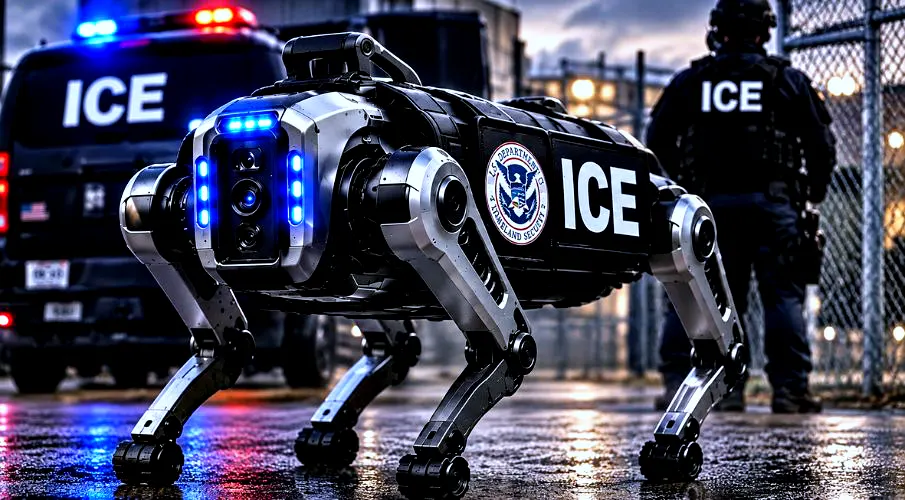
A four-legged robot is now patrolling for an immigration agency. A company born out of the war on terror is watching over a basketball game. On the corner of a residential street hangs an eye that reads every license plate. None of this is considered especially remarkable in America anymore. The unsettling has settled so deeply into everyday life that hardly anyone is frightened by it. What yesterday would have looked like a state of emergency now sits in the landscape like a piece of furniture, ignored like a mailbox. The cameras fade into an annoying privacy dispute, the robot dogs into a bizarre news item. And counterterrorism for female athletes gets a friendly story about how important it is to fight extremism in sports.

The engine behind this order is not sitting in Washington. Flock Safety, whose artificial intelligence-powered license plate readers sit on poles in thousands of American cities, has long since stopped selling its technology only to the police. The other half of its revenue comes from private customers, from homeowners associations and apartment complexes. Shopping center operators pay for it too. The Fourth Amendment limits the reach of the government. It says nothing about the homeowners association, and there are few institutions in America that rule as bossily as this association of neighbors, known there as an HOA. Constitutional protection ends where private property begins, and surveillance has learned to live in exactly that gap. Without you being able to do much about it, your car, its make and model, along with information about the driver, moves into a massive database of movements.
Maybe the agency should first examine its own behavior and put itself on a leash.
That means the transformation does not need an authoritarian decree. Fear from below is enough, and the security apparatus and its private partners are only too happy to create that fear. Fear is the cheapest building material of control, it needs no law and no vote, only a neighbor who is afraid. The state no longer has to give the order, it only has to watch as citizens monitor one another and hand over the images on their own.
When the company started, it did not fight its way through municipal bureaucracy. It was spared controversial city council votes and public procurement procedures. It went straight to the boards of suburban homeowners associations. The overzealous monitors there, who guard their cul-de-sac more closely than the Pentagon guards the Strait of Hormuz, got automated vehicle surveillance delivered right to them. Local police then gain real-time access to a privately funded network that no taxpayer ever approved.
After that, the camera network keeps growing, first for missing-child alerts, then for kids on electric bikes, until eventually, thanks to artificial intelligence, the giant homeowners association on the lamppost is watching over the entire country. What begins below as fear returns above as a spectacle. ICE is buying the robots from Boston Dynamics and invoking public safety. The danger to its own officers, the agency says, has grown so much that two legs are no longer enough. Strip away the grand language and one uncomfortable fact remains. Not a single officer from the agency was killed in the line of duty last year. Not one.

ICE is planning to buy robot dogs from Boston Dynamics. The document comes from the procurement system of the U.S. Department of Homeland Security. Under number F2026075113, the acquisition of Boston Dynamics SPOT robots for ICE is explicitly announced. The estimated contract value is between one and two million dollars. The robots are supposed to be remotely operated for inspections, situational awareness, and the examination of dangerous environments so officers do not have to be sent directly into risky areas. The planned start of the procurement process is listed as September 4, 2026.
Coming from the agency, however, it sounds like an epidemic. This buildup against an imagined enemy directs its harshness in reality against the people the officers face every day. Maybe it should first examine its own behavior and put itself on a leash.
The situation in the WNBA is even stranger. The basketball team Chicago Sky hired a company from the national security field to respond to a supposedly extremist threat. The rivalry between Angel Reese and Caitlin Clark is cited, along with online threats and abuse directed at Reese. Then Moonshot takes over, a company founded to combat recruitment by the Islamic State and the spread of jihadist material online.

Even a basketball team is now turning to methods from counterterrorism. NPR reported in late August on why a WNBA team was bringing in national security experts. The team in question is the Chicago Sky, which hired a threat intelligence company because of threats and attacks against players. Moonshot originally developed methods to combat Islamist radicalization and ISIS activity online. Those same methods are now being applied in part to threats and extremist content surrounding professional basketball.
Together with Jigsaw, Google's technology project, Moonshot developed the so-called Redirect Method during the war on terror. Users searching for terrorist propaganda were directed through targeted search ads toward deradicalization content. The idea of guiding a man drawn to violent jihad toward the Boy Scouts through a search ad has something touchingly naive about it. The same method is now being aimed at people who behave badly online the moment the conversation turns to basketball.

It says a lot, people from this industry itself now say, that the same technology and the same methods used ten years ago to help governments fight terrorism and deal with targeted violence now have to be used in sports entertainment. It does say a lot, just not in the sense the statement gives itself. The revolving door between government homeland security and the private threat-monitoring business turns without resistance. From the Bush administration through the Trump administration, the same expert held changing national security positions, most recently as Assistant Secretary for Counterterrorism and Threat Prevention at the Department of Homeland Security, before moving into private consulting on counter-extremism. Experience gained in government becomes a product, and that product finds its market in exactly the fears the government once existed to manage.
Hostility on social media is almost part of the culture there by now. Declaring it a matter of national security and treating it with the tools of counter-extremism is institutional self-expansion in its purest form. Hate and threats online are real and ugly, and sometimes they justify police intervention. But the moment they are interpreted as radicalization, a mouthy internet user starts being treated almost like an insurgent.
This is no longer just about a CIA that has gone off the rails or an FBI that has slipped its leash. It is about a culture that can no longer imagine ordinary everyday life without constant threat analysis and automated surveillance. It reaches for the tools of counterinsurgency to deal with it. The established media outlets mostly glide past that point and at best bring in a civil liberties expert who puts the audience to sleep with an introductory lecture on the Fourth Amendment.
This is what permanent war looks like once it comes home. The difference between citizen and suspect begins to blur once every movement is recorded and every crude remark is declared a threat. In my own reporting, I have stopped using the term national security state because this has long since stopped being a purely government phenomenon. These days I simply call it: national security.
Updates – Kaizen News Brief
Alle aktuellen ausgesuchten Tagesmeldungen findet ihr in den Kaizen Kurznachrichten.
To the Kaizen News Brief In English


