
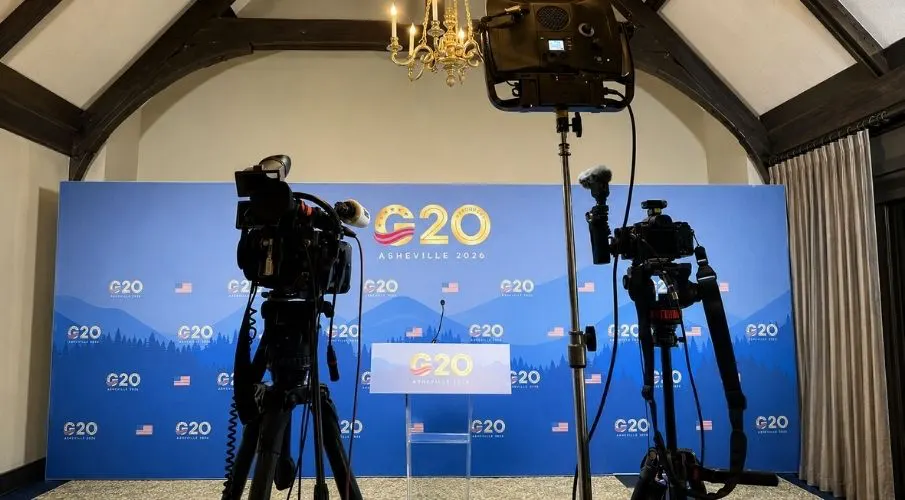
A host who writes the guest list himself turns a summit into a home game. The meeting of G20 finance ministers in Asheville, North Carolina, was thrown into turmoil on Monday when Russian Finance Minister Anton Siluanov unexpectedly appeared in the room, for the first time since Russia's invasion of Ukraine in 2022. The invitation came from the Trump administration, nobody had announced it, and objections from Europe followed immediately. Inviting the man representing the country responsible for the attack to the table turns the seating arrangement into a statement. Who else is missing and who is there tells the rest of the story.
The sharpest response came from Berlin. Vice Chancellor and Finance Minister Lars Klingbeil confronted Siluanov in an early session over the war, demanded that it end, and pledged further support for Ukraine, which was not represented in person. Welcoming the Russian here sends a message that he finds troubling, Klingbeil said. He would have liked the American side to make it clear that this was not an ordinary guest. A vice chancellor publicly rebuking the host's guest says a lot about the rift between Washington and its oldest allies.

The Europeans did not stop at words. Germany and others threatened to refuse the traditional group photo of the ministers if Siluanov appeared in it. The threat worked, the picture was taken without him and with the Europeans. The Russian is used to a cold reception at meetings like this: in 2022, then-U.S. Treasury Secretary Janet Yellen walked out of a G20 session on the sidelines of the International Monetary Fund's spring meetings when Siluanov, joining remotely, began to speak. In 2023, she confronted Russian ministry officials in India and blamed them for the deaths in Ukraine and the damage to the global economy. What under her predecessor meant walking out of the room now means inviting him in.
Siluanov's appearance came during a telling week. President Vladimir Putin was planning to meet Xi Jinping and Iranian President Masoud Pezeshkian in Kyrgyzstan, while a Chinese representative, as usual, was also sitting at the table in Asheville. Washington is welcoming the man its allies want isolated, while Moscow is meanwhile drawing closer to Beijing and Tehran. The map of the camps is being redrawn right now, in the middle of a room in the mountains of North Carolina. Turning the excluded into the guest of honor shifts more than an invitation, it shifts the front.

Who the host invites says as much as who he keeps away. Many Europeans were troubled by the absence of South Africa, a longtime member of the group and the continent's largest economy. Trump had announced its exclusion last year, after skipping a summit hosted by South Africa, based on the false claim that white South Africans were being randomly killed and having their land seized. Africa's largest economy is thus sacrificed to a fabricated story, and the selection follows the host's whim instead of the standing of the economies involved. The attacker is allowed in, South Africa stays out.
Instead of representatives from other governments, the administration brought its own people to the table. It invited American business figures from banking and the cryptocurrency industry to put them in touch with government leaders, and rejected a request to allow representatives from other G20 countries to take part as well. Some participants were irritated. That is how the host decides who gets to speak and who gets to profit. A summit of governments becomes, on the side, a networking event for Wall Street.
Through all of this, Bessent presented himself as a champion of a level playing field. In his opening remarks, he named stronger growth and prosperity for all as goals, thanked Europe for helping choke off the Iranian economy, and announced that he would return the G20 to its original mission, from which it had drifted over the decades. The group would address global imbalances and the sovereign debt of emerging economies. A sustainable global economy, he said, could not rest on actions that plundered neighbors and suffocated fair competition. Those words came from a government that is covering global trade with steep tariffs. Surcharges against neighbors and a hymn to the free market do not sit well together.

The backdrop makes the situation serious. The International Monetary Fund expects slower growth and rising prices since the American attack on Iran in February disrupted oil flows and pushed energy costs higher. U.S. gross debt has just passed $40 trillion and is fueling creditors' fears of higher interest rates. Growing budget pressure and rising bond yields are worrying markets and policymakers alike, said IMF chief Kristalina Georgieva. The stalled return to low inflation is another concern. In the mountain town, ministers also discussed stronger supply chains for raw materials such as critical minerals and ways to reduce or restructure debt. Bessent's surprising interventions in currency and bond markets have so far had only limited effect and met resistance in the European Union, whose currency suffered as a result. When $40 trillion in debt is pushing interest rates higher, every shock becomes more expensive, and the richest countries negotiate over the hardship of the poorest while their own coffers groan. The numbers are one thing, the fading trust another, and both are slipping at the same time.
Above everything hangs the campaign against Tehran. Under the name "Operation Economic Outcast," Washington is asking its allies to strangle the Iranian economy, and Bessent threatened sanctions against any country that refuses to cut its ties with Iran. Last week, he said his patience with countries still doing business with Tehran was limited and expressed hope that they would follow Washington's demands to avoid a larger economic war. On Sunday evening, he met with Chinese central bank governor Pan Gongsheng and rejected the idea that Iran's economy could not be strangled without China. Only 30 million barrels of Iranian oil were still on the water, he said, and an American blockade was preventing further sales. "Why would I want to blow up the global financial system?" he asked. Threatening sanctions against everyone who trades with Iran turns partners into hostages of an American calculation. A global forum becomes a tool in Trump's fight with Tehran.

The unity Bessent invokes is something he has damaged himself. Many countries are struggling with uncertainty over Trump's trade policy and the steep tariffs on their exports, while the war with Iran adds another burden to growth. A meeting that preaches cooperation is taking place among participants Washington has only just threatened with higher tariffs. The call for fair competition rings hollow when it comes from the loudest tariff man in the room, and some at the table did not know whether they were partners or the next target.
It fits this order that the Treasury Department denied accreditation to individual American reporters from The New York Times and The Wall Street Journal, along with Bloomberg News correspondents from several countries. Germany's Finance Ministry intervened and secured a credential for the Times' Berlin bureau chief, but not for the Bloomberg reporter, something one diplomat described as unprecedented and unacceptable. Two colleagues from our own newsroom were also denied accreditation, but we are reporting anyway. Other smaller or investigative newsrooms were hit by the ban as well - but there, it is met with more of a smile than with any willingness to bend to this administration. No independent European media outlet was denied accreditation, which says quite a bit about how unwilling some newsrooms are to pick a fight with this administration. A host who chooses the guests and screens the questioners runs the world's summit like his own private event and calls it cooperation.
Updates – Kaizen News Brief
Alle aktuellen ausgesuchten Tagesmeldungen findet ihr in den Kaizen Kurznachrichten.
To the Kaizen News Brief In English


