
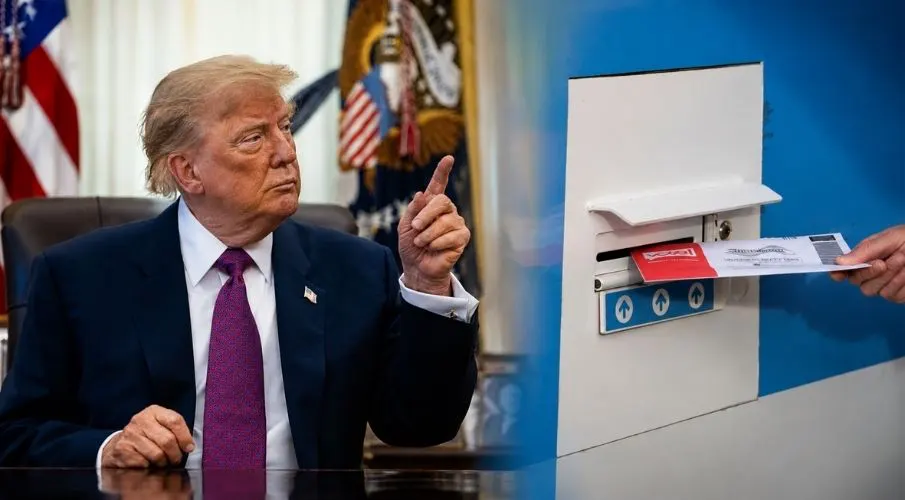
The man who casts his own ballot by mail wants to restrict that very option for everyone else, as if trust could simply be switched on and off whenever it suits him. On Thursday, a federal judge stepped in for the second time. Indira Talwani barred the administration for two weeks from enforcing Donald Trump’s order targeting mail voting, just over a week before the first ballots for the approaching midterm elections are supposed to start going into envelopes.
The fight could quickly end up back at the Supreme Court. Just a few days ago, the court initially cleared the way for the administration in a procedural ruling. The conservative majority left the legality of the order open and merely held that Talwani had intervened too early. On Monday, she lifted one of her injunctions, and the Obama-appointed judge reluctantly followed by lifting the second. Democrats and voting-rights groups then refiled their cases, adjusted to the ruling from Washington, and are now seeking a more lasting block. The order is bouncing between courts, and every swing eats up days nobody has left before the election.

The administration has now formally laid out the conditions under which the U.S. Postal Service will deliver states’ mail ballots at all. That effectively started the legal fight over again. The Postal Service now wants to deliver only if states provide lists of eligible recipients and format the envelopes according to its rules. Two requirements are enough to throw a well-established delivery system off track. The legal fight hits the midterms at the root. Nearly one in three Americans votes by mail, and election officials say there is not enough time to adapt their systems to the new requirements. Talwani wrote that the states bringing the lawsuits do not have the money or time for what would be required. New materials would have to be designed and printed, election systems reworked. Staff would have to be trained on the Postal Service portal and voter data uploaded, all before Election Day. None of those tasks can be completed in the time that remains, and the officials who would have to carry them out know it.
The White House did not immediately respond to a request for comment. A hearing is scheduled for September 3.
Letitia James, New York’s attorney general and one of roughly two dozen Democratic attorneys general behind one of the lawsuits, called the rule a blatant attempt by the federal government to interfere in elections it has no authority to control. A federal court, she said, had stopped it before it could create chaos at the polls.
For Democrats and voting-rights groups, the Postal Service requirements are unconstitutional. The Constitution gives authority over elections to the states and, in certain cases, to Congress, not to the president and not to his Postal Service. Courts used the same reasoning to strike down Trump’s first order last year, which would have required, among other things, documentary proof of citizenship for voter registration. The case touches an old boundary in the American system. The president is not supposed to decide who gets access to the ballot, and a mail carrier was never meant to become the gatekeeper of democracy.
Trump has attacked mail voting for years and falsely blames it for his 2020 defeat, even though he votes by mail himself. A 2025 Brookings Institution report found fraud in just 4 out of 10 million mail ballots cast. Against that vanishingly small number stands an accusation he repeats relentlessly, as if sheer volume could make it grow. He issued the order in March, his second election-related decree since returning to office. Opponents sued immediately. The administration argued that the lawsuits were premature as long as there were no concrete implementation rules and initially prevailed with that argument in Washington, D.C., while Talwani issued temporary blocks for the November election in two Boston cases. From the beginning, it was ruling against ruling, a country unable to agree even on the route a ballot takes through the mail.
The hearing will show whether the block holds or whether the fight moves upward once again. For now, the decision is back in the hands of the courts while the deadline for the first envelopes closes in and nobody knows for sure whose rules they will be mailed under.
Updates – Kaizen News Brief
Alle aktuellen ausgesuchten Tagesmeldungen findet ihr in den Kaizen Kurznachrichten.
To the Kaizen News Brief In English


