
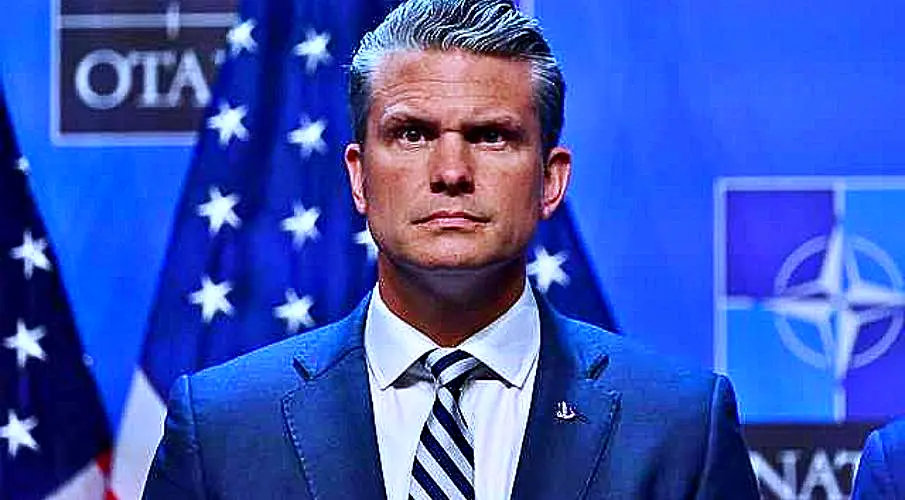
Pete Hegseth is pushing one top general after another out of service while the dead are being counted at U.S. bases in the war against Iran. A country at war usually holds on to the men who are supposed to win it. Defense Secretary Pete Hegseth, whom Trump calls his War Secretary, has done the opposite. His firings at the top of the armed forces have put the U.S. military in a position that is hard to sustain in the middle of the war against Iran, and the extent of the damage goes further than was previously known. A secretary who takes his title from war has dulled its tools before the enemy even had the chance.

The Army has been without a chief of staff since April. Hegseth fired General Randy George and at the same time pushed at least 3 senior officers out of service who had been considered possible replacements for him, according to current and former government officials. An Army without its top soldier fights as if its backbone were missing.
All told, Hegseth has pushed at least half a dozen senior officers out of their posts, according to people inside the government. The purge has ripped expertise out of the force and thinned out its top leadership. That kind of bloodletting would hit any military, but it is hitting one that is already in the field. General James Mingus, the Army's vice chief of staff, was pushed aside by Hegseth last year with little explanation. General David Hodne was brought in by Hegseth and fired just 8 months later.
The list keeps growing. Major General William Green and General Christopher Donahue were also pushed out of service. General James Slife, the Air Force vice chief of staff, was forced out as well. Hegseth had already removed General CQ Brown Jr. as chairman of the Joint Chiefs of Staff in the opening weeks of Donald Trump's second term, and General David Allvin retired early last fall.
For some of these departures, no one gave a reason that matched the rank of the people involved. When experience disappears without explanation, the rest learn that obedience matters more than ability. An army rebuilt this way does not just lose names, it loses the memory in which its mistakes and victories are kept. What a successor does not know, the first real crisis has to teach him, and that crisis is already underway.
Daniel P. Driscoll, the Army's highest-ranking civilian official, is also expected to leave in the coming months, according to consistent reports. He has already moved out of the large family home outside Washington that he had been renting. An empty house outside the city often says more about an agency than any official statement. Democratic Representative Pat Ryan of New York, himself a former Army intelligence officer, named the price directly. Removing the "most battle-tested, most lethal and proven" leaders in the middle of a war means troops are less safe and the chances of victory go down. Over generations, he said, it damages the idea that the military is an apolitical institution that swears its oath to the Constitution and not to a president. An oath to a document binds differently than loyalty to a man, because the document does not change its mood.
There is now a gap at the top. When Hegseth was confirmed, 10 four-star generals were on active duty. Now there are 5, the fewest in years. A high command cannot be replaced overnight, because the experience holding it up takes decades to build and can die with a signature. In war, decisions are made by the hour, and every one of them demands someone who has already survived something similar. The halved line at the top lacks that calm while the enemy tests every day how far it can go. Every day without leadership is a day handed to the other side for free.
Meanwhile, Iran's cheap drones have been hitting U.S. bases across the Middle East since late February in seemingly endless numbers. At least 18 U.S. service members have been killed in the war, and more than 776 have been wounded. At home, the price of almost everything rises with the price of oil, while shipping companies are struggling under more expensive fuel. That is how the war reaches from the bases all the way to the checkout counter. The generals who were supposed to lead it are sitting at home or in retirement, and an enemy could hardly ask for more convenient help than a country that sends its own field commanders home.
Updates – Kaizen News Brief
Alle aktuellen ausgesuchten Tagesmeldungen findet ihr in den Kaizen Kurznachrichten.
To the Kaizen News Brief In English


Wie lange kann dieses Irrsinnkomplott noch durchhalten??
…gute Frage, bis zu den Midterms muss man noch durchhalten …
Der Einzige, der seinen Posten räumen muss, ist Hegseth.
Aber vielleicht hält er sich auch für so einzigartig wie Trump, dass er die „paar“ Posten selber ausfüllt.
Die Soldaten haben einen Eid auf die Verfassung geleistet.
Ohne ihr dazutun wird es zu einem Eid auf den Präsidenten.
Wie stumpf sind die Militärs, dass sie sich bicht wehren?
…es wird ihm auf die füsse fallen, und zwar gewaltig
Das kann man nur hoffen.
Er ist noch „Jung genug“ um die Konsequenzen zu spüren.