
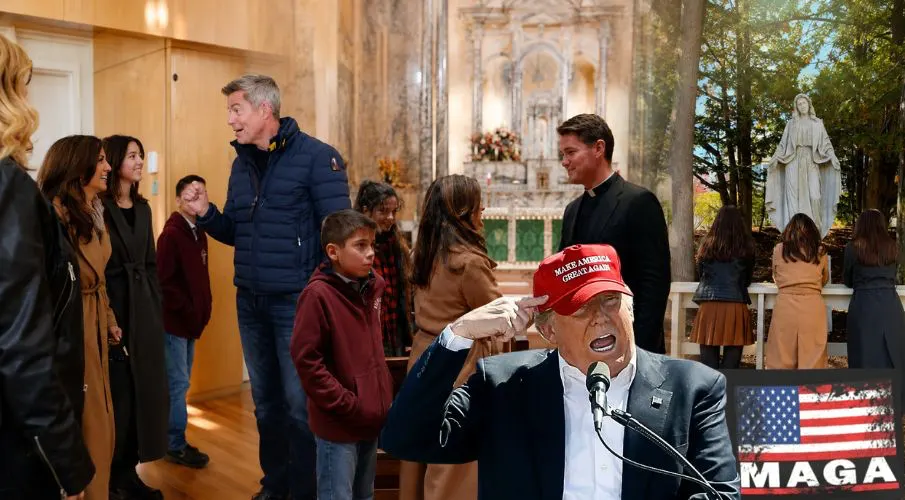
Sitting across a massive kitchen island, a sitting Transportation Secretary faces his 17-year-old daughter and asks her a question as if they were talking about an accident. “Let’s say you got into Harvard, would you be pushing us to actually have you go?” Ominous music starts playing in the background, just as reality TV demands. Paloma says yes. Sean Duffy, 14th in line to the American presidency, listens to his daughter as if she were about to join a cult.
Sean Duffy to his daughter, who wants to go to Harvard: “If I send you there, I think what happens is they have professionalized figuring out how they can take good, young girls like you and, I think, corrupt their mind … They get perverted and contorted.”
The scene comes from the second episode of “The Great American Road Trip,” the secretary’s newly released travel show, filmed in the sprawling suburban home he shares with his wife Rachel Campos-Duffy and their 9 children. 4 of them are going along to Boston. But first they have to settle what a single semester at a liberal university might do to the faith of a child who has been raised as a strict Catholic for years. The camera cuts to Campos-Duffy, barefoot on the couch, curled up next to her husband. She says she has spent a lot of time giving her children faith and firm values, and now the idea of dropping a daughter off at a place that undermines exactly that worries her.
Alone with Paloma, Duffy gets more explicit. Harvard, he says, has developed a professional operation for taking good young girls like his daughter and corrupting their minds. A Cabinet member who suspects something like that could have it investigated. But Duffy is not speaking here as a man holding public office. He is speaking as a father who sees the country’s most prestigious private university as a factory for sex and communism. His daughter pushes back, smarter than the conversation seems prepared for. She comes from an extremely conservative school and an extremely conservative family; a liberal environment, she says, would finally give her a well-rounded education. That knowing look appears on Duffy’s face, the one adults use when lecturing young people who supposedly still have not understood anything. Young people from religious homes, he says, get perverted and contorted once they venture too far out. He raised Paloma and does not trust her mind enough to withstand the corrupters of Harvard.
That spells out the contradiction at the heart of the entire series. Supposedly, the family is traveling across the country to discover the places and people that make America what it is. In reality, a man travels for months through a country he barely seems interested in and wants to keep much of it away from himself and his children, just as he wants to keep Paloma away from Cambridge. A journey that avoids everything unfamiliar remains little more than a longer stay at home.
The 6-part show is half family movie, half prohibited advertising. It was controversial from the moment it was announced, and for good reason. Its funders include companies like Boeing and Shell, companies the Transportation Secretary is supposed to oversee and regulate. Automaker Toyota is part of it too. Federal employees are not allowed to use their office for private gain or promote companies while serving in government. Under the second Trump administration, that prohibition has become more of a recommendation, and that is what made the series possible in the first place.

Originally, the production was supposed to appear as part of Trump’s dubious “Freedom 250” celebration. Millions of dollars poured into a production that, despite all that money, is almost unbearable in its boredom.
Before every episode, a disclaimer assures viewers that no taxpayer money was spent on the family vacations. What remains unanswered is whether the family was paid for taking part by “The Great American Road Trip Inc.,” a nonprofit organization under Section 501(c)(4). Duffy and Campos-Duffy insist they received no money; the organization remains silent about who benefits from its spending. If money was paid, the ethics violation would be the lesser problem. It could potentially amount to bribery. We are also still waiting for an answer to our second inquiry.

In several episodes, Duffy says he now has to briefly “work” for the department before visiting one of the facilities belonging to companies that are paying for his family’s vacation. In Charleston, South Carolina, the family marvels at the new Dreamliner inside a Boeing plant; the aircraft manufacturer is one of the biggest funders and holds several contracts with the Department of Transportation. In Fort Worth, Texas, the secretary briefly leaves his family behind and visits Cement Roadstone Holding, the country’s largest asphalt producer, which stands to benefit substantially from Duffy’s planned highway expansions. In Scottsdale, Arizona, the children get to ride in Waymo’s self-driving cars, which their father calls the future of transportation.
At least the disclaimers and the quiet release reveal some остаток of a conscience, unusual for an administration that otherwise seems to have shed all sense of shame. Maybe they made it through the entire production before realizing just how thoroughly they had broken the rules.

The violations are not the only reason the series should never have aired. Its own college storyline turns into a defeat in the administration’s war on American universities. In Cambridge, the family drives to St. Paul’s Catholic Church and asks Father Nathaniel Sanders whether a Catholic can leave an Ivy League university without losing their faith. Campos-Duffy, already unsettled by the time her oldest daughter Evita spent at the University of Chicago, wants to know why anyone would give money to people who hate them and hate their values. Sanders stays calm. He does not believe anything sinister is happening there. If someone already knows who they are and who God is to them before they arrive, he says, that will only continue to blossom there.
The tour through Harvard’s Catholic center is the only image of the university the series shows. A university visit in which the university itself does not appear. The reason is easy to guess: too many images of Harvard would show just how baseless the Duffys’ fear is, and the whole game would be over.
Later, at Fenway Park, after the visits to Harvard and Boston College, the secretary gives in. A smart, good girl, he says, can find her way just fine at a really good university. After seeing the campus with his own eyes, he can no longer maintain the claim about brainwashing. On “The Great American Road Trip,” that already counts as dramatic personal growth.
A learning moment, certainly. But alongside the administration’s continuing campaign against Harvard and the other “liberal” colleges, it rings hollow. That campaign lives on ignorance and fear disguised as culture war. Duffy took back his claim after looking for himself just once. What would have to happen for the rest of the administration to look too?
Duffy may have had his little conversion, but the series teaches something else. It teaches that encountering what is unfamiliar is not worth it, that a sheltered worldview does not need to be shaken. The trip does have one purpose after all: visiting the companies paying for it. In the final episode, Paloma learns while traveling historic Route 66 that the University of Chicago has accepted her. While the family races into the past, the girl looks toward the future.
Why the family did not visit Chicago as well is quickly explained. The city is facing an invasion by its own government. This is what the country this show is supposed to celebrate looks like: A secretary sells his office to the companies he is supposed to oversee and fears his own country’s universities more than any outside enemy. On August 19, as shown above, another clip from the episode appeared. In it, Duffy tells his daughter that Harvard has turned taking “good young girls” and corrupting their minds into a business; young people there, as he puts it in English, get “perverted and contorted.” This is what a country sounds like when it fears its brightest children attending its best universities: recorded at a kitchen island, underscored by ominous music.
Updates – Kaizen News Brief
Alle aktuellen ausgesuchten Tagesmeldungen findet ihr in den Kaizen Kurznachrichten.
To the Kaizen News Brief In English


Zumindest besteht für die nächste Generation Hoffnung!
Das Mädchen aus erzkonservativen faschistischen Fsmilien noch eine eine eigene Meinung haben.
Sich aktiv dafür interessieren einen anderen Blickwinkel, ihne die engen Zwänge von Daheim, zu finden.
All den Mädchen, wie Paloma, wünsche ich ein erfolgreiches Stdium.
Eine neue Sicht auf die Dinge, außerhalb des Erzkonservativismus und der MAGA Bubble