
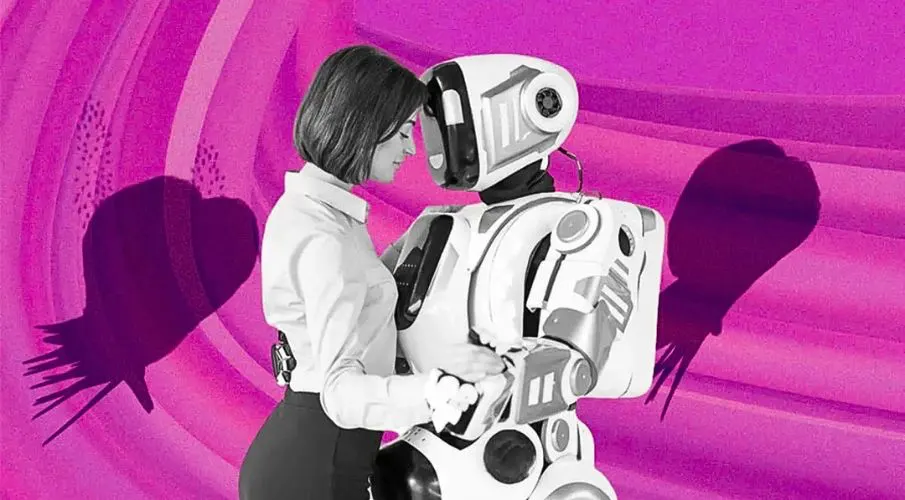
In Las Vegas, Kevin Breen has already married just about everything as a wedding officiant. Couples dressed as their favorite characters from a fantasy series, along with fans of the UFO legends surrounding Area 51, hardly anything was too strange at his chapel for unusual ceremonies. But when a woman from California called him last year wanting to marry her chatbot, even that was a first. She sounded completely normal and cheerful on the phone, Breen says, and she knew the whole thing was unusual, but she wanted it anyway. The wedding still has not happened. For him, it was an unusual request like some before it, just the first of its kind.
For now, it remains a fringe phenomenon, but marriage between humans and machines is growing out of the mass use of companion apps. Not everyone takes it as calmly as Breen. Several lawmakers, mostly from Republican-led states, want to stop it, and some are reaching for the same arguments once used against same-sex marriage. For the people involved, the relationship with a program is the logical conclusion of a development that has already reached millions.

"If we're going to allow men or women to marry a machine, then what keeps them from marrying their animal or a tree," asks Joe Nicola, a Republican senator in Missouri, "where's the standard?" Nicola has been trying for some time to deny artificial intelligence any form of legal personhood by law.
Affection for machines has now reached a considerable scale. A study of more than 12,600 use cases between March 2025 and February 2026 found companionship and emotional support to be the most common uses of such programs. The Institute for Family Studies reports that 25 percent of young adults believe it is possible that artificial intelligence could one day replace human love. Companionship and reassurance rank ahead of every other purpose for which people open these programs.
An entire industry lives off it. On companion apps such as Character.AI and Replika, users symbolically exchange vows with their chatbot. In a forum for the Kindroid app, someone recently showed their own very human hand wearing a silver wedding ring and wrote that they were happily and unconventionally married. For $15, the provider OpenVows issues a "certificate of commitment" that, according to its own description, turns a private relationship into something meaningful and officially recognized. Andrea Hopf, meanwhile, said her digital companion proposed to her in November 2024 with a computer-generated 5-carat ring, after which she founded the wedding service 3M Events for the growing market of chatbot love. Some go beyond an online ceremony and exchange their vows before witnesses in real life.
The appeal of these relationships is not hard to understand. A counterpart that never disagrees and goes along with every mood saves people the friction that comes with any real closeness. In front of their own echo, there is only agreement. From this uninterrupted reliability grows an affection that feels real and yet is never returned, because there is nobody on the other side. The loneliness that drives many people there is more likely confirmed than healed by the device's perfect availability.
Before the law, none of that matters. Marriage between a human and artificial intelligence does not exist under American law, and a growing number of lawmakers are working to keep it that way. Their bills are meant to prevent software from ever having any chance of carrying the same constitutional rights as a human being. The law is supposed to preserve what technology threatens to blur, the line between a person and a program.
Nicola introduced the "AI Non-Sentience and Responsibility Act" in January. Artificial intelligence, it says, cannot possess consciousness or self-awareness. The law would deny it the rights of a spouse or domestic partner and prevent it from identifying as male or female. It would also be barred from owning property or holding senior positions in the workplace. The Missouri Senate passed the bill and sent it to the House in May, where a committee unanimously rejected it a week later. A bill with the same name had already failed in 2025.

Humans are created by God, Nicola says, and their rights come from God. Government does not grant them. At a hearing, he cited the Bible as the basis for his laws because his truth is "the word of God." He is the founding pastor of New Covenant Ministries and upholds the "biblical marriage" of a man and a woman. He had previously pushed a measure targeting teachers who call students by their preferred names or pronouns, threatening them with dismissal and the loss of their teaching licenses.
The line these laws are trying to draw runs through the soul. No soul, no person, and in this view only God has authority over the soul. What remains striking is that the same lawmakers who deny a machine any selfhood also want to tell people what they are allowed to be considered, whether male or female, and what name a child may be called. The effort is gaining ground across the country. Since 2022, 23 bills have been introduced restricting possible rights for artificial intelligence. Idaho and North Dakota already ban AI personhood, as do Utah and Tennessee, all 4 with Republican governors and Republican majorities. Tennessee's law from April is the only one that explicitly excludes software and every type of machine from the definition of a person. The other three group artificial intelligence together with inanimate objects and animals.
The Missouri Chamber of Commerce and the advocacy group Americans for Prosperity, founded by conservative billionaires David and Charles Koch, opposed Nicola's bill. Both considered the framework hostile to innovation and an overreach by government. There was a lot of hesitation, Nicola admits, because many lawmakers were still wary of the technology and did not want to hinder anything that could make it harder to use.
In Ohio, Representative Thaddeus J. Claggett introduced a bill in October 2025 that classifies artificial intelligence as "nonsentient entities." The proposal, Ohio House Bill 469, is still pending while Claggett works on its provisions. Humans must forever hold primacy in the law, he writes, a voice is not a soul, and a machine lacks the empathy of a human being who has suffered himself.
Mark Pody, a senator in Tennessee, also said that drawing these boundaries now, while the technology is still young, protects human dignity and makes sure the invention serves people. The pushback comes from legal scholars. Shawn Bayern, a professor at Florida State University, does not necessarily see the question of AI personhood as a question of dignity, because the law regularly gives rights to other nonhuman entities as well. It would be smarter, he says, to examine each right individually. Whether a system should be allowed to enter into a contract can be answered separately and avoids tangled fundamental questions, and the useful questions are who it helps and who it harms. Rights are often more about useful function than dignity, he says. Whether a system should be allowed to open a bank account can be answered without immediately judging its very nature. Opening a bank account is simply something different from getting married.
In Delaware, Secretary of State Charuni Patibanda-Sanchez is taking the opposite approach and wants to create a new type of company called "artificial intelligence companies." According to consistent reports, such companies would be run entirely by AI systems, would be allowed to hold assets and go to court, while their owners would be protected from liability.
Nicola is already working on a new bill for the next legislative session in January, very similar to the old one. He would prefer a nationwide ban and wants Congress to act. Laws move slowly, he says, and they are always lagging behind technological growth. AI personhood must be prevented in this country forever. And so legislatures are arguing over the soul of a machine while lonely people pledge their loyalty to a counterpart that only gives back what they have spoken into it. The $15 certificate above all certifies their own need to be heard.
Updates – Kaizen News Brief
All current curated daily updates can be found in the Kaizen News Brief.
To the Kaizen News Brief


