
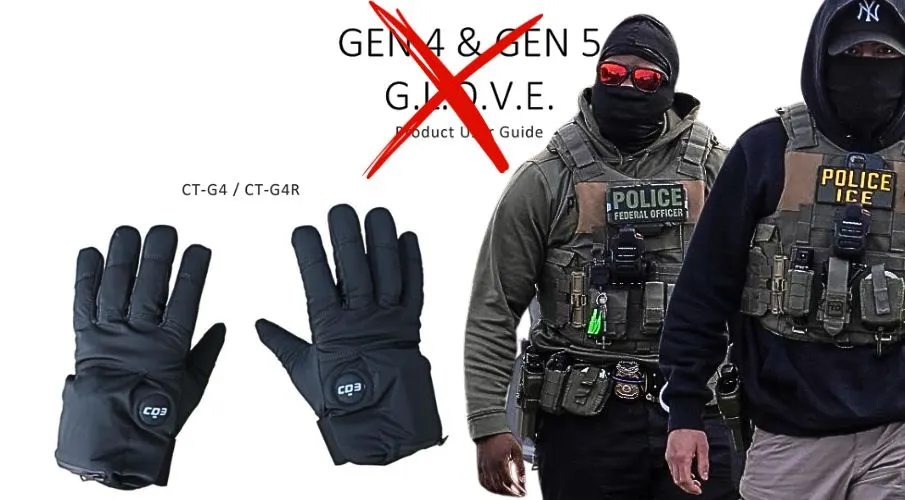
Soon, officers with the U.S. immigration agency ICE could be wearing gloves that deliver painful electric shocks at the push of a button to break people's resistance. According to a notice from the Department of Homeland Security on Monday, ICE wants to spend up to $20 million by March to buy thousands of these devices for its officers. In bureaucratic language, they are called conductive distraction and de-escalation devices, which is already enough to make you sit up and take notice, because a tool that inflicts pain is being declared an instrument of de-escalation. They are known by the acronym G.L.O.V.E., which stands for Generated Low Output Voltage Emitter, and they are made by Compliant Technologies of Lexington, Kentucky. They are already being used in prisons and by some police departments. What would be new is the scale on which a federal agency now wants to roll them out and the speed with which it intends to do so.

At first, they look like ordinary tactical gloves. Only when the officer flips a switch does the electrical mode turn on, and when he then presses the glove directly against the skin, it triggers a painful shock. The pain itself is the means used to force the person to comply with the officer, and, as the manufacturer promises, within just a few seconds. John Peters, who has studied how the device has been used so far for the Institute for the Prevention of In-Custody Deaths, describes the sensation as immediate and sharp, like a bee sting; if someone resists, he says, it is certainly an effective tool. In his assessment, the planned purchase would probably be the manufacturer's biggest order to date, and it is supposed to be awarded without a regular bidding process, with the solicitation possibly appearing as early as Friday.

The new electric-shock glove operates at up to 362 volts and current spikes of 1.2 amps. The pulses last only around 115 microseconds, but that is exactly what the device was designed for: forcing people into compliance through immediate electrical pain. What is especially troubling is that the shock does not come from an openly visible device, but directly from the officer's hand. Holding someone and delivering an electric shock are now separated by nothing more than a switch. Even the manufacturer warns against using the glove on particularly vulnerable people and against using it as a punishment device. A device that needs warnings like that does not belong in the category of what anyone can honestly sell as harmless control.
A French thinker described half a century ago how modern power leaves the scaffold behind and instead quietly acts on the body to make it compliant. That is exactly what this glove does. It needs no big scene and no visible blow, just a button and a touch, and the body obeys. Where punishment was once put on display so everyone could see it, today a grip that almost no one notices is enough. Pain becomes a shortcut that bypasses the other person's will, and the more inconspicuously it can be inflicted, the harder it is to control. A device that only turns into a weapon at the push of a button even blurs the moment when a glove becomes an instrument of power.

Civil rights groups, journalists and lawyers are sounding the alarm. They pointed out that ICE officers are already accused of using force too quickly and facing too little accountability while carrying out Donald Trump's harsher immigration policy. Jenn Rolnick Borchetta of the ACLU doubts that the agency will use the devices with restraint and asks why tools like this are needed at all to enforce civil immigration law. ICE has shown the country over the past year that its officers are too quick to use force; now they could deliver electric shocks with the push of a tiny button that no one else may even notice. Gloves that make it so easy to inflict severe pain during an encounter are a recipe for harm to the public, she warned, especially because people could be hit with them without any warning at all. The objection carries weight, because what is being enforced here is civil law, where people are taken out of their everyday lives, not the restraint of hardened criminals. Someone whose papers are not in order is not an attacker.

The manufacturer itself warns against using the device as punishment. It should not be used against people who are merely verbally defiant or acting aggressively, and not against children, pregnant women, elderly people or people with disabilities. Anyone who provides a list of exceptions like that is also saying how serious the harm could be when things go wrong. Because nothing about a glove stops an agitated officer from using it exactly where the manufacturer says not to, and no one has to be standing there to see it. Peters can easily imagine ICE using the gloves to drag unwilling people out of cars and homes or move them into and out of detention; for smaller and physically weaker officers, including older ones, he sees an advantage because a person can be brought to the ground more quickly and a physical struggle shortened.
Behind the clumsy name lies a quiet normalization. A device that was meant for exceptional situations in prisons is now moving into the hands of officers who break down doors and stop cars. What was a last resort inside a closed facility becomes an everyday tool out on the street, and with every step the threshold at which pain is considered legitimate gets lower.
Supporters insist that the devices are usually used only in prisons and during prisoner transports, not in ordinary street policing; they have been used, for example, to subdue violent suspects who refused to get into a patrol car or prisoners who were hurting themselves. Peters expects a small number of employees to misuse the gloves, as happens with any police technology, but considers serious injuries unlikely; what matters, he says, are clear rules and thorough training. Before the first use, according to the manufacturer, officers would have to complete a course and renew their certification every two years. But a certification renewed every two years changes nothing about the fact that the decisive moment takes place out of sight, in a touch that no video necessarily captures.
The Department of Homeland Security said only on Tuesday that it was working on a response and otherwise remained silent. Jeff Niklaus, founder and CEO of Compliant Technologies, said only that unfortunately he could not comment on the matter. So what remains is an image that speaks for itself. An agency accused of using force too quickly is arming itself with a tool that turns pain into a silent routine. Of course, people will object that it is only a stimulus, a sting, hardly worth mentioning. But the history of violence rarely begins with the big blow, it begins with the small one that people talk themselves into accepting. A shock no one notices demands accountability from no one, and what no one sees, no one has to answer for. A bee sting, the expert says. Except that this sting will soon be decided by a thumb on a switch, and no one asked the person on the receiving end.
Updates – Kaizen News Brief
All current curated daily updates can be found in the Kaizen News Brief.
To the Kaizen News Brief


