
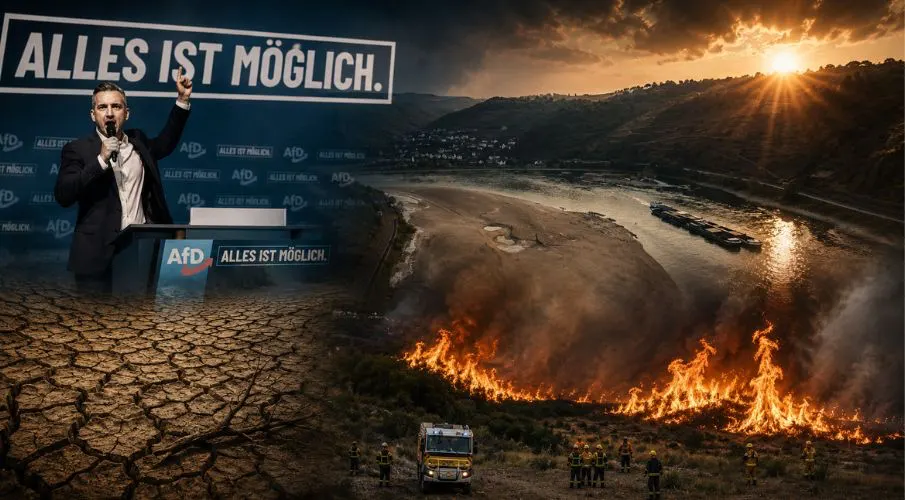
Europe is heading into another heat wave, and this is hardly the first one the continent has faced this summer. Starting Tuesday, France and the UK, among others, are preparing for the fifth wave of the season, and anyone who has followed the past few months already knows what that means. France's national weather service, Météo-France, is warning of temperatures approaching 40 degrees Celsius in southeastern France, an amber heat health alert is in effect across large parts of England, and temperatures are expected to reach as high as 36 degrees Celsius later this week. Since May, unusually persistent heat has been driving temperatures higher across Europe. It has fueled major wildfires and deepened a drought, broken national records, and contributed to thousands of projected deaths. The summer of 2026 reads like the story of a continent that has become too hot for the things people here once took for granted. Anyone living in a European city these weeks knows those nights when the heat simply refuses to let go.

Globally, 2026 so far ranks as the third-hottest year, behind 2024 and 2025, but the year isn't over yet. The combination of accelerating human-caused warming and an unusually powerful El Niño, that recurring warming of parts of the Pacific that throws weather patterns around the globe out of sync, has scientists saying it is possible that 2026 could become the hottest year ever recorded by year's end. The Copernicus Climate Change Service reports that this past July saw the highest average sea surface temperature ever recorded across the extratropical and seasonally ice-free oceans, 20.96 degrees Celsius, above the previous record of 20.89 set in 2023. A warm ocean isn't some abstract number. It is fuel for more severe storms and part of the reason the air above it loses its ability to cool. The average global surface air temperature was 16.90 degrees Celsius, ranking second in the record and tying July 2024. In Western Europe, the June-July average reached 21.62 degrees Celsius, surpassing the previous record set in 2022.
Samantha Burgess, strategic lead for climate at the European Centre for Medium-Range Weather Forecasts, describes the connection without mincing words. Persistent high-pressure systems had trapped heat over Western Europe and intensified the widespread drought; as soils dry out, they lose their cooling effect, allowing heat to build even more easily. It was a clear example, she said, of how global warming intensifies heat extremes, with heat and drought increasingly reinforcing each other. That feedback loop isn't up for negotiation, any more than the physics of overheated oceans can be changed by a party convention resolution.

The repetition itself is the real story behind the individual records. Since May, one heat wave after another has swept across Europe, and now the fifth is approaching. What used to be considered an exception during an especially hot year has become the rhythm of the European summer. Soils are drying out faster than winter can replenish them, and forests are burning earlier than they did in previous decades. The stretches when nights no longer bring relief are getting longer. A single hot July could be dismissed as a quirk of the weather. An entire chain of summers like these is a declaration from physics.
What this means for people can be measured in numbers, and those numbers are merciless. In France, heat wave alerts were issued in May for the first time since records began, with more than half the country reporting new monthly temperature highs. In June, conditions grew even worse, and the country's public health agency counted at least 5,700 deaths above what would normally have been expected during that period. It is rarely the young and healthy who die this way. It is the elderly and the sick, often people living alone in overheated apartments, with no one there in time to bring them water. Météo-France declared June 23 the hottest day ever recorded in France, with temperatures in the southwest climbing to 44.3 degrees Celsius.

Two more heat waves followed in July, along with a historic wildfire in southwestern France that forced 220,000 people from their homes. It was one of the largest evacuations Europe has seen since World War II, and it happened in a wealthy country at the heart of Europe. Scenes long associated with distant crisis zones were suddenly unfolding among French villages whose names few people outside the region had ever heard. What remained were burned forests and people who spent days not knowing whether their homes were still standing.
The UK is going through an equally brutal summer. Half of England and all of Wales are in drought, preliminary data show the driest July since records began in 1836, and 19 English counties went the entire month without rain. The current alert warns of major consequences for health services, including an increase in deaths among older and particularly vulnerable people. Two near-record heat waves in May and June have already resulted in more than 2,800 excess deaths linked to extreme temperatures. On Sunday, an 18-year-old got into difficulty in the sea at Camber Sands beach in southern England and died, the latest among dozens who have died in open water in recent months.
Above the numbers from individual countries stands the European total, and it is staggering. At least 12,000 excess deaths have so far been reported across nine countries for June, and even that number is preliminary. One scientific model estimates 13,975 heat-related deaths for the period from June 15 to June 28, while an analysis by the EuroMOMO network found more than 10,000 during the worst week at the end of June alone. What attribution research adds is crucial, because it doesn't stop at saying that it was hot. For England and Wales, it estimates more than 2,700 heat-related deaths during the May and June heat periods, with 42 percent of the additional heat attributed to human-caused climate change. That means warming is no longer some vague background condition. It has a measurable share in actual graves. Every one of those numbers represents a person who didn't wake up one day in June, and relatives who have had to go on living without them ever since.

Germany, too, has long since stopped experiencing the consequences as some theoretical climate forecast. The Rhine is falling to historic lows, rivers and soils are drying out, groundwater levels are unusually low in many places, cargo ships can carry only reduced loads, and water and animal feed are becoming scarce in agriculture. In Baden-Württemberg, 64 percent of gauges are now reporting extremely low water levels. Along the Rhine, levels are being recorded that fall below even those seen during the record drought of 2018. While Europe is already counting thousands of heat deaths, Germany, too, is showing that the climate crisis isn't something that starts someday. It is already here, just not for the AfD.

Into this picture, into a summer that is killing people, steps a party that declares all of it a fantasy. In April 2026, the AfD parliamentary group in the Bundestag called for an end to all German climate protection measures. It wants every law and regulation requiring climate protection abolished; it wants Germany to withdraw from international climate agreements, explicitly including the Paris Agreement, and it wants carbon pricing ended. It is all there in the Bundestag's own records.
In May, the rhetoric became even more explicit. During a Current Affairs Debate requested by the AfD, its lawmakers described existing climate policy as the result of what they called the greatest fraud in human history, while in the Hamburg Parliament the party claimed that science had called off the climate apocalypse. The AfD's own material says that human-caused warming has not been scientifically proven. It has been, and about as conclusively as science can establish anything. That statement puts itself directly against the established body of scientific knowledge, and it does so at the very moment the dead are being counted.
The demanded withdrawal from the Paris Agreement carries particular weight
It would remove Germany from a framework that explicitly connects climate protection with human rights, and it would do so precisely at a time when the United Nations has formally established that connection. The phrase "greatest fraud in human history" isn't being thrown around casually. It is an attempt to discredit an entire body of knowledge with a single word so that the obligation flowing from that knowledge disappears with it. Anyone who talks this way stretches the boundaries of what can be said in a parliament, and does so deliberately.

The figures come from Nowcast EU, an independent project that combines polling from various institutes into rolling averages and election projections. Nowcast EU does not conduct its own voter surveys. No party-political affiliation of the project is apparent. The figures shown should therefore not be understood as the result of a single poll, but as a current polling average calculated from multiple surveys.
A German philosopher once drew from the vulnerability of nature a command that could hardly be simpler, yet demands everything: act in such a way that genuine human life can continue to exist on Earth. He made fear an honest adviser because only fear allows us to grasp the magnitude of what lies within our power to destroy. The responsibility he described reaches beyond our own time, into a future that cannot defend itself and has no voice in today's parliament. That is precisely the responsibility the AfD is walking away from. Anyone who declares the danger imaginary doesn't have to prevent it, and anyone who calls it a fraud can spare himself every obligation that follows from it. That is the real convenience of denial: it absolves the denier of everything that would otherwise have to follow.
Because protecting the climate has long since become more than a matter of political taste. In 2022, the United Nations General Assembly recognized the right to a clean, healthy and sustainable environment as a human right and directly linked climate protection to the realization of human rights. In Germany, the legal situation is even clearer. In 2021, the Federal Constitutional Court ruled that Article 20a of the Basic Law obligates the state to protect the climate. From the fundamental right to life and physical integrity under Article 2(2), it also derived a state duty to protect people from the dangers of climate change, explicitly including heat waves, wildfires, heavy rainfall and other extreme events. The Court also tied that obligation to the freedom of those who come after us and prohibited shifting the burdens of climate protection one-sidedly onto future generations. What the AfD wants to tear down is an obligation of the state, not some fantasy invented by its opponents.
Does that change the criminal-law question? It sharpens it. The dispute is no longer merely an academic argument over models and curves, because this is about foreseeable threats to life and physical integrity and about people who have already died. And yet criminal law demands more than outrage. Simply denying human-caused climate change doesn't become a crime because 12,000 people have died, nor does the political demand to dismantle protections. As unbearable as that may sound, precision matters here, because only precision can survive when the issue ultimately reaches a courtroom.

We Are Prepared If the Day Ever Comes
And yet criminal law demands more than outrage over one temperature record after another, droughts and thousands of heat deaths. That is exactly why the legal question is worth asking today, before political announcements one day turn into government action. The most obvious thought initially leads to failure to render assistance under Section 323c of the German Criminal Code, but Section 13, commission by omission, is legally far more interesting. Under that provision, criminal responsibility can also arise when someone fails to prevent an outcome even though they are legally obligated to ensure that the outcome does not occur. The decisive issue would be what German law calls a Garantenstellung, a specific legal duty to act. And this is where the real question begins, because the state's obligation to protect people from the consequences of climate change is anything but a political invention.
The Federal Constitutional Court explicitly stated
"The duty of protection arising from Article 2(2), first sentence, of the Basic Law also encompasses the obligation of the state to protect life and health against the risks posed by climate change." In addition, Article 20a of the Basic Law obligates the state to protect the natural foundations of life. The Federal Constitutional Court also stated that, under the Constitution, lawmakers may not simply stand by and allow climate change to continue unchecked. The state's duty to protect therefore exists. What remains open is the legally fascinating criminal-law question of when that duty could create a personal legal obligation to act for individual officeholders under Section 13 of the Criminal Code. If political decision-makers demonstrably know that climate change is putting human lives at risk, if people are actually dying from the effects of extreme heat, and those responsible simultaneously and deliberately eliminate or prevent effective protective measures, then at some point the issue is no longer exclusively one of constitutional responsibility, but also one of potential criminal responsibility through omission. That would require examining an individually attributable act or omission, an applicable criminal offense, intent or the required degree of negligence, and a demonstrable connection between the conduct and a specific injury or death. Particularly decisive would be the individual officeholder's personal legal duty to act and whether the omitted measure would have prevented the harm that occurred. The AfD currently holds no mandate to govern at the federal level.
Its campaigning against climate protection measures, its demands to abolish existing regulations, or its denial of scientific findings therefore do not, by themselves, create a personal legal duty to act for its politicians under Section 13 of the Criminal Code. But that situation could look fundamentally different if those demands one day became actual government policy. Ministers and other specific officeholders would then possess state decision-making authority, and what had previously been a political demand could become the actual repeal, obstruction or omission of protective measures. If officials, despite demonstrable knowledge of concrete dangers to life and health, deliberately rolled back or failed to take appropriate protective measures, it would have to be examined whether the constitutional duty to protect could also give rise to individual criminal responsibility.
That is exactly the situation we are prepared for: not by claiming that such criminal liability has already been established today, but with the decisive legal foundations, the documented scientific evidence, and the question that could no longer simply be argued away if actual government responsibility ever comes into play - how far does the personal criminal responsibility of an officeholder extend when announced refusal becomes state inaction and human life and health are knowingly put at risk?
The situation is different once state decision-makers enter the picture, see a scientifically established threat to life that they know about, and still deliberately eliminate or prevent protective measures. Then things get serious. The duties to protect under Article 2(2) and Article 20a, the case law of the Federal Constitutional Court and the European Court of Human Rights would have to be examined, followed separately and carefully by the possible points of criminal liability. The 12,000 dead, and depending on the calculation by now considerably more, necessarily belong in such an examination. They do not solve the problem of legal causation by themselves, but they make the question impossible to ignore. Anyone who wants to abolish these protections today should know that these numbers will not be forgotten.
So what are we supposed to make of a party that, in the very summer when heat is killing people, wants to abolish the protections against that heat? It has decided to declare reality a fraud because reality stands in its way. That is the most dangerous turn a political party can take, because anyone who treats facts as negotiable eventually treats the people those facts are supposed to protect as negotiable too. Today it is the climate whose danger it denies; the question is what established reality it will call a scam tomorrow. In the end, the price for this convenience is paid by elderly people in overheated apartments and sick people with no lobby, not by lawmakers sitting in air-conditioned chambers. A party like this has itself become a danger, and people need to be warned about it, in all sobriety.

For weeks, part of our team has been working on this party, and in the coming days our photo documentation begins in eastern Germany. What already stands out is the inertia of many politicians from other parties, from the left all the way to the center, and our investigation will tell stories about it that nobody has told before. We can already identify one reason for the advance of an ideology from hell. A party like this grows less through its own strength than through the space others surrender to it without a fight. Its rise doesn't need great minds. All it needs is inertia, a bratwurst, and the unreliability of those who could stop it while giving grand speeches. Where responsibility hesitates, the vacuum fills itself.
As the AfD grows stronger and stronger, its opponents seem remarkably busy congratulating themselves on their own successes. They warn about the shift to the right, explain their platforms and reassure one another that they're on the right side. Only one thing visibly happens far too rarely: changing politics in a way that wins back the people who stopped listening long ago. When a party classified in parts as right-wing extremist is now heading toward 40 percent in eastern German states, this is no longer just a story about the AfD's strength. It is equally a story about the failure of its political opponents to stop that rise through convincing action.

The questions remain that no satisfaction with politics can answer, but that we owe the ballot box: What do we owe those who come after us and have no voice today? A party that wanted to tear down protection from the heat in April 2026 and called science the greatest fraud in human history in May has already given its answer. It owes the future nothing because it considers the future an invention. Anyone who lets that happen and stays silent becomes part of that answer, because indifference here is the silent consent of those who watch as protections fall and graves fill up. The 5,700 dead from France's June and the 12,000 from a single European month can no longer object; the living have to make that objection for them, in every sentence recorded before it can be denied. The next heat arrives Tuesday. A democracy that closes its eyes to its own dead has stopped defending itself, and what does not defend itself will eventually be taken.
Updates – Kaizen News Brief
All current curated daily updates can be found in the Kaizen News Brief.
To the Kaizen News Brief


„Es gab früher schon heiße Sommer“ – Sarkasmus.
Mit diesem einen Satz tritt die AfD Wählerschaft dem Klimawandel entgegen.
Das kommt gleich hinter „früher war alles besser“.
Wissenschaftsfeindlich, Leugnen von Tatsachen, Verschwörungstheorien rund um Impfungen,Remigration und komplett rückwärtsgewandt.
Das ist das ganze Wahlprogramm der AfD in Kurzform.
Ganz nach ihrem Vorbild Trump.
Wer AfD wählt, wählt den Untergang.
Aber die anderen Parteien bieten leider auch nicht viel.
Wer ist dann von denen, für einen selber, das kleinere Übel?
Vom Volkswillen haben sie sich alle um Lichtjahre entfernt