
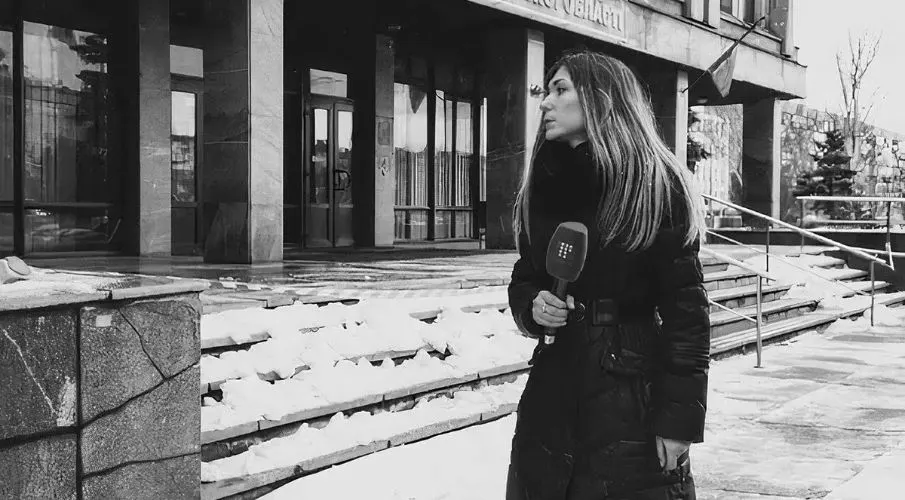
Russian authorities took nearly five months to enter a medical explanation for the death of Ukrainian journalist Viktoria Roshchyna into their records. The 27-year-old had died in Russian captivity. When her body was returned to Ukraine, her eyeballs and brain were missing. Ukrainian forensic experts discovered a fracture at the back of her skull, a broken rib, and injuries indicating severe abuse. The Russian death registry eventually listed a disease of the heart muscle. Officials had even changed her date of death beforehand. Paper will put up with anything, even when the body has long since told a different story.

Excerpt from hacked data belonging to Russia's federal statistics agency, Rosstat. The original record lists December 16, 2024, as Viktoria Roshchyna's date of death and an unknown cause of death. Russian authorities later changed both the date of death and the medical explanation for her death.
Viktoria investigated abductions in Russian-occupied parts of Ukraine. Her disappearance became known in August 2023. Russian security forces initially held her captive in occupied Melitopol. Ukrainian investigators documented cuts inflicted on her there. The journalist later ended up in Russian captivity again. In 2024, she was held at the notorious Pretrial Detention Center No. 2 in Taganrog, where Ukrainian prisoners were systematically abused.

Enlarged excerpt from the Russian death record. The entry "2024-12-16" is the originally recorded date of death. Under diagnostic code R99, the Russian text reads "Unknown cause of death." Only months later did Russian records replace that explanation with a disease of the heart muscle.
Former fellow prisoners described a woman who kept losing weight until she could barely move. Her condition was already life-threatening when she was transferred to Pretrial Detention Center No. 3 in Kizel, in Russia's Perm region, in September 2024. The violence continued there. According to the Ukrainian police investigation, Roshchyna was beaten on September 12. Afterward, she could no longer stand up on her own. She repeatedly lost consciousness. Seven days later, she was dead.

Investigators even identified the cell where Roshchyna spent her final days. On September 19, 2024, the other prisoners were removed from it. The room was cleaned afterward. A Ukrainian soldier who had been released from captivity and had been transferred to Kizel alongside the journalist confirmed that she died in that prison.
What happened next inside Russian government offices can now be reconstructed using hacked records from the federal statistics agency Rosstat. Rosstat confirmed the cyberattack but denied that any information had been leaked. Yet the data contained seven saved versions of Roshchyna's death record and two drafts. The first entry dates back to late December 2024. December 16 was listed as the date of death, while the cause remained unknown. Even so, the medical death certificate had already been issued as final. A few days later, the civil registry office in Perm corrected the date of death to September 19, 2024. According to that date, Roshchyna had died six days before a prisoner exchange in which she was supposed to have been included.
What happened next inside Russian government offices can now be reconstructed using hacked records from the federal statistics agency Rosstat. Rosstat confirmed the cyberattack but denied that any information had been leaked. Yet the data contained seven saved versions of Roshchyna's death record and two drafts. The first entry dates back to late December 2024. December 16 was listed as the date of death, while the cause remained unknown. Even so, the medical death certificate had already been issued as final. A few days later, the civil registry office in Perm corrected the date of death to September 19, 2024. According to that date, Roshchyna had died six days before a prisoner exchange in which she was supposed to have been included.
Russia returned her remains in a bag labeled "unidentified male." Her body was severely emaciated. According to information from the Ukrainian investigation, parts of her larynx were missing along with her eyeballs and brain. A forensic expert involved in the case considered it possible that removing those organs was intended to conceal evidence of suffocation or other forms of violence.

Workers in protective suits unload bags containing human remains from a refrigerated truck. In February 2025, Ukraine received the bodies of prisoners who had been killed. Among them was journalist Viktoria Roshchyna, whose body showed signs of severe abuse and was missing several organs.
The Ukrainian Prosecutor General's Office also reported evidence of torture involving electric shocks. Roshchyna had been beaten repeatedly. She had been humiliated and threatened. She had also been denied medical care, as well as adequate food and drinking water. Investigators consider her death an intentional killing resulting from severe abuse. A definitive medical determination of the immediate cause of death has not yet been possible. Russian Foreign Ministry spokesperson Maria Zakharova refused to provide information about where or under what circumstances she died.
The Russian registration itself is also striking. The record lists Perm as the place of death, even though Ukrainian investigators place her death in Kizel. No exact address is provided. Information about her citizenship and other personal details was also omitted. Similar entries appear for other Ukrainians who died in Russian captivity.

The 74-year-old Alexander Markov, from Ukraine's Zaporizhzhia region, had been sentenced to 14 years in prison for transferring 15,500 hryvnias to a foreign bank account allegedly used by Ukrainian intelligence services. He died while being transported between detention facilities. His Russian death record lists a heart attack followed by a rupture of the heart.

The Southern District Military Court in Rostov-on-Don. This is where 71-year-old Ukrainian Viktor Demchenko stood trial on charges of espionage, participation in a terrorist organization, and illegal possession of weapons. He died in Russian custody before a verdict was reached. The case was closed after his death.
For 71-year-old Viktor Demchenko, who had been accused of espionage and involvement in a terrorist organization, the registry lists a rupture of the abdominal aorta. Russian investigators had previously reported a stroke. Demchenko died in February 2024 in a prison hospital.

Alexander Ishchenko, a former driver for Ukraine's Azov Regiment, during court proceedings in Rostov-on-Don. The 55-year-old died on July 22, 2024, in Russian pretrial detention. No definitive cause of death was established because of advanced decomposition. Even two years later, no final death certificate had been issued to replace the preliminary one. Ukrainian forensic experts identified severe chest injuries and multiple broken ribs as a possible cause of death.

Russian authorities documented the death of Polish citizen Krzysztof Galos in a similar way. Russian soldiers detained him in occupied Ukrainian territory in 2023 and took him to Taganrog. Former fellow prisoners reported severe beatings. Galos died in the summer of 2023. Russia did not confirm his death to Poland until almost three years later. The recorded cause: a disease of the heart muscle.

No death record could be found, however, for Yevhen Matvieiev, the mayor of Dniprorudne. Russian soldiers abducted him in March 2022 when he tried to help miners who had been detained at a checkpoint. He was taken to Kizel in September 2024. Former prisoners reported that he had been severely beaten upon arrival. Two days later, on September 7, he died. Ukrainian forensic experts found multiple broken ribs and severe lung injuries. Investigators classified his death as a homicide. Whether his death record is missing from the Russian registry itself or only from the leaked data remains unclear.
The United Nations documented systematic torture of Ukrainian civilian prisoners. Many were held without formal charges, and their families often did not even know where they were being kept. A UN special rapporteur cited 438 Ukrainian prisoners who had died in Russian custody as of November 2026. The bodies of 375 were returned. The International Committee of the Red Cross confirmed the captivity of 146 people, while the status of another 229 was confirmed through other sources. Autopsies had established torture and denial of medical treatment as causes of death.

Viktoria Roshchyna was severely abused in Russian captivity. Her body showed signs of torture when Russia finally returned it. Parts of her internal organs were missing. While Ukrainian investigators examine the circumstances of her killing, Russian records list a heart condition. Seven versions of a death record, two drafts, and a date of death changed after the fact document just how much attention the authorities devoted to recording her death. They offered no explanation for her broken bones or the severe abuse she endured.

On paper, there is an illness and a death. The evidence of torture was on the body Russia returned. Trump calls Putin a friend. Well, now we know who we shouldn't be calling a friend. Dann wissen wir ja, wen wir alles nicht Freund nennen sollten
Updates – Kaizen News Brief
Alle aktuellen ausgesuchten Tagesmeldungen findet ihr in den Kaizen Kurznachrichten.
To the Kaizen News Brief In English


Mir dreht sich der Magen um.
Für mich ist nicht nachvollziehbar wie Menschen jemanden foltern können.
Sind das keine gefühllose Maschinen?
… mit Worten ist es nicht zu beschreiben ….
Russlands Gefängnisse sind die Hölle. Ohne Kontrolle ohne große Informationen nach außen.
Es wird alles so gedreht, wie man es braucht.
Kritiker, Kriegsgefangene… sie sterben auf „wundersame Weise“ Alle eines natürlichen Todes 😢
Wenn man es so dreht… Folter, Unternährung, mangelnde medizinische Versorgung führen irgendwann zu Herzversagen.
Jeder Mediziner und Mensch mit klarem Verstand weiß, dass das nur die Folge, nicht die Ursache war.
Die anderen Länder schauen weg.
Keine Zeile dazu in den Medien.
Und Trump lobt Putin weiter. 🤮
Ich sage nur „wer solche Freunde hat, braucht keine Feinde“