
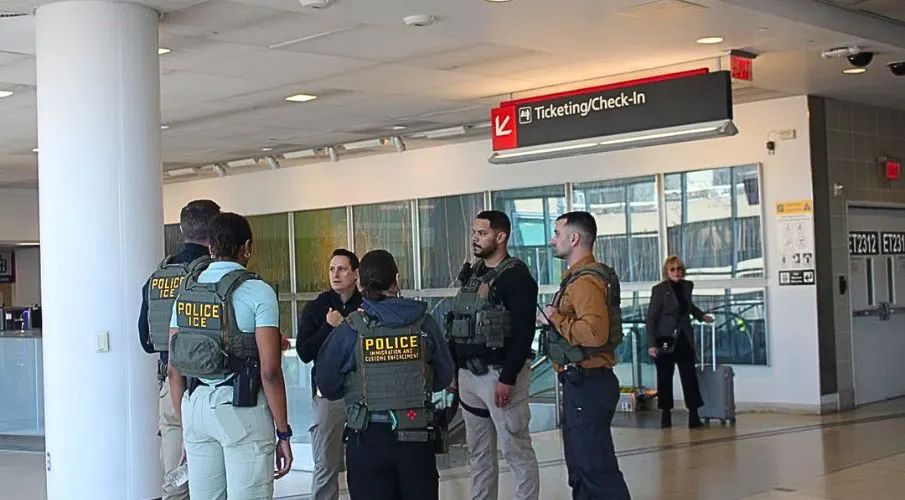
At the gate for a flight to Orlando on July 25, a Homeland Security investigator calls out a first name into the crowd, David, as passengers scan their boarding passes. He is looking for a specific traveler and wants to board the Southwest flight. In his possession is an ICE administrative warrant signed by one of the agency's supervisors. The gate agent refuses to let him through, not without a warrant signed by a judge. Airline employees do not reveal anything on their computer screens and provide no information about the passengers. When an officer conducting the investigation asks for the name of an employee, he is denied that as well. That is what internal documents show, according to reporting.
The incident in Dallas was not an isolated case. At Southwest alone, there were at least six similar scenes within just a few weeks. Throughout the past year, ICE made only occasional arrests at airports. Now the pace has accelerated. Agents are making arrests at gates and check in counters, at airports from San Francisco to Miami, including Kansas City. Last month alone, according to a government official, there were between 12 and 36 arrests a day. Agency leadership instructed its officers to make arrests at security checkpoints whenever possible, but not everyone in the field is following that directive.

Many of those being arrested would not have been agency targets in the past. ICE once focused primarily on people with final removal orders. Now it is arresting people whose visas have expired while another immigration status remains pending, such as a Green Card or an asylum application. People waiting on those decisions are generally allowed to continue working and are protected from deportation. ICE nevertheless considers the expired visa sufficient grounds for arrest. The pressure comes from the White House, which has demanded roughly 2,000 arrests a day. At the same time, these operations are moving into public view. Travelers are recording them on their phones, and airlines and their employees are increasingly caught in situations that can quickly become dangerous.
Between those two documents lies the entire difference. An administrative warrant carries the signature of a supervisor from the very agency that wants to make the arrest. A judicial warrant carries the signature of a court that stands outside that agency. Anyone presenting only the first is demanding compliance with an authority that grants permission to itself. The gate agent who insists on the signature of a judge is holding on to the old idea that power must be validated by something other than itself. That small act of refusal contains more respect for the rule of law than many speeches about it.
What that looks like in everyday life is captured on video. In Denver, agents escorted a woman off the jet bridge leading to a Southwest flight. The incident was caught on camera and drew widespread attention. The woman was Chantal Morales Rojas, who was on her way back to Oakland. Her attorney says she had been living and working legally with authorization from the U.S. government. In Las Vegas, agents arrested a woman last week while she was waiting for her JetBlue flight, saying she had overstayed her visa and was subject to a final order of removal. At an airport in the South, ICE asked another airline in July for assistance in arresting a father on the jet bridge who was traveling with his wife and children. The airline refused, and in the end the family never showed up for the flight at all.

The airlines are pushing back. Southwest says it follows the law and only releases customer information after agents present the proper legal documents. JetBlue says it does not collect customers' immigration status and does not report anyone to the government. Airlines for America, the industry's trade association, says it is holding constructive discussions with ICE and the Transportation Security Administration so that the safety of everyone at the airport remains the top priority during enforcement operations. The airlines want to know whether arrests can legally be made based solely on an administrative warrant and whether agents will stay off the aircraft themselves. They also say they would prefer arrests to take place at security checkpoints. At the end of July, airline representatives discussed those issues with the Department of Homeland Security.
Until recently, Denver International Airport CEO Phil Washington said he was concerned about escalation and the risk to innocent bystanders. Meanwhile, technology is quietly doing its work in the background. ICE and the Transportation Security Administration are both part of the Department of Homeland Security, and TSA provides ICE with passenger manifests so agents can search them for potential targets. Since last summer, that cooperation has reportedly led to hundreds of arrests. Every airline reservation has become another line of information that someone searches for names. Back in March, the Association of Flight Attendants warned in a letter signed by its president, Sara Nelson, that there were serious concerns about workplace safety and legal protections. In Minneapolis, according to the letter, an officer boarded an aircraft to threaten a passenger with deportation after the passenger criticized the agency's presence. The department responded only that it was enforcing existing laws and regulations, according to spokeswoman Lauren Bis. It did not address the letter itself.
An airport is a place of transition, built so people can pass through it and continue on their way. Now an agency searches passenger manifests for names, and the gate where people wait to travel becomes the place where the journey ends. The employee at the counter who asks for the signature of a judge keeps open, if only for a moment, the line beyond which government power is not enough on its own. It is a fragile protection: one missing signature, one computer screen that remains hidden. That is where it is decided whether a traveler is still a passenger or has already become a case. Whether that will be enough remains to be seen.
Updates – Kaizen News Brief
All current curated daily updates can be found in the Kaizen News Brief.
To the Kaizen News Brief


Ein Flughafen ist ein sensibler Bereich.
Waffen sind nur im Ausnahmefall gestattet.
Masken verboten.
Ein Zugriff im Wartebereich, beim Einstieg am Gate sind für ICE sicher und einfach.
Niemand hat Waffen, Niemand kann einfach weg rennen.
TSA arbeitet zu, ICE greift zu.
Ein Dank an Southwestairlines jnd auch Jet Blue.
Weißt Du, wie es andere Airlines handhaben?
Wie z.B. Delta,die ja gut an Abschiebeflügen verdienen.
Alaska Airlines hat letztens eine evangelikale Frau aus dem Flugzeug verbannt, als sie anfing laut ihren Ansichten zu beten.
Auf dem Flughafen tat sie es auch. Da schritt Niemand ein, obwohl sie sehr laut war und es zu Unruhe kam.
Ein hoch auf Akaska Airlines, die sie auf ihre No-fly Liste gesetzt hat.
Auf jeden Fall ist es an der Zeit für eine Reisewarnung.
Was Menschen nit Greencard passiert, kann auch Personen im Visa Waiver passieren, die das Visum nicht überzogen haben.
Insbesondere, wenn sie einige Inlandsflüge haben.