
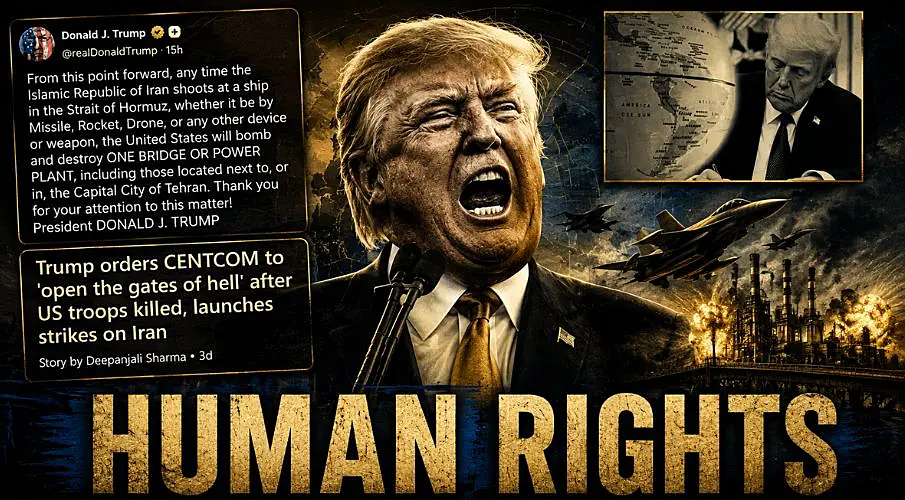
On Wednesday morning, the President of the United States put a price on war. From this point forward, he wrote on his platform, every single time the Islamic Republic of Iran fires at a ship in the Strait of Hormuz, whether with a missile, a drone, or any other device, the United States will bomb and destroy ONE BRIDGE OR ONE POWER PLANT, including those near or inside the capital, Tehran. The capital letters are his.

Take a close look at what was published here, and at what has already happened before. This is no ordinary threat. It is a rate sheet. One ship equals one bridge. The president has publicly established an exchange rate between a military incident and the destruction of civilian infrastructure, and he made it simple enough for everyone to understand. Whoever blows up a bridge that people use to get to work, or a power plant that keeps hospitals running, is not striking the government in Tehran. He is striking elderly people trapped in elevators, premature babies in incubators, dialysis patients connected to machines. That is now the value of one ship.
Under international law, the deliberate targeting of civilians and civilian infrastructure is a war crime. It does not matter whether Iran may itself commit such crimes by attacking civilian ships. One state's conduct does not release another state from its legal obligations. Anyone who abandons that principle has not merely violated the laws of war. They have abandoned them as a foundation altogether, for everyone.
The announcement itself is not new, only more precise. On April 5, Trump announced that Tuesday would become Power Plant Day and Bridge Day in Iran. Two days later, he wrote that an entire civilization would die that night and never return. This week he promised that every time Iran kills an American soldier, it will pay many times over. Multiplying retaliation is not just a figure of speech. It is the violation itself, because international humanitarian law requires proportionality and forbids exactly what is being promised here.

It does not stop with words. The administration has already struck civilian infrastructure during several waves of attacks, including water facilities. In the opening days of the war, an elementary school in Minab was bombed. One hundred sixty-eight people were killed. The investigation has been completed. It has never been released. That means the investigation was conducted, the findings exist, and they have been kept from the public. There are forms of silence that speak louder than any admission ever could. We spent weeks inside Iran ourselves, carrying out extensive investigations and documenting what we found, some of which we have already published in ourIran Warseries. We will now use that material as well.
Whoever destroys a power plant does not kill immediately, and that is precisely what makes it so convenient. The victims of a blackout never appear in a single statistic. They die weeks later, in hospitals without cooling, from water that no longer reaches them because the pumps have stopped, from medication that can no longer be stored. It is killing by delay, stretched over months and scattered across so many different causes that, in the end, no single one can be identified. That is exactly why civilian infrastructure enjoys special protection under international law, and exactly why destroying it as retaliation is what it is - punishment inflicted on people who made none of the decisions. A president who measures bridges and power plants against ships knows that. He has simply declared it acceptable.
Alongside the violation of international law comes the violation of American law. The U.S. Constitution gives Congress alone the authority to declare war, and the War Powers Resolution of 1973 places strict time limits on a president's use of military force. This administration is ignoring those limits. A president who treats neither international law nor his own country's laws as binding is not waging war on behalf of his nation. He is waging his own.

How things reached this point was less than five weeks ago. Last month, both sides signed a declaration of intent that Trump celebrated at the time as a complete success, saying they had achieved everything they had set out to accomplish, and much more. That agreement has since collapsed, and the war has escalated every single day. That makes Trump's latest announcement fit perfectly. He now says he intends to bomb Kolang Mountain, known in the West as Pickaxe Mountain, where the United States and Israel believe nuclear material is being stored. He said the area will probably be struck very soon, and that there is absolutely nothing Iran can do about it.
One more word about the structure of this announcement. By fixing a predetermined price for retaliation, the president removes any need to weigh the facts. Once a fixed tariff exists, no one has to ask whether a target is military, whether the damage is proportionate, or whether there is a less destructive alternative. The automatic response replaces human judgment, and that is not an oversight. It is the entire purpose. Whoever publicly announces in advance exactly what they will do never has to explain afterward why they did it. At the same time, he shifts responsibility onto his opponent. Under this logic, Tehran decides whether Tehran loses its electricity. It is the oldest justification ever used by a hostage taker, and it does not become any better when a government uses it.

At this point, our role as observers comes to an end. Anyone who has spent weeks documenting how a head of state publicly announces the destruction of civilian infrastructure, and who can demonstrate that those announcements are followed by action, can no longer hide behind the excuse that they merely reported it. We will therefore initiate a second legal review.
The first has been pending since January 10, 2026. It concerns the military operation carried out by the United States on the territory of the Bolivarian Republic of Venezuela on January 3 and 4, during which armed units attacked government and military facilities, breached state control structures, and accepted armed confrontations in populated areas, resulting in civilian deaths and extensive property damage. Nicolás Maduro and Cilia Flores were taken into custody during that operation. Our submission was filed as a communication under Article 15 of the Rome Statute with the Office of the Prosecutor in The Hague, while at the same time being submitted as a petition to the Inter-American Commission on Human Rights in Washington, with a copy provided to the Inter-American Court of Human Rights in San José, Costa Rica. The submission does not ask for a political judgment of any government. It asks only whether the prohibition on the use of force under the UN Charter, international humanitarian law, and international human rights law were violated during those two days in January. The Iran case would become the second proceeding of the same kind, filed by the same party and judged by the same legal standard.

Read also our article: Why We Are Having the US Military Operation Reviewed by International Bodies
The procedural status will be updated regularly. The request for preliminary examination is available as a PDF in a German version and in the English original.
The road ahead is straightforward, but it is long, and we say both because no one benefits from false expectations. As a non-state actor, we cannot file a direct case. What we can do is submit a communication under Article 15 of the Rome Statute to the International Criminal Court in The Hague. The Office of the Prosecutor then examines whether there are sufficient grounds for a preliminary examination or further investigative steps. Because the United States has not ratified the Rome Statute, the Court's legal options regarding Washington are limited. We know that. Even so, findings, legal assessments, or procedural documents generated during such proceedings may later serve as evidence and as a legal foundation in other international proceedings. That is precisely where their value lies.
The second step is to file a petition with the Inter-American Commission on Human Rights in Washington. The Commission conducts its own independent assessment of whether human rights violations have occurred, carries out investigations where appropriate, and publishes reports along with recommendations. It is not bound by the assessment of the International Criminal Court, although it may take the Court's findings into account. If the Commission concludes that human rights have been violated, that does not automatically create a legal claim before an American court. Its findings can, however, later be presented before U.S. courts as significant evidence grounded in international law and human rights law. The international process therefore creates the foundation for possible legal remedies at the national level. It does not replace them.
Preparing the submission will take us approximately 30 to 60 days because we are writing it ourselves. The proceedings that follow will take years, and in the end there may never be a conviction. Anyone who turns to the law expecting quick satisfaction will leave disappointed.
So why do it at all? Because the strength of the law does not begin with a judgment. It begins with the claim that comes before it. A crime that nobody names disappears into history as though it never happened. A crime that becomes part of an official record does not stop existing simply because a court lacks jurisdiction today. It waits. It waits for another jurisdiction, another government, another country that may one day stop protecting the accused. The case file outlives the president. It outlives his administration. It outlives the convenience of those who choose to look away today.
That is the difference between a report and a legal submission. A report is written for the public and is old by the next morning. A legal submission is addressed to an institution and remains there until someone opens the file. We do not know when that day will come. We know only that a statement like the one issued on Wednesday morning belongs in an official record, complete with its date, wording, and author.
Remarkable is who has chosen not to pursue this path.
To this day, not a single country has initiated proceedings over the American military operations in Iran, neither before the International Court of Justice nor before the International Criminal Court.
And yet this is precisely the path that is reserved for states alone, because only sovereign states can bring a case before the International Court of Justice. There are 193 member states of the United Nations. Not one of them has considered it necessary. We all know the explanations that are offered - concern for alliances, concern over trade relations, the belief that such proceedings would ultimately fail. Those arguments may sound pragmatic. But pragmatism in this case means allowing the rule itself to go unused, and a rule that no one invokes loses a little more of its authority every single day. That is the real tragedy of this year. The new reality is not that international law is being violated. The new reality is how naturally everyone has stopped reaching for it.
That leaves Europe with an uncomfortable question. So far, not a single European government has openly called the announced destruction of power plants and bridges in a city of millions by what it is. We know the outrage these same words would provoke if they came from Moscow. Coming from Washington, they somehow seem to carry a different temperature. International law, however, recognizes no exceptions for allies or favored nations. Anyone who applies it only against their adversaries eventually turns it into a weapon that one day will lose its edge.
The president has published an exchange rate. One ship. One bridge. We will make sure that exchange rate becomes part of a case file that no one will ever be able to erase.
Updates – Kaizen News Brief
All current curated daily updates can be found in the Kaizen News Brief.
To the Kaizen News Brief In English


Danke, ihr zeigt Rückgrat und Verantwortung gegenüber Menschen.
Regierungen machen nichts weil sie die Wirtschaft nicht schädigen wollen, soll heissen man will Donorange nicht verärgern.
Es ist einfach traurig.
Danke, trotzdem wie viele meinen es geht sie nichts an, bezeichnend ist das nur noch …
Es ist unfassbar wie unterwürfig die Staaten gegenüber den USA sind.
Genau deswegen macht Trump weiter.
Keiner schreit auf, keiner versucht überhaupt etwas zu unternehmen.
Weil Donfather Donny den Atomkoffer hat und Keiner jahrzehntelange Handelsbeziehungen und Lobbyarbeit riskieren will.
Und das Rusiko eingehen, obwohl die USA den IStgH gar nicht anerkannt haben?
Ermittler und Richter sogar mit drastischen Sanktionen belegt haben.
Keiner will in den Fokus geraten und womöglich von Kreditkarten, PayPal, Amazon etc abgeschnitten zu werden.
Also schweigt man. Duckt sich weg und hofiert Trump auch noch.
Russland hat den IStGh auch nicht anerkannt.
Kann aber keine wirksamen Sanktionen gegen Mitglieder verhängen.
Da liegt der Unterschied.
Russland hat zwar auch den Atomkoffer, aber die USA haben eine jahrzehntelang aufgebaute wirtschaftliche Macht.
Leider ist der IStGh heute bicht mehr das, was er vor 30 Jahren war.
Heute reisen Staatsmänner Wie Putin in Länder, die sich dem IStGh angeschlossen haben. Werden mit Pomp empfangen und nicht verhaftet.
Immer mehr Länder treten aus dem IStGh aus.
Die Konsequenzen aus ejnem Verfahren werden immergeringer und werden, wenn es weiter so geht, bald ganz verschwunden sein.
Staatengemeinschaften funktionieren nyr, wenn man (alle) sich an die Regeln halten.
Mit Trumps 2. Amtszeit ist das alles passé.
…ja schweigen ist der neue schlachtruf 2026