
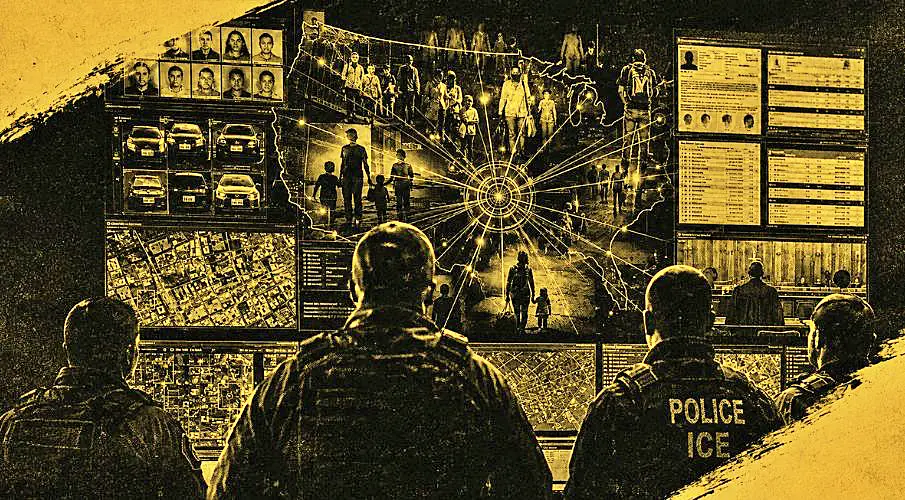
Ten thousand people in five days. At first glance, it sounds like a massive law enforcement effort, the result of relentless investigations, agents breaking down doors from dawn to dusk and tracking down fugitives one by one. But that image is precisely what obscures what actually happened. ICE did not find these ten thousand people out of nowhere. The government already had the map.
This is the point that the narrative of mass deportation carefully conceals. The public is shown what appears to be a narrowly targeted operation, a series of focused arrests against a limited number of individuals. The machinery behind it reveals something much broader. A large share of these people had long been visible to the government because the system itself required them to be visible. Addresses, court appearances, reporting requirements, employment records, vehicle registrations, all the local systems their lives had already touched. Once the White House pushed ICE to increase arrest numbers, that visibility became a dragnet.
No country has ever been destroyed by its immigrants.
Countries have always been destroyed by those who claimed they were saving them from immigrants.
According to our reporting, ICE arrested ten thousand people over a five day period in late June, an average of roughly two thousand per day, marking a sharp acceleration of Trump's deportation campaign. The White House had demanded an increase in detentions and instructed ICE officers to carry out at least two thousand arrests each day. That number does not prove diligence. It proves capacity. ICE was able to move this quickly because the registries, information channels, and data trails were already in place. Mass detention at this pace does not happen because agents start from zero and track down thousands of people one by one. It happens because the government already possesses systems that locate, classify, and expose people. Court calendars, ICE reporting appointments, transfers from local jails, vehicle registration records, employment records, address histories, law enforcement databases, and data sharing networks, all of these can transform a person's ordinary presence in government systems into the starting point for an arrest.

The mechanism lies precisely here, and it can be described in a single chain. Visibility becomes data, data becomes location, location meets a quota, and the quota becomes detention. People become visible because they work, drive, file applications, appear in court, seek asylum, report to authorities, live at known addresses, or move through local government systems. That visibility becomes data that the government can search, compare, and transfer between its systems. And the moment pressure for higher detention numbers demands more bodies in custody, address registries, court calendars, jail transfers, and reporting requirements become trails to follow.
Those who call this public safety conceal exactly this process. This is how government files become a dragnet.
According to the data available to us, ICE was holding 60,311 people in detention as of April 4, 2026, and 70.8 percent of them had no criminal conviction whatsoever. Among those who did have convictions, many cases involved minor offenses, including traffic violations. That is a far cry from the public narrative used to justify mass detention. The data dismantles the myth. Trump presents mass detention as a measure to protect the public, but the detention machinery reveals something very different - people with no convictions, people with pending immigration proceedings, people attending required appointments, people whose addresses and court records, whose official filings, made them easier to locate simply because they were already inside the system.
For asylum seekers, the damage cuts even deeper. The asylum process requires contact with the government. Those seeking protection must provide an address, attend hearings, apply for work authorization, report to immigration authorities, and appear for scheduled appointments in order to remain in the process. That cooperation is supposed to move their case forward. Under a quota driven detention system, the very same cooperation becomes the path into custody. This is the true human cost of this campaign. Families, workers, asylum seekers, and people with pending cases are instructed to follow the rules, only to be punished because following those rules made them easier to find. The system demands visibility and then turns that visibility into vulnerability.

ICE's reach depends on systems that extend far beyond ICE itself. It is well documented that the Nlets network transfers a broad range of personal information from state motor vehicle databases that ICE uses for immigration enforcement. Through Nlets and state criminal justice networks, ICE can obtain information on arrests, convictions, vehicle registration records, residential addresses, and license plate information.
Local jails and law enforcement systems can become feeders into ICE detention. ICE began arresting more people with no criminal convictions, carrying out more arrests within local communities and at ICE reporting appointments, while street arrests increased elevenfold during 2025. The dragnet does not have to announce itself when the records people are required to create already expose them. A person may become visible because they drove a car, lived at a known address, appeared on a court calendar, worked at a targeted location, reported to ICE, passed through a local jail, or simply because their information existed in a government database. The moment the order comes from above to increase arrest numbers, those records stop being background information. They become leads.
The number ten thousand matters because it demonstrates capacity. The machinery already existed before the five day operation. The only difference was political pressure. Once the White House demanded more arrests, the system already had places to search, registries to examine, agencies to rely on, and people whom the immigration process itself had already made visible. That turns compliance into a trap. No one appearing in court should have to wonder whether the court calendar made them easier to arrest. No one seeking asylum should have to wonder whether the address they provided to remain in the process became a location file. Workers should not have to wonder whether their employer's records are being used to fill detention quotas.
And this is where the story stops being uniquely American. What becomes visible in the United States is not an American exception. It is a characteristic of every modern state that records information about the people living within it. Europe, in particular, should pay close attention because it is becoming more transparent to the state with every passing year. Population registries, immigration authorities, biometric identification documents, automated license plate recognition, health and social welfare records, data retention, payment records, all of these are merging into a single picture that captures the individual in extraordinary detail. At the same time, the rights that are supposed to protect that individual are being reduced piece by piece. Asylum protections are being weakened. Privacy safeguards are being diluted. Citizens are losing control over their own data trails. Europe also requires asylum seekers to provide addresses, attend appointments, and remain continuously reachable. The difference between an administrative state and a state of persecution does not lie in the data they possess. It lies solely in the intentions of the person pressing the button. The infrastructure of visibility has already been built, in Washington and across Europe alike, and it remains neutral only as long as the hand operating it remains neutral. A database has no ideology. It waits. And it obeys whoever gives the order.
This is the quiet lesson of the ten thousand. A society that demands complete visibility from its most vulnerable people while promising that cooperation will provide protection is creating a tool that can be turned against them overnight. What is called administration today can become enforcement tomorrow, and the distance between the two is nothing more than a political decision, often nothing more than a single election, a single change in government. The real story behind the ten thousand people arrested in five days is not the story of a government that suddenly found people out of nowhere. It is the story of government files, surveillance access, jail transfer systems, court records, data sharing, and pressure from the White House converging into a system of mass detention. The public is expected to see a number and think enforcement. The mechanism reveals something far more dangerous: a government using the visibility it required from immigrants in order to locate them, arrest them, and drive them deeper into the deportation machinery on a massive scale. Mass detention does not happen by accident. It happens through government records, quotas, surveillance, and the participation of the state. And no country that maintains the same kinds of records should assume it is safe simply because the hand operating them appears gentle today.
Updates – Kaizen News Brief
All current curated daily updates can be found in the Kaizen News Brief.
To the Kaizen News Brief In English


