
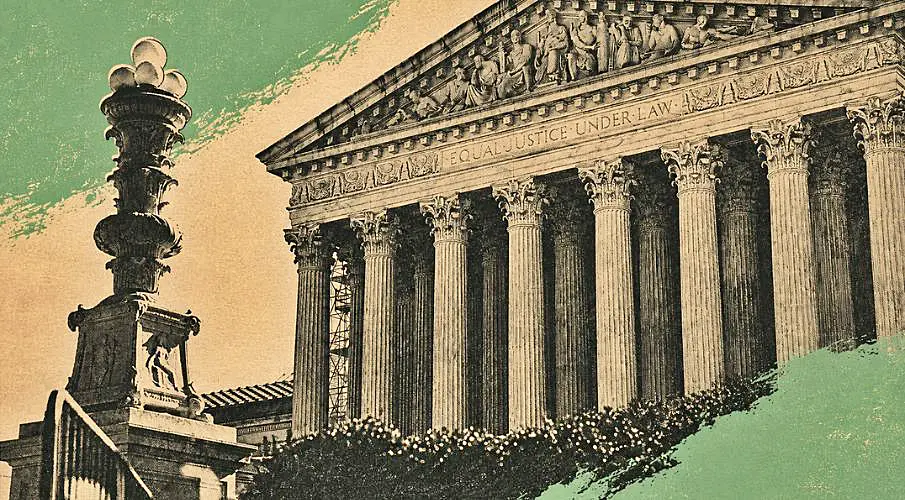
The Supreme Court of the United States on Tuesday reaffirmed a broad interpretation of birthright citizenship, rejecting the president's order that sought to deny citizenship to children whose parents are in the country unlawfully or only temporarily. The ruling follows the long established interpretation of the Fourteenth Amendment. It came on the final day of a term that revolved almost entirely around Donald Trump's sweeping claims of presidential power and, in most cases, ruled in his favor. Trump called the decision bad for the country.
Chief Justice John Roberts authored the majority opinion. He traced American birthright citizenship back to English common law, under which anyone born within the sovereign's dominion was considered a natural-born subject. Anyone born in the United States, the Court held, is a citizen, subject to only a handful of narrow exceptions.
An old shadow returned in the briefs. The Supreme Court's decision in Dred Scott v. Sandford in 1857 had declared that Black people, whether enslaved or free, were not citizens of the United States. Roberts called that ruling abhorrent, describing it as a departure from a previously accepted understanding that had been met with widespread outrage. The Civil Rights Act of 1866 and the Citizenship Clause of the Fourteenth Amendment, he wrote, restored that earlier understanding, and lawmakers made unmistakably clear that they intended to repudiate the Dred Scott decision. Across the 194 pages of the majority opinion, the concurrences, and the dissents, the name Dred Scott appears forty-eight times. Yet, Roberts wrote, the government and the principal dissent ultimately argue for a return to its central premise - that for certain people, birth on American soil is not enough to confer citizenship.

That principal dissent was written by Clarence Thomas. According to Thomas, the majority misunderstands and misuses the Fourteenth Amendment. The Citizenship Clause and the Reconstruction-era laws enacted after the Civil War, he argued, granted citizenship to those who were born and domiciled in the United States regardless of race. None of those texts, however, guaranteed citizenship to those who were not domiciled in the country. Black Americans, Thomas continued, were entitled to citizenship because they were Americans. They had no other homeland, owed allegiance to no foreign power, and were subject to no other sovereign authority.
The presence of Supreme Court Justice Clarence Thomas at the Capitol shortly before major decisions is remarkable, particularly because Thomas has faced criticism in recent years over ethics issues and his contacts with political figures. We will continue to follow this.
Question: "Who are you meeting with this afternoon?"
Justice Thomas: "Nobody."
Question: "So what are you doing up here at the Capitol?"
Justice Thomas: "Just walking."
At the heart of the dispute is the meaning of being subject to the jurisdiction of the United States. The majority maintains that simply being present on American soil subjects a person to the nation's laws, with narrow exceptions such as foreign diplomats. Thomas and the other dissenters argue that anyone who remains under the distinct authority of a foreign government is not, within the meaning of the Citizenship Clause, subject to the jurisdiction of the United States.
Ketanji Brown Jackson answered Thomas in a separate concurring opinion that accompanied Roberts' majority. Thomas, she wrote, had long championed the idea of a colorblind Constitution, yet now advanced the surprising claim that the Citizenship Clause was a race-specific remedy intended only for formerly enslaved people such as Dred Scott. She called that an unduly narrow understanding of the democratic expansion envisioned during Reconstruction. That interpretation, Jackson argued, pits Black Americans against immigrants, something the architects of the Fourteenth Amendment deliberately refused to do. Formerly enslaved Black Americans fought for the shared humanity of all people.

It is a meeting of profound significance. Jackson is the first Black woman to serve on the Supreme Court of the United States. Thomas is the second Black man to sit on the Court, succeeding Thurgood Marshall, who won Brown v. Board of Education, the landmark case that ended racial segregation in America's public schools.
What is at stake in this dispute is older than any statute. It is the question of whether the ground on which a person is born makes that person a member of the political community, or whether belonging depends instead on allegiance to a sovereign and the bloodline of one's ancestors. The president's order sought to create a class of people born on American soil who would nevertheless stand outside the body of citizens - living in the country, yet not belonging to it. Giorgio Agamben described the figure whom the law includes by excluding, the person who lives under a legal order while remaining unprotected by it. That is precisely the class this order sought to create, and this time the Court prevented it.
Trump remained defiant. The ruling, he said, was bad for the country, but Congress could easily resolve the matter through ordinary legislation. There was no need for a long and cumbersome constitutional amendment. The ruling, however, says the exact opposite. Roberts grounded his opinion in the Fourteenth Amendment when he held that everyone born in the United States, with only a few narrow exceptions, is a citizen. Anyone seeking to change that principle cannot avoid amending the Constitution.

The Department of Justice said it remains determined to crack down on what it described as unlawful birth tourism and is working with federal prosecutors across the country to do so. Anyone exploiting legal loopholes to secure automatic citizenship for their children, the department said, poses a threat to national security and will be brought to justice. The statement was released on X.
To understand the weight of this single victory, it must be viewed alongside the Court's other rulings from the same days. On that same Tuesday, the Court upheld laws in roughly half the states barring transgender girls and women from competing on girls' and women's sports teams at schools and universities. It also struck down limits on political party spending in federal elections. One day earlier, it handed the president a major victory by allowing him to remove the heads of independent federal agencies at will. Only one official remained protected - Federal Reserve Governor Lisa Cook, who retains her position while challenging her dismissal, which the president justified by accusing her of mortgage fraud.
Confusion also marked the edges of the day. The Court's Public Information Office rejected a report, later withdrawn, claiming that Justice Samuel Alito had announced his retirement. The public radio network that broadcast the story retracted it shortly afterward. As has become his custom following the Court's final decisions of the term, Roberts had announced the retirement of several Court employees, but Alito was not among them. Speculation about his future had surfaced earlier in the year, yet by the spring it had been reported that he intended to remain on the bench. The network's editors acknowledged that the story had been reported incorrectly and announced that correspondent Nina Totenberg would explain what had happened during a later broadcast.
What remains, in the end, is a victory that carries its own warning. The Court preserved birthright citizenship, yet during the same week it granted the president much of what he had sought elsewhere, while the dissenting voices ultimately argued for nothing less than the return of the principle by which the nation once denied Dred Scott his humanity. This time, the ground on which children are born spoke louder than those who sought to take it from them. It would be unwise to assume that it will speak just as loudly the next time.
Updates – Kaizen News Brief
All current curated daily updates can be found in the Kaizen News Brief.
To the Kaizen News Brief In English


Auch wenn das Geburtsrecht mit Begründung auf den 14. Verfassungszusatz bestätigt wurde, zeigt sich die verfassungsfeindliche Gesunnung des Marionetten Supreme Court.
Thomas im Capitol, vor den Urteilen.
Da fragt man sich unweigerlich, was ein Richter so kostet.
Alito, der treueste Trumpist wird nicht zurück treten (können?).
Alle anderen Urteile sind ein Gewinn für Trump (außer Carroll).
Ein herber Schlag für transgender Menschen.
Der Supreme Court bleibt eine Marionette der Trump Regierung.
3 Richter haben auf die Verfassung geschworen, aber sind nur Trump treu.
3 Richter haben auf die Verfassung geschworen und besinnen sich ganz selten darauf, aber immerhin sie wissen noch was es ist.
Lediglich die 3 demokratischen Richter folgen dem Schwur auf die Verfassung.