
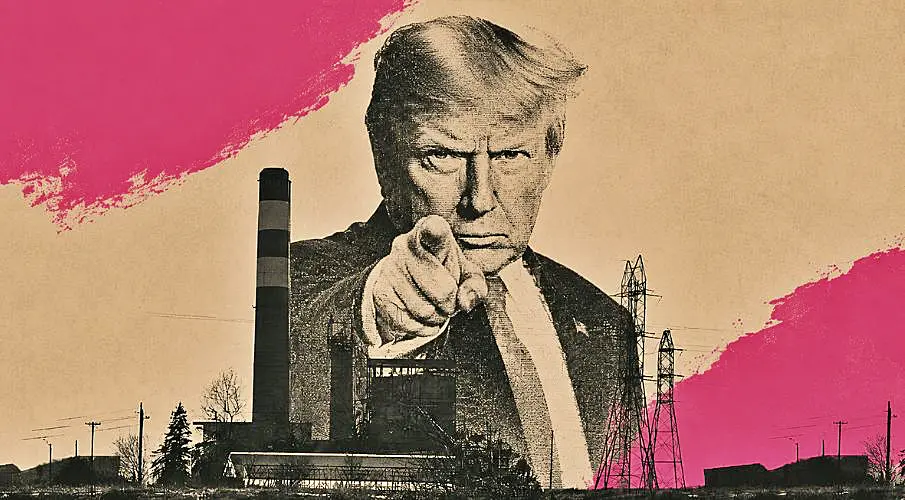
America freed itself from a king 250 years ago. This weekend, it celebrated that anniversary on the National Mall, where the face of the sitting president stares down from banners draped across federal buildings, and where Donald Trump held an event he himself described as a "Trump rally." The irony has become so overwhelming that it barely qualifies as irony anymore. It has become the condition itself.
Since returning to office in January 2025, Trump has nominated his personal attorney to serve as attorney general, directed the Justice Department to pursue his political opponents, deployed U.S. Marines to Los Angeles, placed his own name on the Kennedy Center, filed a private $10 billion lawsuit against the IRS to be paid with taxpayer dollars, launched cryptocurrencies that conservative estimates say have earned him $870 million this year alone, hosted a UFC fight on the White House lawn for his eightieth birthday, and only days later publicly revealed that his Justice Department was investigating California Governor Gavin Newsom after Newsom openly criticized him.

When King Charles III visited the White House, the official White House X account posted a photograph of the two men with the caption: "TWO KINGS." Earlier in his second term, after ending New York City's congestion pricing program by executive order, Trump posted: "LONG LIVE THE KING." They are posts that could be dismissed as jokes. They are also posts that show Trump does not fear the comparison. He embraces it.
In a "60 Minutes" interview, Trump said, "I'm not a king." Months earlier, he told The New York Times that the only limit on his global power was "my own morality. My own mind. That's the only thing that's going to stop me." During his first term, he told a youth summit that Article II of the Constitution gave him "the right to do whatever I want as president." The statement has endured. He has never taken it back.
The comparison to a king fits Trump differently than it has fit previous presidents - not only because of what he has done, but because of how he views himself and what he believes the presidency is meant to be. "We are celebrating the nation's founding principles, and one of the driving ideas behind them was the fear of what centralized power becomes when it goes unchecked. And here we are again." The financial entanglement is the monarchical feature of this administration: "We have never seen a person with a business empire of this size and scale directly benefiting from the governmental decisions that person is making."
The administration's chief advocate before the Supreme Court, D. John Sauer, has argued in court that judges have no authority to review presidential actions. "Once the President has made a decision, there is no further role for the reviewing court." Sauer previously served as Trump's personal attorney in the case where a judge asked whether a president could be prosecuted for ordering the assassination of a political rival. Sauer's answer at the time was a qualified yes. Today, he is the lawyer defending the outer limits of presidential immunity before the Supreme Court.

The Supreme Court has not ruled in Trump's favor on every issue. It allowed Federal Reserve Governor Lisa Cook to remain in office after Trump attempted to remove her, and it rejected his global tariffs because that authority belongs to Congress. But in the middle of Trump's presidential campaign, the Court had already ruled that presidents enjoy broad immunity from criminal prosecution for official acts - a decision that halted multiple investigations arising from Trump's first term, including the investigation into his efforts to overturn the 2020 election.
On the foundation created by that legal doctrine, Mississippi is now building something else. Beginning this Wednesday, the state government will be legally authorized to create a database of every person living in Mississippi without lawful immigration status. The database will include names, addresses, country of origin, age, and criminal history. State officials are authorized to use "all reasonable lawful investigative means" to compile it. The law neither requires nor prohibits sharing that information with ICE. The program is scheduled to operate for two years. It is not a one-time survey. It is continuous registration.

Efrén Olivares of the National Immigration Law Center describes what he sees without hesitation. "It is deeply troubling because it eerily resembles other countries that created lists of certain groups of people." The historical comparison is obvious, and Olivares deliberately leaves it unstated because it does not need to be stated. Lists organized by origin and legal status carry a history that speaks for itself.

Republican State Senator Angela Hill, who sponsored the legislation, calls it "common sense." She argues that the state must understand the size of the problem before it can solve it. The argument becomes weaker the closer it is examined. What exactly is the problem? Olivares points out that a person's immigration status can change within weeks. Someone may be undocumented today, obtain legal status tomorrow, and lose it again the following month. A database that attempts to capture that reality in real time is either permanently inaccurate or permanently watching people. Neither outcome is reassuring.
Measured against its population, Mississippi has one of the smallest undocumented populations in the United States - fewer than 28,000 people, less than one percent of the state's residents. That fact makes clear that the law is not responding to an overwhelming practical crisis. It is responding to a political message. The message is simple: We know who you are. We know where you are. We can find you. Lydia Grizzell of the ACLU of Mississippi explains the consequence. Laws like this destroy trust between immigrant communities and law enforcement. People who fear that any contact with authorities could expose them will stop calling the police when they become victims of crime. That makes communities less safe, not more secure. It is legislation that promises order while institutionalizing fear.

Meanwhile, the opposition has adopted a slogan loaded with historical meaning. The largest protest movement of Trump's second term calls itself "No Kings." Ezra Levin of Indivisible says they deliberately chose the slogan with the nation's 250th anniversary in mind. "It looks like the same kind of tyranny we rebelled against 250 years ago - the kind of rule where Americans are governed by a secret police that kills people in the streets." He points to the fatal shootings of two demonstrators by federal officers earlier this year.

In 1776, America broke away from a man who believed he had the right to rule as he pleased. Two hundred fifty years later, another man occupies the White House after declaring that Article II of the Constitution gives him exactly that authority. His portrait hangs from federal buildings. A state is compiling lists based on origin. Courts are increasingly treated as obstacles rather than safeguards. And on the National Mall, America celebrates its independence with a man on stage calling himself "your favorite president" while asking more people to come.
George III never had to ask.
Updates – Kaizen News Brief
All current curated daily updates can be found in the Kaizen News Brief.
To the Kaizen News Brief In English


Es wird auch nach Trump wohl noch sehr viel über diese Zeiten gesprochen werden und Eure Recherchen sind dafür Gold.
Es warmth mich jefes Mal, dass der Supreme Court Trump diese quasi allumfassende Immunity während der Amtszeit gegeben hat.
Und Trump nutzt sie.
Mir wird im Hinblick auf die Midterms ganz anders.
Dieses Gesetz würde ihn auch von jeglicher Verantwortung befriend, wenn er seine Getreuen zur Gewalt gegen das Wahlergebnis aufruft. Sollten die Republikaner beide Kammern gewinnen.
Er könnte ihnen eine Begnadigung für alle möglichen Straftaten auf Bundesebene in Aussicht stellen.
Und all das, ohne selber etwas befürchten zu müssen.
Was in Mississippi geschieht, ist nur der Anfang.
Republikanische Staaten überschlagen sich um zu zeigen, dass man voll auf Trumplinie ist.
Noch vor den Midterms, falls sich das Machtgefüge dort ändert.
Zu feiern gibt es gar nichts.
Die Idigenen haben nichts zu feuern, sie wurden fast ausgerottet, ihrer Identität und ihres Landes beraubt.
Abtreibungsrecht wurde massiv eingeschränkt.
Frauenrechte offen in Frage gestellt.
Queerfeindlichkeit hat extrem, auch in Gesetzen zugenommen.
Der Rassismus weitet sich immer weiter aus.
Ebenso der evangelikale Religionswahn.
Vielleicht erinnert man sich mal daran, dass die Puritaner aus Europa verjagt wurden, weil man ihre extreme religionsauslegung nicht teilte… in den USA fasten side Fuß und waren Schuld an den Hexenverbrennungen (vor allem in Salem/Massachusetts)
Der Faschismus galoppiert.
Und obenauf ekn Präsident, der sich als unantastbarer König sieht.
Sich selber die Taschen füllt, während vuele Amerikaner nicht wissen, wie sie die nächste Mahlzeit auf den Tisch bringen sollen.
Ich sehe keinen Grund zum Feiern.