
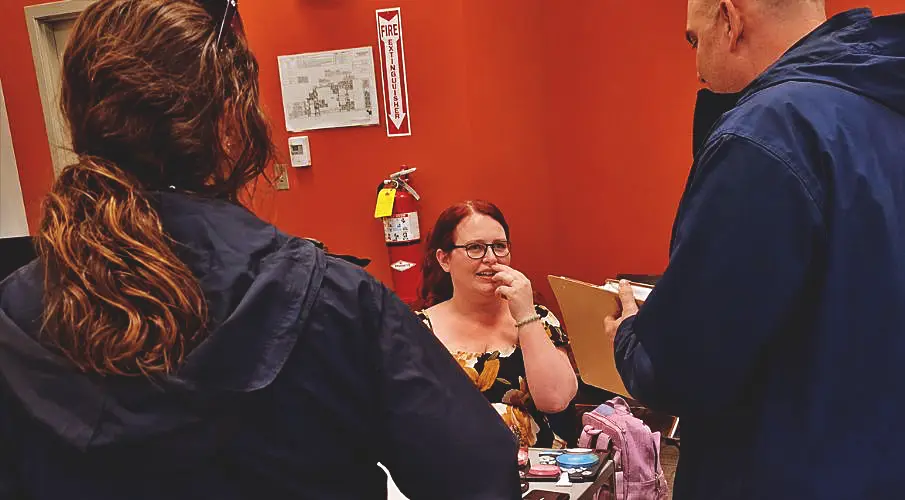
Paigelynn Gonyea has 100,000 followers on TikTok, where she posts comedy videos and reviews skincare products. On Instagram, where she has another 33,000 followers, she occasionally posts about politics. In January 2026, just days after ICE agent Jonathan Ross fatally shot Renée Macklin Good in Minnesota, Gonyea shared a photograph of Ross with the caption: "I think today would be a good day for Jonathan to be indicted." Ross has not been charged to this day.
On Tuesday, June 23, 2026, Gonyea was working as an election inspector at the Central Library in Syracuse, New York. It was Election Day. During a quiet break between voters, she received a voicemail from someone identifying himself as a special agent with the Department of Homeland Security, leaving a New Jersey phone number. "We were just at your apartment," the voice said, adding that he had obtained her number from her partner. "We're calling about a post we believe you made on Instagram in January in which you doxxed an ICE agent."

According to Gonyea, she never published an ICE agent's address. Doxxing generally refers to publishing sensitive personal information such as home addresses or phone numbers. DHS later claimed that Gonyea had posted an address and had therefore committed a federal crime. The agency presented no evidence. Gonyea's response was straightforward: "Where is the address? I've carefully gone through my social media, and I don't see an address." Gonyea called the agent back and explained that she was working at a polling place. The agent wanted her to step outside. She refused. "I don't trust dealing with ICE agents in any way," she said. Her fellow election worker, 70-year-old Sheilia Milledge, who relies on a cane, also did not want Gonyea to leave the building. "Too many people are being kidnapped by ICE, and I can't run after her," Milledge said.
Instead, Gonyea invited the agents to come inside. A man and a woman wearing ICE credentials entered the library. Milledge and another election worker recorded the encounter. Milledge can be heard on the video attempting to contact city officials. What followed was later described by Republican Election Commissioner Kevin Ryan as "a comedy of errors from beginning to end" - with one critical difference: comedies usually have harmless endings.

The agents carried a file on Gonyea. It contained her name, address, date of birth, height, weight, and eye color. They demanded that she sign a document stating that her Instagram account might have violated a federal law prohibiting threats or intimidation against a federal officer. The document came from ICE's Office of Professional Responsibility and carried a warning in large bold letters across the top: "YOU MAY BE IN VIOLATION OF FEDERAL LAW." Beneath that, it read: "OPR is requesting that you promptly remove and/or discontinue the aforementioned behavior."

The document is an official warning issued by ICE, the U.S. Immigration and Customs Enforcement agency, specifically by its Office of Professional Responsibility. It is addressed to Paigelynn Gonyea's Instagram account, "TURNDAPAIGEOFFICALL," and carries the bold headline: "YOU MAY BE IN VIOLATION OF FEDERAL LAW." The notice states that the account has given ICE reason to believe it may have violated federal criminal statutes prohibiting threats or intimidation of federal officers, as well as the publication of their personal information with the intent of facilitating violence. Gonyea is explicitly instructed to "promptly remove and/or discontinue the aforementioned behavior." The notice concludes by stating that delivery of the warning has been documented and that it will be taken into consideration in the event of any future "criminal activity."
What the document does not contain is equally important: it identifies no specific post, no specific statement, and no evidence that personal information about a federal officer was actually published with the intent of promoting violence. It alleges the possibility of a violation, yet it is written in a way that gives the impression the conclusion has already been reached.
From a constitutional perspective, this raises profound concerns. Federal agents personally appeared before Gonyea and demanded that she remove political speech - without an indictment, without a court order, and without presenting evidence that a crime had been committed. In the American constitutional tradition, prior government pressure aimed at suppressing political expression occupies one of the most sensitive areas of First Amendment law. The First Amendment affords the highest level of protection to political speech, particularly speech demanding accountability for the actions of government officials. This document treats precisely that kind of speech as a potential criminal offense.
Gonyea refused to sign. She also refused to delete a single post.
Entering a polling place by armed federal law enforcement officers is prohibited under federal law. Whether the agents were armed remains unclear. In addition, a recently enacted New York law specifically bars immigration authorities from entering polling places. Ryan, the Republican election commissioner who witnessed the encounter firsthand, said the agents should never have entered the polling location. He also questioned why they chose Election Day to confront Gonyea over a social media post that was already five months old.

That is the real question. Not the legal one - although the legal issues alone are troubling enough. The real question is political: Why Election Day? Why a polling place? Why ask her to step outside instead of initiating a formal legal process? The Department of Homeland Security has still not explained which specific post prompted the visit, even though the agents confirmed to Gonyea that it concerned the Ross post, and she was able to see a printed screenshot of that post inside their file.
Perry Grossman of the New York Civil Liberties Union identifies the constitutional issue at the heart of the case: "Calling for government accountability after the killing of an American citizen is highly protected political speech. If this is the kind of speech DHS intends to pursue, then they are attempting to fundamentally redefine the First Amendment and the boundaries of permissible public discourse. And that is wrong. It is absurd." Grossman is right, and if anything, his assessment is restrained. What Gonyea did is not merely constitutionally protected. It is exactly what a democratic society is supposed to do when a government official kills someone: identify the officer, demand accountability, and refuse to allow the incident to disappear from public memory. Jonathan Ross shot and killed Renée Macklin Good in Minnesota. Gonyea shared Ross's photograph and wrote that today would be a good day for him to be indicted. It was not a call for violence. It was not harassment of his family. It was not a protest outside his home. It was an Instagram post.
Five months later, federal agents appeared at her home. Then they appeared at her polling place. They arrived carrying a file. They arrived carrying a document demanding that she erase her speech.

After the encounter, Gonyea published the warning letter, the voicemail, and the video on Instagram. Her caption included the word "doxxed" - intended as an ironic quotation, not as an admission of guilt. That DHS ignored the obvious irony and immediately asserted that she had in fact engaged in doxxing, without presenting any evidence, completes the picture. You accuse someone of a crime, produce no proof, and when that person asks where the evidence is, you remain silent.
Anyone who exercises power through paperwork, without evidence and without a judge, is not administering justice - they are demanding obedience.
George Orwell wrote a novel about a state that sought not merely to control people's actions, but their thoughts - a state that rewrote language, erased the past, and persuaded its citizens to doubt their own perception of reality. Gonyea says that whenever she thinks about what happened to her, her mind returns to 1984. "It was one of my favorite books growing up. I just never thought I would live in a time when it would begin to feel so familiar."
The novel was published in 1949. It was intended as a warning, not as an instruction manual. Yet consider the sequence of events: a federal agency appears at a polling place five months after an Instagram post, carrying a file containing the subject's physical characteristics, demanding that she sign a document calling for the removal of her political speech, alleging a federal crime without presenting evidence, while entering a place that the law explicitly protects. Anyone who sees no resemblance to Orwell's surveillance state is reading that book through very different eyes than Gonyea.
The larger question is how many Gonyeas there are who do not have 100,000 TikTok followers. Who cannot call someone like Perry Grossman. Who do not have a coworker standing nearby with a phone recording everything. For them, the visit from federal agents may become the end of their political speech - not because they signed a document, but because they no longer dare to post at all. That is how intimidation works. Its purpose is not merely to silence one individual. Its purpose is to silence everyone watching. If the message is that an Instagram post identifying an ICE agent involved in a fatal shooting can bring federal agents to your polling place five months later, everyone else contemplating a similar post will begin calculating the risk. Most will decide it is not worth it.

Constitutional scholars have a name for that phenomenon: the chilling effect - the deterrent effect that arises when government enforcement is used not merely to prosecute a particular individual, but to discourage an entire category of protected speech. Gonyea refused to sign. She refused to delete anything. But the government has already won if the next person who considers naming an ICE agent pauses before pressing "Post." As a child, Paigelynn Gonyea believed 1984 was a novel about another time and another world. She now lives in a time when federal agents enter polling places on Election Day to demand that women remove political speech from the internet. Jonathan Ross has still not been indicted. Renée Macklin Good is still dead. And the Department of Homeland Security has still produced no evidence that Gonyea ever published the address it claims she posted.
Updates – Kaizen News Brief
All current curated daily updates can be found in the Kaizen News Brief.
To the Kaizen News Brief In English


Echt richtig krass. Danke für diesen Bericht.
Danke, dass Ihr das sichtbar macht.
Für all die, die glauben die USA sind noch das Land, dass es vor 2 Jahren war.
Einschüchterung, so funktionieren Diktaturen.
Stasi, Gestapo, FSB etc.
Sie Alle agieren so im Regierungsauftrag.
ICE setzt sich über geltende Gesetze hinweg.
ICE erscheint illegal in einem Wahllokal.
Bedroht eine Wahlhelferin und sendet damit ein Signal an alle Anwesenddn.
Wer gegen Trump, ICe etc ist… wir wissen wer ihr seid.
Hoffentlich hat das auch rechtliche Konsequenzen.
Und typisch Republikaner.
Es war ein Mißverständnis…. nein, war es nicht.
Es war falsch, dass die ICE Beamten das Wahllokal betreten haben.
Nein es war illegal und ER hatte sofort reagieren müssen.
Und wenn ICE das Gewicht von Gonyea kennt, haben sie wohl Zugang zu ihren medizinischen Faten.
Es sei denn, sie postet es regelmäßig.