
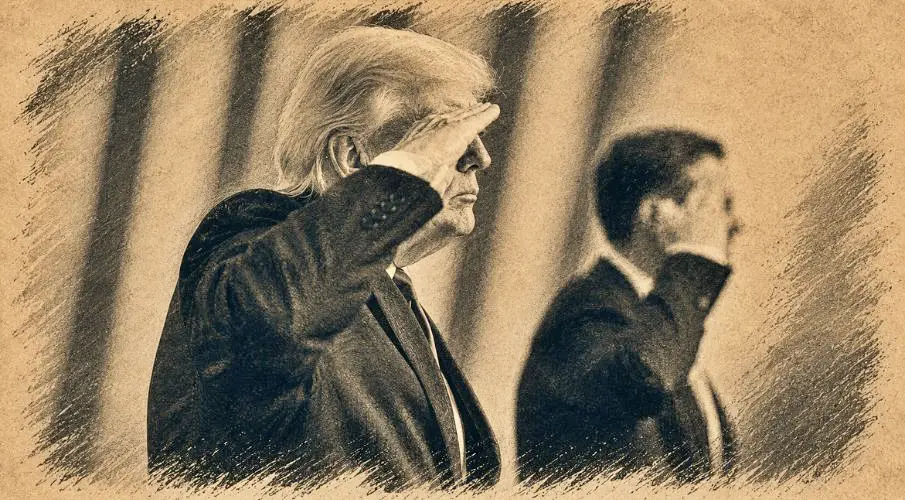
While technology stocks crash and the Pentagon demands eighty billion for its war, the National Guard watches over a pond that has turned green and arrests whoever touches it.
At the foot of the Lincoln Memorial lies a reflecting pool that was supposed to be blue. American flag blue, that one blue had been personally chosen by the president, and for fourteen million dollars he had the long basin on the National Mall relined so that it would shine for the republic’s two hundred fiftieth birthday like a freshly painted promise. It does not shine. Weeks after he declared the work complete, the pool turned toxic green, an algae bloom of the kind that has haunted this pond for a hundred years, and the coating meant to last forever peeled away in shreds and drifted across the water. Reporters saw pieces floating, some more than half a meter wide. In a single image, that is the condition of the country. Something is declared complete before it is finished, in a color nobody asked for, and then the water shows what the speech had claimed.

What happened next is the real lesson. Instead of admitting the botched work, the president declared the pool a crime scene. Sick, disturbed people had vandalized it, he wrote, a ninety meter long cut had been sliced into it and chemicals had been illegally dumped, and while experts fought the algae with ozone and tiny bubbles, the National Guard took positions at the edge of the pool. Five people had been arrested, five more were suspected. One of them, David Hearn, sixty seven years old, from Maryland, once an Olympic canoeist, had done nothing more than bend down and touch the peeling coating. It felt rubbery, he later said, he was simply a curious citizen. They held him for five hours. It is not even clear which law a person violates by reaching into a pond. But this is the point at which farce turns into something colder. A state that cannot tolerate its own mistake needs culprits, and where none exist, it invents them and posts soldiers at a wading pool.

One could laugh at this if it were an isolated case. It is not. On the same day troops guarded the green pool, prices fell on Wall Street, and once again technology dragged everything down with it. Nasdaq futures lost 2.6 percent after already falling 1.3 percent the day before. Chipmakers plunged, Micron and Intel by more than 7 percent, Qualcomm by more than 6 percent. Memory companies Sandisk and Seagate lost 9 percent and 7 percent. Elon Musk’s space company, under whose roof the artificial intelligence firm xAI sits, had fallen 16.4 percent at the beginning of the week and kept sliding, from more than two hundred dollars the previous week to barely one hundred fifty six. In Tokyo the Nikkei lost 3.6 percent, in Seoul the benchmark index collapsed by 10 percent. Across Europe too, from Frankfurt to London, markets fell. Fear has a name, and it is the name of the war this president started.

Because the bill for it is coming now, and it is coming from two sides. The war against Iran, begun at the end of February, pushed oil prices for months, and expensive fuel is now eating into consumer prices. A barrel of American oil costs just under seventy four dollars, North Sea crude just over seventy seven. For May, statisticians expect inflation of 4.1 percent after 3.8 percent in April, and the central bank, which must contain that inflation, will be forced into the rate hike that will choke growth even further. A week ago, traders put the probability of such a hike at 57 percent, now at almost ninety. The yield on the ten year Treasury note, just under 4 percent before the war, is now 4.5 percent, and every point makes mortgages and loans more expensive and weighs on precisely those overheated valuations that the frenzy around artificial intelligence had driven into the sky. One feeds the other. A war sold as triumph hits the kitchen table as inflation, and the market that had just been dreaming of machines that are supposed to think remembers that money too has a price.
And while that happens, the Pentagon demands money as if there were no tomorrow. Around eighty billion dollars is what the Defense Department is asking from Congress, almost entirely for the Iran war, and that is only the surcharge on an already enormous sum. The White House wants one and a half trillion dollars for the armed forces this year, an increase of almost half. What is remarkable is not the height alone, but how the number grew. Only a few weeks ago Defense Secretary Pete Hegseth put the war costs before Congress at twenty nine billion. At the beginning, the department had even floated two hundred billion, with the first week of war alone said to have consumed eleven billion. The estimate grows every time one looks, just like the algae in the pool, and nobody knows where it ends. Senators from both parties hesitate. Senator Patty Murray confronted the secretary, saying he was spending families’ hard earned money on a war many opposed. Senator Jim Banks of Indiana, in turn, praised the whole thing as an investment in the domestic arms industry, one he would sell to his state. It was less about the war, he said openly, than about warehouses full of ammunition. That is how people speak in a country that no longer has to justify war, only book it.

Anyone who thinks the institutions are holding the line should read the ruling issued Monday in Washington. A federal judge barred the government from using a data tool with which it searched state voter rolls for alleged noncitizens. The judge is named Sooknanan, and her words were unusually sharp. The federal government, she wrote, had knowingly trampled on the privacy of American citizens in a way that threatens the sacred right to vote, and the court could not stand idly by. Congress had expressly prohibited pooling Americans’ personal data in one place, and the agencies knew their database violated that prohibition. More than sixty seven million registrations had been run through the system in at least twenty five states since the government upgraded it in the spring, with active help from the cost cutting agency Elon Musk had led. And the system was wrong. It temporarily struck a naturalized American from Texas, Anthony Nel, a citizen for more than ten years, from the rolls because it considered him a foreigner. He hoped, Nel said, that others would see this fight and not take their right to vote for granted.
The problem that was supposed to be solved with a crowbar barely exists. Voting by noncitizens is already illegal and punishable up to deportation, and it occurs exceedingly rarely. James Percival, a lawyer at the Department of Homeland Security, nevertheless scoffed that it was amazing how hard the left fights to prevent the government from solving problems it claims do not exist. He said the sentence to mock the other side and did not notice that he was describing himself. Because the problem does, in fact, barely exist, and for its sake the rights of real people are sacrificed so the imagined ones can be kept out. Here lies the same inversion as at the green pool. Where there is nothing, a danger is asserted, and to protect the assertion, the state reaches for those closest to it.

And the man in whose name all this happens is meanwhile traveling to Pennsylvania. To a truck factory near Allentown goes the president, his first major appearance away from the capital since he signed the preliminary agreement meant to end the Iran war. He wants to speak, now again, about the economy, about the high gas prices his war caused, as if one could put out a fire with the match that lit it. The district is contested, the narrow majority in the House depends on districts like it, and the numbers are merciless. Only about one third of adults approve of his handling of the economy, and two out of three reject how he has handled Iran. His predecessor once stood in that same factory and spoke of work returning. But industry knows only one direction. In 1979 the country counted almost twenty million manufacturing jobs, today it has twelve point six million. No appearance in front of a truck changes that. It is the backdrop before which a man speaks of strength while his country grows weaker as he speaks.
Five images from a single day, and they all say the same thing. A pool that turns green and is supposed to be called blue. A market that falls because a war was expensive, though it was called victory. An army of numbers that a ministry hands to Parliament and that grows every time one looks. A court that must stop the government from removing its own citizens from the rolls. And a president who stands before a factory to talk about an economy he has set on fire. What connects all of this is not malice alone. It is a particular attitude toward reality, the conviction that declaring something is enough to make it so. American flag blue, power declares, and the water turns green. Complete, it declares, and the coating floats away. Victory, it declares, and prices rise. Culprits, it declares, and grabs an old man at the pool. A country can live like that for a long time, for a while even splendidly, because declaration costs nothing and sounds magnificent. But reality keeps its own books, and eventually it opens them. The old question of whether a thing becomes true because one says it has been answered by this country with a decisive yes, and it is paying the price in toxic green water, falling markets, eighty billion for a war, and five hours of detention for a curious old man. America declares itself every day, louder and shinier. And every day, the paint peels a little further away.
Updates – Kaizen News Brief
All current curated daily updates can be found in the Kaizen News Brief.
To the Kaizen News Brief In English


Giftgrün im doppelten Sinne.
Dank Trumps Chemikalien gegen die Algen giftig, in der Farbe dunkelgrün.
Schuldig sind die, die ungläubig rein greifen und als Vandalen bezeichnet werden.
Alt National Park hat es auch sehr gut beschrieben.
Ohne Ausxchreibung zu ejnem Oreis der mehr wie deutlich über üblichen Preisen liegt, wurde eine Firma aus Florida (ein Schelm wer böses dabei denkt) beauftragt.
Ohne die Denkmalschutzbehörde, die Nationalparkverwaltung zu involvieren.
Es wurde gemalt, befüllt, die schöne Reflektion war dahin.
Böse Zungen sprachen schon vom Rejection Pool.
Dann kamen due Algen, dann die Chemie und schwupps, machte sich die teure blaue Farbe, die bun grün war, von dannen.
Wirklich sinnvoll das Geld der Steuerzahler investiert.
Ebenso der Irankrieg.
Nichts gewonnen, aber die Menschen und die Umwelt haben viel verloren.
Dennoch wird laut Sieg gerufen.
Schamlos weiteres Geld gefordert.
Hoffentlich hat der Kongress endlich mal Rückgrat und winkt es nicht wieder durch, wie so Vieles.
Ein Irrer leitet eine Regierung von Eierlosen Ja-Sagern.
Leider bewahrheitet sich bei Trump der Darmtz „schlimmer geht immer“.
Nicht nur täglich, sondern manchmal stündlich oder minütlich.
…jetzt lässt er schutzglas um den pool bauen LOL
Und bus dahin darf die Nationalgare ran 🙈