
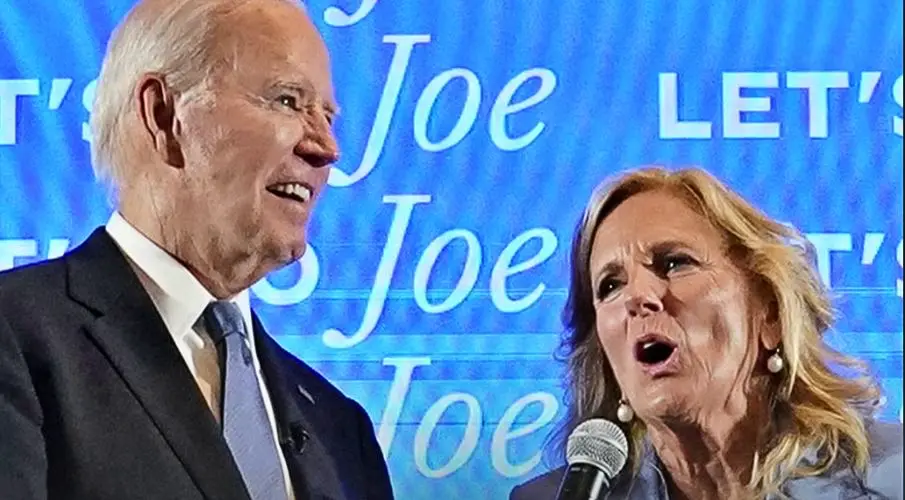
Jill Biden describes a moment in her memoir that now reads like a turning point in American politics. When Joe Biden faced Donald Trump on the debate stage in June 2024, she barely recognized her husband. From the very beginning of the event, she noticed that something was wrong. When Biden delivered the now infamous line about Medicare during the debate, a thought flashed through her mind that she says she has never forgotten. She wondered whether her husband might be suffering a stroke.
Former First Lady Jill Biden now says that during her husband's televised debate against Donald Trump in 2024, she feared that Joe Biden might be having a stroke. Immediately after the debate, Jill Biden joined her husband on stage and declared that he had done “a great job.” Today, she describes the situation very differently: “I thought, ‘Oh my God, he's having a stroke,’ and it scared me to death,” Jill Biden now admits.
In her book, the former first lady writes that Joe Biden recovered somewhat as the evening went on, but never enough to ease the concerns of viewers. She says she had never seen that expression on his face before. Looking back, she acknowledges that the White House may have mishandled the situation. At the time, the official explanation was that Biden had been suffering from a cold. Today, Jill Biden believes they perhaps should have been more honest with the public about what everyone had seen. Millions of Americans could see that the president appeared ill. Because no convincing explanation was ever provided, she writes, the debate followed him for the remainder of his presidency.

Jill Biden also breaks with her husband's position on another political decision. After Hunter Biden was convicted on several charges related to the purchase of a revolver in 2018, Joe Biden initially stood by his promise not to pardon his son. Jill Biden saw things differently. The family viewed the entire case as politically motivated and was surprised that it went to trial at all. In her memoir, she writes that Joe Biden may have gone too far in trying to demonstrate absolute impartiality. After Donald Trump's election victory, Biden ultimately changed his position and granted Hunter Biden a pardon. In doing so, he spared his son from a possible prison sentence.

Jill Biden speaks especially emotionally about the destruction of the East Wing of the White House. For decades, the building served as the organizational center for first ladies and their staffs. Donald Trump ordered the historic structure demolished to make room for a new ballroom. Friends in Washington sent her photographs of the demolition. She writes that she could barely bring herself to look at them. For her, it was not just a building that disappeared, but a piece of institutional memory. The demolition equipment erased history that extended far beyond any individual presidency.
She also recounts a deeply personal chapter. The longtime professor at Northern Virginia Community College says she unexpectedly received a termination notice after the funding that supported her salary expired. She describes feeling physically sick when she read the message. The issue was later resolved and she was able to keep her position. Nevertheless, her teaching career ultimately came to an end in December 2024. After four decades as an educator, she concluded her academic career while the Bidens prepared to leave the White House.
While Jill Biden reflects on the past years, Washington's attention is simultaneously turning toward a new flashpoint. Although representatives of the United States and Iran are now speaking of a preliminary agreement to extend the ceasefire and begin new nuclear talks, Donald Trump's administration is at the same time intensifying economic pressure on Tehran.

The U.S. Treasury Department imposed additional sanctions on Iranian oil exports. Among those targeted is Sepehr Energy Jahan, the sales organization used by the Iranian armed forces to market crude oil. According to the U.S. government, millions of barrels of Iranian oil continue to reach China through a network of companies. Washington accuses Tehran of using the revenue to finance military activities across the region. Treasury Secretary Scott Bessent announced that pressure on Iranian oil exports will continue to increase.
At the same time, comments by Vice President JD Vance suggested that even within the administration, the goals of the conflict are now being described less clearly. While Donald Trump and his administration had maintained since the beginning of the conflict that Iran must never possess a nuclear weapon, Vance now spoke of having significantly set back Iran's nuclear program for the long term. That is a different formulation from the originally stated objective of permanently preventing an Iranian nuclear weapons capability.
Vance was also unwilling to predict how the negotiations would ultimately unfold. He said it was difficult to know whether Donald Trump would eventually sign the preliminary agreement. Although Iran apparently wants a deal, significant disagreements remain. These include, in particular, Iran's stockpiles of highly enriched uranium and the question of whether Iran will be allowed to enrich uranium in the future. As a result, the United States finds itself in a contradictory position. On one hand, diplomatic talks aimed at reducing tensions are underway. On the other hand, new economic penalties are being imposed at the same time. While the administration publicly speaks of negotiations, it is simultaneously increasing financial pressure on Tehran. The coming weeks will determine whether these efforts produce an actual agreement or whether the talks follow the same path as many previous rounds of negotiations between Washington and Tehran.
Updates – Kaizen News Brief
All current curated daily updates can be found in the Kaizen News Brief.
To the Kaizen News Brief In English


Jill Biden hätte früher auf ihren Mann einwirken sollen.
Es war richtig am Debattenabend ihre Unterstützung deutlich zu machen.
Aber danach hätte sie ihren Mann überzeugen sollen, seine Kandidatur zurück zu ziehen.
Ehrlich mit seiner Gebrechlichkeit umzugehen.
Damit hätten die Demokraten etwas mehr Zeit gehabt sich neu aufzustellen.
Ob es etwas am Ergebnis der Wahl geändert hätte?
Das werden wir nie erfahren können
Nicht nur im Iran herrscht Uneinigkeit über die Ziele für ein Kriegsende.
Vance formuliert es zwar anders als Trump, aber macht deutlich, dass nur Trump entscheidet, was unterschrieben wird.
Und da Trump heute so, morgen so entscheidet, wird das schwierig.
Vorerst erfreut er sich an den schwankenden Aktienkurse und Ölpreise, die auf jede seiner Aktionen regieren.