
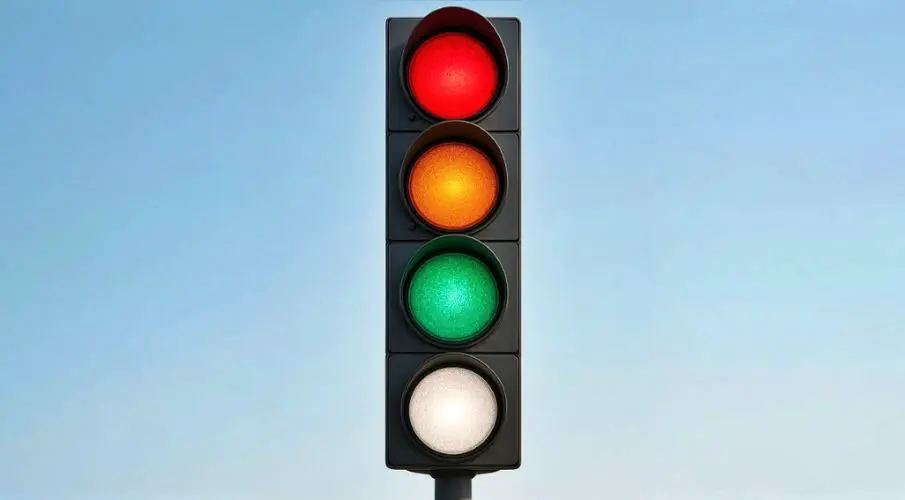
There are inventions so old that people no longer notice they were once new. The traffic light belongs to that category. In Germany, it has existed since 1924, when it was first installed in Berlin, and yet it is older than many realize. As early as 1868, a first signal appeared in London, powered by gas and manually operated by a police officer. Its fame was brief. Only weeks after entering service, the system exploded because of a gas leak. But even then there was red and green, the two colors that have since determined in countless cities around the world when a person may move and when they must wait. Later came yellow, the transition color, the in-between state. For more than a century, that image remained unchanged. Now researchers are seriously considering for the first time whether the system may need a fourth color, and the reason no longer sits inside the cars themselves, but inside the computers controlling them.

A group of scientists at North Carolina State University led by Professor Ali Hajbabaie has presented an idea officially called the White Phase. It was first described in 2020 and has since been revised several times. Initially, the researchers relied on a centralized control system, but that approach proved too slow. Today they are working on a distributed solution in which autonomous vehicles themselves divide the computing tasks among one another. It is a small technical adjustment with enormous consequences. The cars are no longer simply receiving commands. They become part of a conversation circle negotiating with one another at the intersection while the traffic light beside them grows almost silent.
The white signal would illuminate whenever enough autonomous vehicles approach an intersection simultaneously. At that point, the cars themselves take over coordination. They communicate with one another, negotiate within milliseconds, and search for the fastest and safest path through the intersection without relying on a central authority to dictate it. For human drivers, the white light means something different. It does not say drive and it does not say stop. It says you now follow the car in front of you, because that car currently knows more than the traffic signal itself. It is an image that makes one pause for a moment. The human behind the wheel is no longer the one making decisions. He follows a machine that follows another machine that follows a third. It is the quiet announcement of a world in which we no longer drive ourselves, but are carried along, even while sitting behind the steering wheel.

As soon as the number of autonomous vehicles at an intersection falls again, the system returns to the familiar three colors. It is not a permanent takeover, but rather an alternating balance between two worlds, a kind of transitional stage on the path toward a traffic logic that we still do not fully know how to imagine.
The numbers from the first simulations are remarkable. Even with autonomous vehicles making up only ten percent of traffic at an intersection, delays fall by roughly three percent. At thirty percent, improvements already exceed ten percent. Reports involving extremely high densities of autonomous traffic speak of reductions in delays of up to ninety-four percent. It is a number that sounds as though it belongs to another world. It promises traffic without gridlock, without horns, without the daily waiting at red lights that consumes so many hours of human life. Whether reality can fulfill that promise remains to be seen.

The researchers themselves emphasize that the color white is not absolutely fixed. What matters is simply that the signal clearly differs from red, yellow, and green. Some discussions have also mentioned other colors, including purple. There is something almost ironic about a technological revolution depending on the question of what color a small roadside light should become. Yet behind that seemingly minor question lies a much larger one. How will we communicate on the roads in the future when not everyone involved speaks the same language anymore?

The first testing areas therefore will not be located in busy downtown districts, but in controlled environments. Ports are being considered, industrial zones, logistics centers, and areas heavily populated by robo-taxis and autonomous delivery vehicles. Places where human driving already plays only a secondary role. From there, the concept would gradually expand into ordinary traffic systems. At present, neither the United States nor Europe has a single public intersection operating with a real white phase in everyday traffic. The idea remains research. It remains a hope. It is not yet reality.
The real problem lies not in the technology itself, but in the transition period. As long as autonomous and human-operated vehicles continue sharing the same roads, some form of communication between the two becomes necessary. That is precisely why the fourth signal was conceived in the first place. It is not meant for the cars, which are already speaking to one another. It is meant for the humans behind the wheel, who need to know when another logic has taken control. Yet this is exactly where questions emerge that nobody has fully answered. Who bears responsibility in an accident during a white phase? What happens if communication between vehicles fails? How should drivers be trained for a traffic system that removes decision-making from them? How do emergency responders operate when they themselves become part of an intersection controlled by vehicles instead of signals? And finally, how does a city protect its traffic systems from cyberattacks once those systems become deeply networked and capable of paralyzing entire districts in the worst-case scenario? These are not questions born from excessive caution. They are the shadow side of every innovation that arrives promising to make life safer.
International attention is growing nonetheless. Technology magazines are reporting on the concept, transportation planners are debating it, smart-city projects are beginning to incorporate it, and developers of autonomous vehicles see it as another step toward a destination they have long been moving toward already. What remains is the sober reality of cost. In the United States alone, there are hundreds of thousands of traffic signals. Many already require modernization, yet upgrading them into an expanded system would be extraordinarily expensive. The question is not simply whether a fourth color should be introduced. It is also who is willing to pay for it, and which city will first dare to redesign its intersections for a future that has not fully arrived yet.
Perhaps this is ultimately the real story behind the idea. It is not simply a question of color, nor simply a question of electricity. It is a question of how much control we as human beings still want to keep in our own hands during the coming decades. For more than a century, the traffic light represented a simple image. Red, yellow, green. Stop, pay attention, go. If a fourth light is now added, then it does not merely add another color to the old picture. It adds an entirely new layer of meaning, and that meaning is that someone else decides without asking us first. Perhaps this is exactly the moment when it becomes worthwhile to think not only about the technology itself, but also about what we are willing to surrender to it.
Updates – Kaizen News Brief
All current curated daily updates can be found in the Kaizen News Brief.
To the Kaizen News Brief In English


Mir ist das zuviel Technik!
Ich mag Fortschritt, Entwicklungen.
Aber nicht alles ist sinnvoll in meinen Augen.
Dazu gehören selbstfahrende Fahrzeuge.
Man sitzt drin und ist allem Weiteren ausgeliefert.
Ich möchte mein Fahrzeug selber steuern und auch Entscheidungen treffen.
Es gab vor kurzen einen sehr interessanten Bericht zu der Elektronik in Autos.
Sie macht sehr häufig Probleme.
Autos, die mitten im Überholvorgang abbremsen, Autos die durch den Spurhalteassistenten in Bausstellen falsch fahren oder Autos die sich nicht aus der eigenen Garage fahren lassen, weil der Parkassistent Dinge falsch interpretiert.
Und dann soll das Auto ganz autonom fahren?
Nein Danke!
Und mal ehrlich, wir haben wirklich andere Probleme, als das weiße Licht der Ampel.
Danke, dass Ihr das Thema aufgegriffen habt.