
In Doha, delegations are taking their seats, shaking hands, discussing conditions, and trying to contain a war that has long since spread across borders, seas, and multiple conflicts at the same time. While Iranian negotiators arrived in Qatar on Monday, the military reality was already moving in a different direction. Before serious discussions about a possible end to the fighting could even begin, American forces confirmed new strikes against targets in southern Iran.
According to US Central Command, the operations targeted missile positions and Iranian boats accused of laying mines. The statement from Washington described the actions as self defense. American troops, officials said, had to be protected from threats posed by Iranian forces. According to military sources, the strikes occurred near Bandar Abbas, a place that means far more to Iran than simply a port city. Bandar Abbas is one of the country's most important naval locations and sits directly on the Strait of Hormuz. Before the war began, roughly one fifth of global daily oil traffic passed through this narrow waterway. Any movement there rarely remains a regional story. Any change affects markets, supply chains, and energy prices far beyond the Middle East.

And it is precisely there that the situation continues escalating.
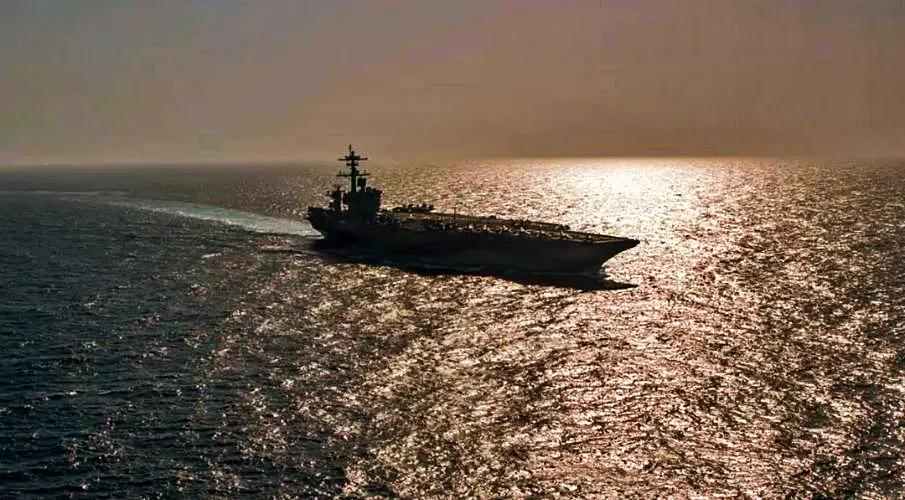
According to American officials, Iranian air defense systems and military activities threatened warships operating in the Gulf of Oman and the Arabian Sea. Nearly two dozen American warships remain deployed in the region. Among them are two aircraft carriers and their accompanying strike groups. At the same time, an American naval blockade remains in effect against ships seeking to enter or leave Iranian ports. According to military statements, one hundred ships have been redirected since the beginning of these measures, four have been disabled, and twenty six humanitarian vessels have been allowed to pass.
But while warships circle the waters and military movements continue along Iranian coastlines, discussions in Doha have grown into something much larger than the question of a simple ceasefire.

Mohammad Bagher Ghalibaf, shown on the right in the image, led the Iranian delegation. Foreign Minister Abbas Araghchi also attended. Tehran made it clear that any possible agreement could not focus solely on the direct confrontation involving the United States and Israel. According to the Iranian position, any agreement would also have to address the fighting between Israel and Hezbollah in Lebanon.
That demand comes at a moment when the situation in Lebanon itself continues to deteriorate. Israel announced plans to expand operations against the Iranian backed Hezbollah organization. While possible de escalation is being discussed in Qatar, another front could simultaneously begin widening.
Donald Trump increased the pressure further. On Monday he stated that a possible agreement would either be major and meaningful or would not happen at all. At the same time, he introduced new conditions. Iran's enriched uranium, he said, would have to be transferred to the United States or destroyed under the supervision of neutral observers. Trump also continued pressing countries such as Qatar and Saudi Arabia to join the Abraham Accords and normalize relations with Israel.

During a Memorial Day event, Donald Trump also recalled the thirteen American soldiers who were killed during the war with Iran. He stated that those men and women gave their lives so that Iran would never possess nuclear weapons.
Whether Iran has actually agreed to such demands remains unclear. An American government official stated that Tehran had generally signaled willingness to give up enriched uranium stockpiles. Public statements from Iran, however, sounded considerably more cautious. Foreign Ministry spokesman Esmaeil Baghaei stated that progress had been made on many issues, but that nobody could claim an agreement was immediately approaching.
While progress is being discussed publicly, assessments are simultaneously emerging that paint a very different picture.
Since the beginning of American and Israeli strikes, officials repeatedly stated that Iran's military capabilities had been severely weakened. Internal American assessments, however, describe a far more complicated situation. According to these evaluations, Iran has regained access to a significant portion of its missile sites, launch systems, and underground facilities.
The numbers are particularly striking.
According to those assessments, thirty of the thirty three missile sites along the Strait of Hormuz have reportedly become operational again. At the same time, Iran is believed to still possess approximately seventy percent of its mobile launch systems and around seventy percent of its prewar missile inventory. Additional concerns also appear to be growing within the American military. Internal assessments suggest that supplies of long range missiles and heavy munitions are declining. Those weapons are considered critical for attacks against heavily protected underground facilities. According to security sources, lighter weapons were at times used to seal entrances rather than completely destroy installations. Iranian forces reportedly repaired damage faster than originally expected.

According to available information, another major bombing campaign along the Strait of Hormuz had already been prepared before the negotiations began. The goal would have been to further reduce Iran's influence over the waterway.
Meanwhile, additional countries are attempting to expand their influence over the talks. Pakistan has now become one of the most important intermediaries between Washington and Tehran. Pakistani Army Chief Syed Asim Munir briefed Chinese leadership in Beijing regarding the status of negotiations. According to Chinese statements, he said that an agreement was moving closer to completion. China is following developments with significant interest. The country remains the largest buyer of Iranian oil. Even financial markets are now showing a contradictory picture. Oil prices fell by 6.5 percent on Monday. Despite that drop, they remain approximately 30 percent higher than they were before the war began. Even if an agreement is eventually reached, it could take months before oil and gas deliveries return to normal levels.
While peace is being discussed in Doha, warships continue moving off Iranian coastlines, new strikes hit targets near Bandar Abbas, and additional fronts threaten to expand. The talks continue. The war does too.
Updates – Kaizen News Brief
All current curated daily updates can be found in the Kaizen News Brief.
To the Kaizen News Brief In English


Mit Trump und MAGA wird das nie klappen, weil Schuldzuweisungen keine Probleme lösen und nichts bringen. Die Vermittlerrolle durch Pakistan war wegen Trumps Dauerregen nicht möglich. Trump überschätzt sich und unterschätzt den Iran. Ohne einen echten Perspektivwechsel ist die Lösung nicht möglich. UND DAZU IST TRUMP NICHT FÄHIG. Im übrigen war er es, der Obamas angeblich schlechten Deal gekündigt. Trump ist das Problem. Danach kommt lange nichts und dann die ganzen MAGA Verherrlichen auf der ganzen Welt.
… dem ist nichts hinzuzufügen
Danke für diese umfangreiche Recherche.
Hier liest und hört man nur „es gab nur vereinzelt Angriffe, aber die Waffenruhe besteht weiter“
Bevor der Krieg anfing, wollten Iran und die USA verhandeln.
Mitten in den Vorbereitungen griffin die USA und Israel an.
Jetzt laufen Verhandlungen und die USA greifen wieder an.
Bei dem, was Trump anstellt, kann man nur zu dem Schluss kommen, dass weder Trump, noch Hegseth und die, die vom Krieg samt Achterbahnfahrt von Öl und Aktienpreisen profitieren, gar jein Interesse an einem Frieden haben.