
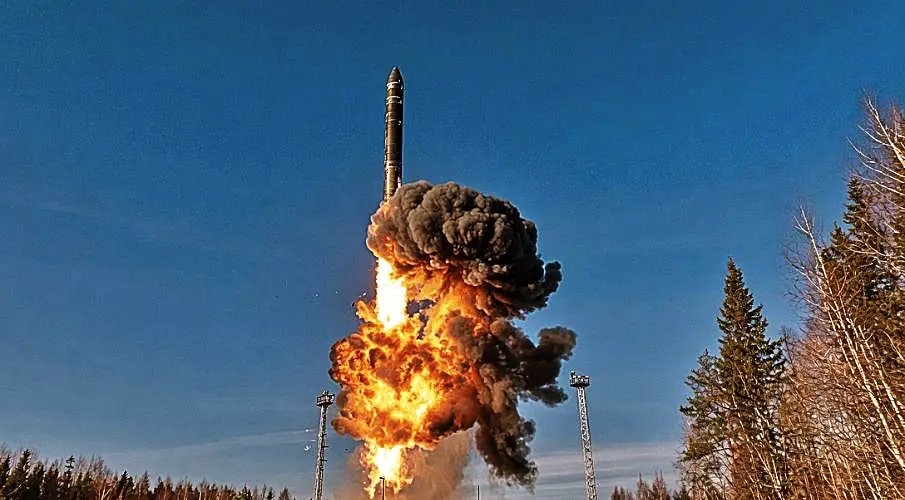
The skies over Estonia became the scene of two developments within minutes that reach far beyond a single incident. For the first time since the beginning of the war, NATO shot down a drone of Ukrainian origin over Estonian territory. At the same time, Russia announced new nuclear exercises that even experts say appear significantly larger than usual.
According to Estonian Defense Minister Hanno Pevkur, radar systems had already detected the aerial threat before it crossed the border. At 12:14 p.m., a Romanian F-16 fighter jet from NATO's air policing mission destroyed the drone over Lake Võrtsjärv. The aircraft belongs to the Baltic Air Policing mission and operates from Lithuania's Šiauliai Air Base. The operation was directed through an air command center in Latvia. Debris later fell into a swampy area near the village of Kablaküla.

Foreign Minister Margus Tsahkna stated that Estonia had not granted permission for its airspace to be used for attacks against Russia. At the same time, he linked the incident to Russian electronic warfare systems. Ukrainian drones had apparently already gone off course in the past because of jamming measures. At the end of March, several drones were detected in Estonian airspace. One of them crashed on Estonian territory. Ukraine's Foreign Ministry later apologized to the Baltic states and also attributed the deviations to Russian interference measures.
The consequences of the latest incident extended beyond the skies. Rail service on the Tallinn, Tartu, Riga, and Vilnius route was affected. Train traffic in northern Latvia temporarily came to a standstill. Tallinn Airport, however, continued operations.
At the same time, Russia's Defense Ministry announced the start of new exercises involving its nuclear forces. Between May 19 and May 21, units from the Strategic Rocket Forces, the Northern and Pacific Fleets, long range aviation, and troops from multiple military districts are expected to participate. Moscow says a total of 64,000 troops, more than 7,800 weapons systems, over 200 missile launch systems, 140 aircraft, 73 warships, and 13 submarines are involved. According to Russia, this includes eight strategic missile submarines.
Pavel Podvig, head of the "Russian Nuclear Weapons" research project, said that Russia regularly conducts such exercises. However, several aspects appear unusual this time. Strategic exercises would normally be held in the fall. Also notable, according to him, is the scale of the participating units and the broader involvement of non strategic systems. Belarus is also playing a role this time. Russian nuclear weapons stationed there are expected to be integrated into the exercises.
Particularly striking is the figure of eight strategic submarines participating simultaneously. Based on our experience, that is not an ordinary scale.
Within just a few hours, two developments came together that are likely to draw attention across Europe. A Ukrainian drone was shot down by NATO aircraft over Estonian territory for the first time, while Russia simultaneously responded with a military program significantly larger than usual.
Updates – Kaizen News Brief
All current curated daily updates can be found in the Kaizen News Brief.
To the Kaizen News Brief In English


Diese Atomübungen, derart nah an der Ostgrenze der EU macht mir Angst.
Putin macht nichts ohne Plan.
Was sein Plan ist?
Das weiß nur er.
Es bedeutet nichts Gutes.
Auf jeden Fall ist es eine deutliche Machtdemonstration.
Gerade zu dem Zeitpunkt, wo Trump US Soldaten aus der EU abzieht und die Verlegung nach Deutschland stoppt.