
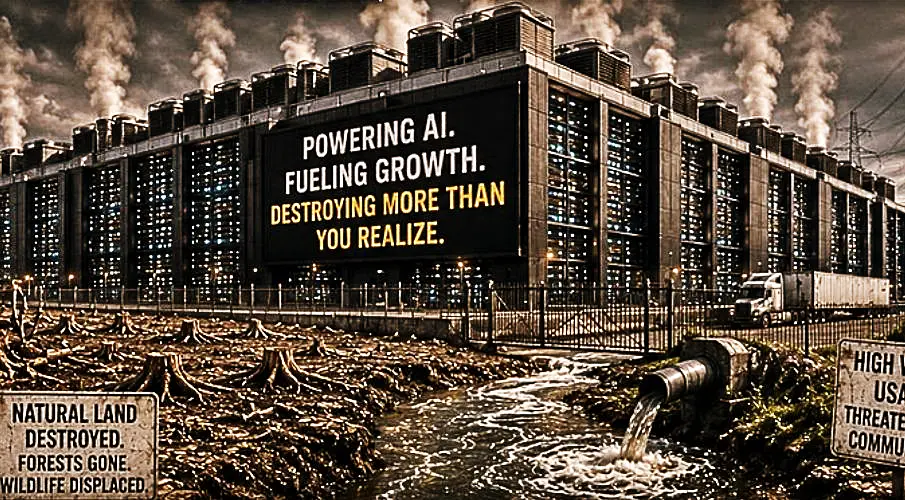
Until recently, artificial intelligence sounded like an endless sales pitch. Work faster. Learn better. Detect diseases earlier. Make life easier. Anyone listening to the major technology companies got the impression that resistance barely existed. The future had arrived and everyone would benefit from it. By now a different picture is emerging in the United States. The technology continues growing. The resistance is growing faster.
Former Google CEO Eric Schmidt experienced that directly just a few days ago. During a commencement speech at the University of Arizona, he spoke about the enormous transformation brought by artificial intelligence. He told students that the development would be bigger, faster, and more consequential than previous technological shifts. Instead of applause, he was met with boos.
It was not an isolated incident. In recent weeks, surveys have increasingly shown clear skepticism toward artificial intelligence. The reasons vary widely. Consumers are frustrated by rising electricity prices. Employees fear for their jobs. Parents worry about impacts on education and the mental health of children. In many regions, the debate has long since moved beyond the internet. People are protesting against data centers. Local elections are being influenced by it. Local politicians report growing pressure. In some cases, lines have been crossed. In April, a twenty-year-old man from Texas allegedly threw a Molotov cocktail at the home of OpenAI CEO Sam Altman and additionally issued threats against the company's headquarters in San Francisco. Shortly before that, thirteen shots were fired at the front door of a city council member in Indianapolis after he had approved a data center project.
Ron Gibson also found messages left outside his door. One note read: "No data centers." A few days later another one followed carrying a much more aggressive message.
Even people who have spent decades studying social developments describe the speed of this shift as unusual. Gregory Ferenstein, who conducted a recent survey together with researchers from Stanford and the University of California, Berkeley, stated that he had never seen public attitudes intensify this quickly.
The numbers show clear differences. Only around thirty percent of surveyed Democrats support accelerating AI development as rapidly as possible. Among Republicans the number is significantly higher. Among technology founders it reaches 77 percent.
At the same time, artificial intelligence is increasingly becoming a political issue. In Festus, Missouri, four city council members lost their positions after approving a six-billion-dollar data center project. In states ranging from Maine to Arizona, communities are now attempting to ban new facilities entirely. According to organizations opposing the expansion of new data centers, approximately 360,000 people are now participating in related Facebook groups. That is roughly four times as many as in December.
Josh Hawley stated that many people feel under pressure. The Republican senator from Missouri has already introduced legislation aimed at creating new requirements for data centers and AI companies. For the companies themselves, this is increasingly becoming a problem. Investors have poured many billions of dollars into companies such as OpenAI and Anthropic. Those firms require ever-growing amounts of computing power. That, in turn, requires new data centers.
But that is exactly where more and more conflicts are now emerging.
According to Data Center Watch, at least 48 projects with a total value of approximately 156 billion dollars were blocked or delayed last year. During the first quarter of this year, another twenty projects were completely stopped after protests. Texas Agriculture Commissioner Sid Miller has even called for a moratorium on new large-scale data centers in his state. He pointed to pressure on electrical grids and potential consequences for farmers.
Public sentiment becomes especially clear in individual examples.

Advertising executive and artist Ndubisi Okoye from Detroit learned last year that his utility provider intended to supply electricity for a new data center that Oracle plans to build near Ann Arbor. His reaction was direct. "We do not want data centers. Especially not in Michigan. Never bring that here." Okoye worries about environmental consequences. At the same time, he fears the impact of artificial intelligence on his work as an artist.
The political discussion is changing in Tennessee as well. Congressional candidate Justin Pearson is gaining support by opposing data center projects. Pearson is among the critics of Elon Musk's company xAI. The civil rights organization NAACP has now filed a lawsuit against xAI, accusing the company of operating gas turbines without valid permits.
Weeks of Investigations in Mississippi
According to current reports, Elon Musk's company xAI is now operating nearly 50 gas turbines at its data center in Mississippi in order to meet the enormous energy demands of its AI systems. Critics accuse the company of exploiting a legal loophole by classifying the facilities as mobile systems, potentially allowing them to avoid certain environmental regulations. The NAACP and additional groups have therefore filed lawsuits. At the center of the dispute are possible emissions of nitrogen oxides, fine particulate matter, and other pollutants. But it does not stop there. Particularly striking is the fact that the facility is located near residential areas, schools, and churches. For critics, the case reflects a development increasingly occupying more and more people: while billions flow into artificial intelligence, the question of what damage it causes continues growing at the same time.

Example: Gas turbines are visible at the xAI data center on Riverport Road in Memphis, Tennessee.
Our investigations paint a picture that is becoming increasingly uncomfortable for xAI. Speed is being placed above caution, while environmental and safety concerns are being pushed to the margins. Also under scrutiny are the emissions control systems being used and the operational practices in Southaven, Mississippi. The discussion reaches far beyond technical issues. Fine particulate matter can settle in air and soil and has been linked to cardiovascular and respiratory illnesses. Gas turbines release carbon dioxide and contribute to global warming. Added to this are potential methane leaks during the extraction and transportation of natural gas, which can have stronger short-term climate effects than CO₂. Also being discussed are impacts on air quality in residential areas, high water consumption for cooling systems, constant noise, and additional pressure on power grids and infrastructure.
As opposition continues to grow, companies are trying to push back. Hundreds of millions of dollars are now flowing into political campaigns. Donald Trump recently even stated that data centers need "a little help with public relations."

Chris Lehane of OpenAI, meanwhile, blames people who constantly warn about worst-case scenarios, along with ongoing anger surrounding social media and negative media coverage. He says that if artificial intelligence is discussed only through fear, then fear is what will emerge.
Other voices within the industry sound considerably more irritated. At a conference in Washington, one participant described opponents of new projects as "cavemen" trying to block all progress. Perhaps that is where the real problem now exists. Because many people have already stopped arguing about whether artificial intelligence will become powerful. For many, that question already seems answered. The argument is now about something else.
Who pays the price for it.
To be continued ...
Updates – Kaizen News Brief
All current curated daily updates can be found in the Kaizen News Brief.
To the Kaizen News Brief In English


Rainer ich wurde auf Facebook gehackt. Bin hier jetzt über die kaizen App. Bis 26.05. Ist mein Account stillgelegt. Am Freitag kommt Jan, um mir zu helfen. Ich kann nichts tun. Mein Name und Geburtsdatum wurden geändert. Viele sind aus meiner Freundesliste weg, auch Du. Dann weisst Du erst mal Bescheid.
…ich hatte dir schon eine email gesendet, drücken die daumen das alles schnell geht, krank diese art hackerei
KI kann sicher hilfreich sein.
Aber wie mit vielen bahnbrechenden Erfindungen, kann es positiv und leider negativ genutzt werden.
Dazu kommen noch die Auswirkungen für Mensch und Natur in direkter Umgebung solcher Rechenzentren.
Die Stromverknappung für die Bevölkerung.
Der Verlust von Arbeitsplätzen.
Es ist gut, dass er ausgebuht wurde.
Es ist gut, dass sich Widerstand regt und Politiker, die das dufchwinken, es politisch merken.
Nicht ok ist Gewalt.