
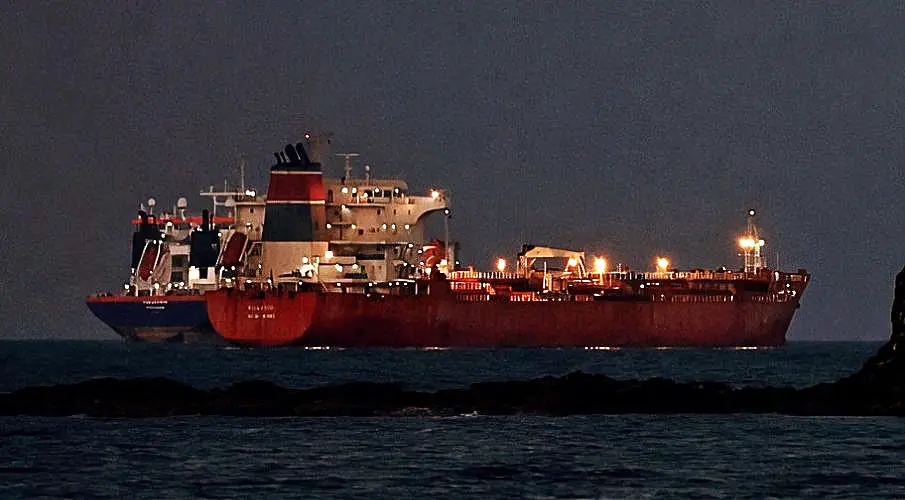
Donald Trump announces an operation that sounds larger than much of what has actually been implemented in recent weeks. Starting Monday, American forces are set to escort stranded commercial ships out of the Strait of Hormuz. A corridor under military protection, intended for hundreds of ships and around 20,000 sailors who have been stuck in the region since the beginning of the war between the United States, Israel and Iran at the end of February.

Trump describes it as a protective measure for neutral states whose ships have been caught in the conflict through no fault of their own. The United States has promised these countries to guide their vessels safely through the blocked waterways so they can continue their business. Trump is under pressure like never before, and he built that pressure himself. Pete Hegseth, his defense secretary, a former Fox host with the strategic depth of a commercial break, did not understand the scale because he could not understand it. The two underestimated what they were dealing with. The mullah regime is not a negotiating partner, it is an incendiary device that burns itself before it bends. It does not know defeat. It knows only the embers in which it would rather burn itself out than explain to an American president that he has won. At the same time, he links this announcement to a warning. Anyone who interferes with this process will be met with force.

The military dimension is significant. US Central Command is planning the deployment of guided missile destroyers, more than 100 aircraft and about 15,000 troops. How exactly these forces will be used remains unclear. The Pentagon provides no details. What is clear is that every movement in this area is under constant threat.
Iran is currently pushing back ...

Tension is coming directly from Tehran. Ebrahim Azizi, chairman of the national security committee in the Iranian parliament, warns that any American involvement in the Strait of Hormuz would be considered a violation of the ceasefire. At the same time, he clearly rejects Trump’s influence and dismisses any form of blame shifting.
Since the beginning of the war, Iran has effectively closed the Strait of Hormuz. Attacks, threats and inspections have brought traffic nearly to a halt. Crews repeatedly report drones and missiles being intercepted above them. Supplies are running low, water and food are becoming scarce. Many of the sailors come from India and other countries in South and Southeast Asia.
On the same day Trump announces his operation, another ship is attacked. Near Sirik, east of the strait, British observers report that several small boats attacked a cargo vessel. The crew remains unharmed. Iran denies the attack and speaks of a document inspection. It is not the first incident of this kind. Since the beginning of the war, more than two dozen attacks have been recorded in and around the strait. The situation remains unclear. Small Iranian patrol boats, often equipped only with outboard motors, move quickly and are difficult to track through the waters. At the same time, Trump had already ordered weeks ago that such boats be destroyed if they deploy mines. Each of these steps increases the risk of direct escalation in extremely confined space.

At the same time, talks are underway, with an uncertain outcome. Iran is reviewing an American response to its own proposal to end the war. A spokesperson for the foreign ministry, Esmail Baghaei, makes clear that the nuclear program is not part of this. Tehran wants to exclude that issue. Instead, the focus is on a rapid end to hostilities. The Iranian plan includes lifting sanctions, ending the American naval blockade, withdrawing troops and halting military operations, including by Israel in Lebanon.
Trump expresses doubt that an agreement will emerge from this. At the same time, he keeps talks open and speaks of something that could be positive for all sides. These contradictory signals have accompanied the entire development for weeks. International pressure is also growing. China, which depends on the Strait of Hormuz for a significant portion of its energy supply, is calling for the route to be reopened. Pakistan continues to mediate. The prime minister, foreign minister and army chief are urging both sides to engage in direct talks and have already organized meetings.
Meanwhile, the economic situation for Iran is worsening. The American naval blockade is cutting Tehran off from key revenue streams. US Treasury Secretary Scott Bessent states that revenue from transit fees collected by Iran is below 1.3 million dollars. At the same time, the country’s oil storage facilities are filling so quickly that production sites may soon have to shut down. But the United States is also under pressure. The Strait of Hormuz is one of the most critical chokepoints for global energy trade. About one fifth of global oil and gas transport normally passes through this route. Any further disruption affects markets worldwide.
What Trump is now announcing is more than an escort mission. It is a direct intervention in an area already saturated with threats, attacks and mutual distrust. Every convoy becomes a potential confrontation. Every incident can trigger the next. Iran makes clear that it will not abandon its position. Vice speaker of parliament Ali Nikzad states that the country will not return to pre war conditions. At the same time, Washington warns shipping companies not to transfer money to Iran, not even digitally.
Between these fronts, an operation is now beginning that is presented as humanitarian assistance but runs under military protection. For the sailors who have been stranded for weeks, it may be the only way out. For the region, it means another risk in a conflict that has long been out of control.
Updates – Kaizen News Brief
All current curated daily updates can be found in the Kaizen News Brief.
To the Kaizen News Brief In English


Natürlich erwartet Trump von NATO und anderen Partnern, dass sie sich an dieser militärischen Operation beteiligen.
Sonst wird er auch die wieder beschimpfen und bedrohen.
Und wer sind die „neutralen Staaten“, die Geleit bekommen sollen.
Wahrscheinlich die, die an Trump zahlen.
Nicht falsch verstehen, ich wünsche den festgesetzten Seeleuten von Herzen, dass sie aus dieser furchtbaren Situation kommen und endlich heim können.
Aber das Ganze stinkt.
Einseitig die Strasse von Hormus öffnen? Das hat der Iran versucht.
Nun will Trump es militärisch durch ziehen. Nicht aus Herzensgüte. Neutrale Staaten werden die sein, die bezahlen.
Damit sich die Aktion rechnet.
Ob die Reeder ihre Schiffe durch schicken?
Die Versicherungen werden sich von dieser Aktion nicht beeindrucken lassen.
Pete Hegseth, der Kriegsminister mit der strategischen Tiefe einer Webepause- 😂