
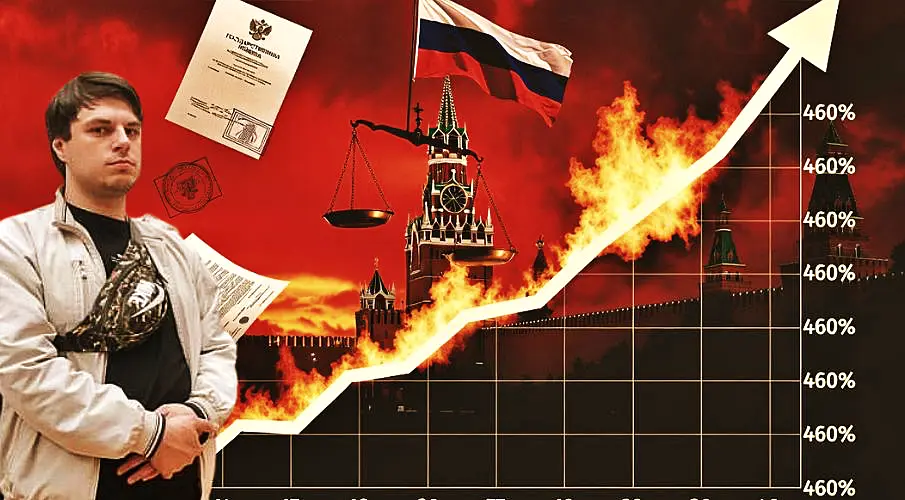
Within two years, the number of treason convictions in Russia has increased by 460 percent. This number does not come from a leak, not from a Western intelligence report, not from an estimate by Memorial or Human Rights Watch. It comes from extended investigation at the Supreme Court of the Russian Federation itself. The country that reports the increase is the same country that produces it. Whoever holds statistics and prosecution in one hand writes history with their own ink and reads it back to themselves.

Putin’s system stands on three pillars. Violence, corruption and intimidation. Three pillars that carry nothing except the man standing on them.
460 percent. In the dry language of the judiciary, it sounds like an accounting category. Translated into life stories, it means something else. Thousands of people are sitting today in Russian camps who were still free two years ago. Mothers who are not told which camp their son is in. Lawyers standing in front of locked archive rooms. Trials conducted behind double doors, in a judiciary that manages its own shadow as if it were the essential thing.
Even at this scale, human rights advocates do not believe the numbers. The real number, they say, is about twice as high. The reason is sober, almost banal. A significant portion of treason cases is conducted behind closed doors. Many verdicts are not published in full. Other cases do not appear in official summaries at all because they are classified, because an official considered them too sensitive, because the apparatus itself decides what is allowed to become statistics and what must remain silent. Anyone convicted of treason in Russia today can disappear into a case file that no one outside the authority will ever read. Disappeared, buried, judicially confirmed, but invisible to anyone who will later ask where he went.
Treason itself is no longer a clearly defined offense in Russia. Originally, the charge referred to classic espionage, direct cooperation with hostile services, the betrayal of state secrets that deserved that name. Today, less is enough. Much less. Contact with a foreign organization. The sharing of information that in the West anyone can read in a free newspaper at a kiosk. Supporting a project that the state has declared undesirable without any law ever having defined what undesirable means. The term has been stretched like a rubber band until it no longer precisely names anything and can capture everything. And that is exactly its new purpose. Not precision. But reach.

Sergei Veselov wrote numbers at a bus stop. Estimated numbers of Russian soldiers killed in the war against Ukraine. Probably with chalk, or with a marker, with something that makes words visible and lets them disappear again when the rain comes. Veselov was convicted for alleged participation in hostile activities, combined with the charge of disinformation and a political motive. Thirteen years in prison. Thirteen years for an estimate that anyone who can read can verify in any independent source. What Veselov did was not espionage. He reminded people, of the dead the state prefers not to count. Memory, Russia has taught us in 2026, has become a crime measured in decades.
Dmitry Kolker was a physicist. He worked on international research projects that were officially approved, on data whose sharing had been authorized by the state itself. He was charged with treason and died during the proceedings before a verdict was delivered. No Western observer saw his files. No independent lawyer was able to defend him as he wished. He died before the system could formally destroy him. Several other Russian scientists have suffered a similar fate, following the same pattern. Cooperation with foreign partners. Exchange of scientific data. All approvals in place. And yet, in the end, a conviction for passing on sensitive information. It is not the act that is criminalized. It is the counterpart. Whoever speaks with the West becomes a traitor, even if the questions they answer were placed on the table by their own ministry.
A shop assistant from Sochi, whose name the public is not allowed to know, was prosecuted for treason because she sent an SMS with military observations. A woman who saw a troop transport parked at the roadside and wrote to an acquaintance what she had noticed. Even at the highest political level, the question was later raised how a superpower could be endangered by an SMS. The question is justified. The answer never came. The shop assistant is still imprisoned.
A former freelance contributor to Radio Free Europe was arrested in 2026 for treason. His name is not mentioned in Russian media, and in Western media there is mostly silence. His name: Aleksandr Andreyev. Charge, cooperation with Ukraine. Details barely public. Proceedings largely in the dark. Aleksandr Andreyev. A name that briefly appeared in Western headlines and then quickly disappeared again, as if no one wanted to hold on to it. The support from Western media for men like him was thin. Very thin. So thin that you had to hold it against the light to see it at all.

Getting information, that worked. That was never the problem. When a correspondent needed a story, a background, a Russian voice describing the regime from within, Andreyev was almost always reachable. And now? Everyone else is always busy with something else.
In the case of Aleksandr Andreyev, the actual pattern becomes visible, clear as a glass of water held against the light. Contact with foreign media is enough. No secret has to be revealed. No evidence has to be presented. It is enough that the suspect’s phone book is sorted by country codes outside the Russian Federation.

Ivan Safronov was a journalist. He reported on defense matters, with sources, with research, with the craft of his profession, with the quiet pride of a man who knows what he is writing about. Later, this very work was interpreted as treason. Twenty two years in prison. His lawyers called the verdict absurd. What Safronov wrote was journalism. What the Russian judiciary made of it was treason. It is the same text, seen through two lenses. One is worn by the citizen, the other by the state. And only the second one judges.

A court in Russia sentenced the lawyer Dmitry Talantov to seven years in prison after he had defended Ivan Safronov.
There are even cases in which proceedings are based on mistaken identity. One activist was prosecuted because investigators confused him with another person. The error was recognized, the error was documented, the error had no consequences. The proceedings continued. In a state governed by law, something like this would produce a headline, an apology, compensation, the dismissal of the responsible prosecutor. In Russia in 2026, it is a note in a file that no one changes. Once someone is inside the machine, they are processed, regardless of whether they were the right person. The machine does not know correction. It knows only forward motion.
What connects these cases is not the severity of the alleged act. It is arbitrariness. A bus stop, a data transfer, an SMS, a phone call to Kyiv, an article about defense, a case of mistaken identity. Any of these can become treason. And that is the real purpose. Not security. Not counter espionage. But deterrence. The message to every Russian who still believes they can speak, write, think, is clearly formulated. Do not do it. We will put you on trial. We will call it treason. You will need twenty years to prove that you did not do it, and you will not live those twenty years.
The speed of proceedings has also changed. Investigations begin earlier. Charges are formulated in days, not months. Verdicts are delivered without extended deliberation. Lawyers report restricted access to their own clients’ files. Families report that for weeks they do not know where their son, their brother, their daughter is being held. This is no longer justice as the West understands it. It is a machine that consumes cases and produces verdicts, as quickly as possible, as quietly as possible, without the trace of public scrutiny that in a democracy acts as a corrective.
All of this fits into a larger pattern. Since the beginning of the war against Ukraine, the Russian state has systematically expanded its control. New laws. Harsher penalties. A growing number of cases against journalists, against activists, against scientists, against people with international contacts. Each of these tools interlocks with the next, like gears in a clock whose purpose is not to tell time but to grind down whatever gets caught between them. Together they form an apparatus through which a state achieves what it wants. Silence at the breakfast table. Self censorship on the phone. The fear of typing the wrong word into a search engine.
If 460 percent is the official number, and human rights advocates assume roughly twice as many, then in reality we are talking about an increase of nearly one thousand percent in two years. Such an increase does not exist in a state governed by law. It exists only in a state that has decided that justice is a tool and not a court. Anyone who looks at Russian history recognizes the pattern. It has a name. Several names. They all stand in history books that Russians do not like to open. They will soon stand there again, with a new name, in a new chapter.
Anyone in Russia today who writes a number at a bus stop risks thirteen years of their life, like Sergei Veselov. Anyone who sends an SMS risks the same. Anyone who makes a phone call with the wrong country code risks the same. Anyone who practices journalism like Ivan Safronov risks twenty two years. Anyone who, like Dmitry Kolker, conducts research on approved data risks their life, because the process crushes them even if no verdict is ever delivered, because the person dies in the meantime. There are countries where you go to prison for a crime. And there are countries where you go to prison so that others do not dare commit one. Russia in 2026 has become the second. Maybe it always was. But now it is so clear that even its own Supreme Court records it in numbers that no one believes anymore.
Treason was once a word for something concrete. Today it is a word for everything the state does not want to hear. And in that transformation lies its sharpness. Whoever empties a word can throw it at anyone. It hits because it has become empty. It breaks the life of the person it strikes because there is no longer any content behind the word that could be disproved. You cannot disprove what no longer means anything. You can only sit. Thirteen years. Twenty two years. An entire generation aging in a cell while the world outside continues and forgets.

The handshake of two men that may be one of the greatest cases of treason in history.
This is the Russian judiciary in 2026. A machine that reports its own numbers and at the same time ensures that no one can take those numbers seriously anymore. A judiciary that empties each new word with every new verdict until nothing remains except the word of the state. Anyone who lives in such a country learns to stay silent. Those who stay silent may survive. Those who speak become part of the 460 percent. Or part of the invisible additional number that does not appear in any statistic because their case was conducted so secretly that even their own family never learns where the father has gone.
Russia counts itself, and the world counts what Russia does not want to count. The difference between the two numbers is the real story of this year. The official statistics show a state that acts firmly. The real statistics show a state that wears down its own citizens, one after another, in closed halls, behind silent doors, in files that no one is allowed to open. Anyone who enters this machine does not come out as the person they once were. And that, in the end, is the real purpose.
Updates – Kaizen News Brief
All current curated daily updates can be found in the Kaizen News Brief.
To the Kaizen News Brief In English


Danke für die Recherche.
Es wäre schön, wenn das auch mal zu den Russland-Anbetern von der AfD und BSW durchkommen würde.
Und ich frage mich immer wieder, was Putin gegen Trump in der Hand haben muss, damit ihm dieser so aus der Hand frisst.
vielen Dank, ja, es wird da noch einiges zu trump/putin zu recherchieren sein um da genaueres sagen zu können
Bedauerlicherweise war das in Russland schon immer so.
Richtige Tatsachen zu den falschen Leuten gesagt, zu falschen Zeit am falschen Ort….. die Liste ist lang.
Kurz nach dem Zerfall der Sowjetunion wurde es besser.
Dann kam Putin.
Und es wurde von Jahr zu Jahr schlimmer.
Nun wird die Meinungsäußerung komplett eingeschränkt.
Dank Putin ein Volk zurück zu stalinistischen Verhältnissen. Zurück zur „Hoch Zeit“ des kalten Krieges.😞
Die Bildunterschrift zum Handschlag von Putin und Trump ist sehr passend.
…das sind so die recherchen, die einen sehr, sehr nachdenklich machen