
Orbán loses power - and clings to the party!

Viktor Orbán has lost the election, clearly and without room to maneuver. After sixteen years in power, his political system is facing a break. His party Fidesz is left with only 52 seats, while the Tisza movement secures a dominant majority with 141 mandates. Orbán does not respond with withdrawal, but with repositioning. He announces that he will give up his parliamentary seat but intends to remain party leader. He justifies this by saying he is not needed in parliament, but for rebuilding his political camp. Control of the parliamentary group is to be handed to his long time confidant Gergely Gulyás.
The move has a clear effect: Orbán removes himself from a new balance of power in parliament, where Peter Magyar will set the tone going forward. Magyar, once part of Fidesz himself, is expected to take over as prime minister and, with his majority, has the ability to reverse key decisions of recent years. Within Fidesz, an open debate is beginning at the same time. Parts of the party are calling for a return to economic issues and an end to constant confrontation with political opponents at home and abroad. Criticism is also directed at Orbán’s circle, especially at economic networks that have benefited from the state and fueled voter frustration.
Despite the defeat, Orbán remains a power factor within the party. Leading voices emphasize that Fidesz without him is hardly imaginable. But for the first time in decades, the party stands without a clear direction, while outside its sphere of influence a new government is already taking shape.
Europe prepares for a long war - without a plan for an end

Europe is bracing for a prolonged war in Ukraine while Washington shifts its focus to the conflict with Iran. That removes decisive pressure on Moscow and at the same time any momentum for serious talks between the warring sides. Neither Russia nor Ukraine is close to a breakthrough, militarily and politically the situation is stuck. In Kyiv, disillusionment is growing over the role of the United States. President Volodymyr Zelenskyy has significantly lowered expectations because clear support is lacking and key Russian demands continue to find an audience in Washington. Talks now take place only in the background, official negotiations are effectively frozen. Proposals for new formats have been rejected by Moscow.
Europe responds with money and sanctions. The European Union is providing a large loan while new punitive measures against Russia are being prepared and existing ones tightened. This is intended to increase pressure, but at the same time there is growing recognition that this alone will not bring a decision. Militarily, Ukraine is holding its positions while Russia, despite heavy losses, is making only limited gains. Both sides therefore see no reason to back down now. The war is increasingly shifting into a state where time, resources, and endurance are decisive.
In European capitals, there is now a lack of a clear idea of how this war can be ended. Support for Ukraine remains politically set, but there is no perspective beyond that. Without an active role by the United States, any solution remains far away, while the conflict continues to drag on.
Trump frames the attack as proof of his importance - and calls for a new ballroom
U.S. President Donald Trump says the shots fired at the White House Correspondents’ Association dinner tonight are a clear example of why the White House needs a new ballroom.
After the shooting at the White House Correspondents’ Association dinner, Donald Trump quickly shifts the focus to himself. At a press conference, he says repeated violence near him is an indication of his own importance. People with influence are targeted, he says, adding that he almost sees it as a distinction. According to police, the suspect moved through a security area toward the ballroom where Trump was seated. A motive remains unclear. The president does not respond with restraint, but with a mix of self interpretation and political demand. He explains that incidents like this show why a new ballroom at the White House is necessary.
See also our article: Shots, sirens, chaos - and a president is pulled out of the room
Trump also refers to earlier incidents, including an assassination attempt during the campaign and another threat on a golf course. For him, danger is part of the office, even as he admits he did not expect it in this form. At the same time, he emphasizes that he will not let it influence him. He originally wanted to continue the dinner, but security forces ended the event. Trump announces he wants to reschedule it within 30 days. The point, he says, is not to let violence dictate how public life operates.
His statements show one thing above all: the attack is not treated only as a security issue, but also as part of his own political framing, in which threat and importance are closely linked. Whether he is wrong about that.
Al Qaeda linked fighters attack Mali - coordinated assaults shake the country
In Mali, armed groups have attacked multiple cities at the same time, pushing the country into a state of emergency. In the capital Bamako, explosions were heard, gunfire lasted for hours while military helicopters circled above the city and the airport was temporarily closed. In Kati, near the country’s largest army base, heavy fighting also took place. Further attacks were reported from Kidal, Gao, Ségou, and Mopti. Witnesses describe fighting in multiple districts, destroyed infrastructure, and ongoing detonations. Even the residence of the defense minister was damaged. Streets in Bamako emptied as security forces tried to regain control.
According to several sources, jihadist groups with links to al Qaeda are behind the attacks, apparently acting together with Tuareg forces. The situation in Kidal is particularly critical, a strategically important city in the north that is said to have partially fallen under the control of the attackers. Foreign forces were recently present there, including Russian units that took over military support for the government after the withdrawal of the Wagner Group. Reports indicate that both Malian troops and these units were targeted.
The government now says the situation is under control but acknowledges that military operations are ongoing. Observers describe it as the largest coordinated wave of attacks in years. For the leadership in Bamako, it is a direct test of stability in a country that has been shaped by conflict for more than a decade and whose security depends heavily on external support.
Russian drones strike NATO territory - Romania reports impacts near residential areas

In Romania, debris from a Russian drone attack on Ukraine’s Odessa region has struck residential areas. In the city of Galați, fragments fell into an inhabited district and were later detonated in a controlled explosion. Shortly afterward, another site near Văcăreni in Tulcea county was confirmed, the area was sealed off and secured by specialized units. The incidents are directly linked to overnight Russian attacks near the Romanian border. According to military data, drones moved in close proximity to Romanian airspace. In response, British Eurofighter jets took off from the Fetești base to monitor the situation.
Residents in border regions were alerted via warning systems. Around 2:30 a.m., residents of Galați reported the crash of an unknown object, shortly afterward authorities confirmed the drone connection. Romania’s Ministry of Defense reacted sharply, speaking of a direct threat to regional security. The impacts on NATO territory show that Russia is disregarding international law and deliberately accepting risks for civilians.
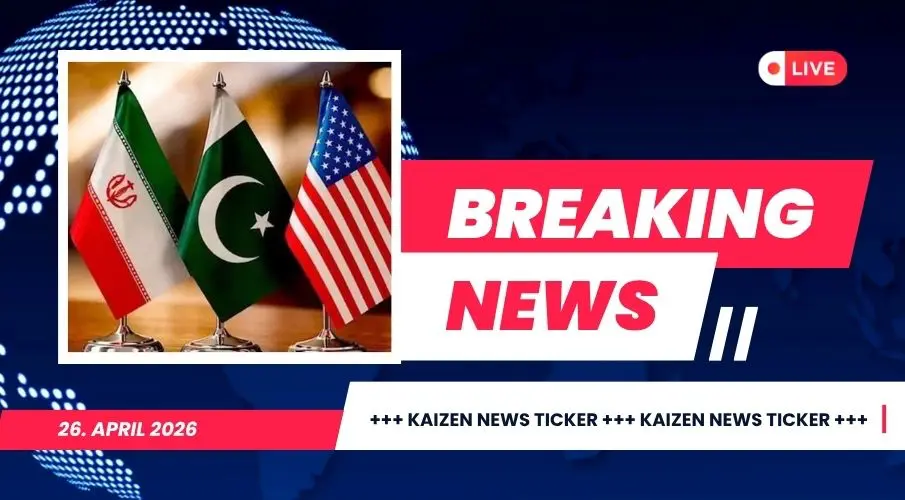
Iran returns to Islamabad - talks continue behind the scenes

Iran’s foreign minister Abbas Araghchi will travel to Pakistan again. After a stop in Oman and ahead of a planned visit to Russia, his return to Islamabad is already scheduled for Sunday. Part of his delegation has previously returned to Tehran to receive new instructions directly tied to possible steps to end the war. Talks are therefore continuing, even if there is no clear line publicly. Pakistan remains a central point of contact for these exchanges while other formats have stalled. Islamabad is trying to position itself as a neutral mediator that makes talks possible in the first place.
At the same time, Pakistan’s prime minister Shehbaz Sharif and Iran’s president Masoud Pezeshkian have spoken by phone. Sharif describes the exchange as constructive and emphasizes that Tehran remains actively involved. For Pakistan, this is about more than diplomacy. The government stresses that it is ready to act as an honest mediator to secure stability in an increasingly tense region. While other actors hesitate or pursue their own interests, Islamabad is keeping communication channels open.
Trump floats state takeover of Spirit Airlines
Asked about the future of Spirit Airlines, Donald Trump responds with a proposal that goes far beyond traditional economic policy. He openly suggests that the government itself could step in and take over the airline. Trump refers to a previously failed merger and draws a direct comparison to the decision at the time under Barack Obama. His conclusion is brief: it did not work. From that he derives the idea that the state should act itself this time.
His approach is unusually direct. Buy, stabilize, later sell. The potential profit is supposed to come from falling oil prices, which would change the airline’s cost structure. He is describing an approach that resembles an investor more than a president. In this case, the state would not regulate, but intervene directly and act entrepreneurially. Whether such a move could even be implemented remains unclear. But the statement alone shows how far economic policy thinking has shifted. State participation is not described here as support, but as a possible investment. How that would end under Trump is not a mystery - it is a guaranteed crash.


Im Trumpversum geht es immer um Trump.
Um seine Genialität, seine Bedeutung, seine Stärke (Ironie)🙈
Was nun genau hinter den Schüssen steckt, weiß noch Keiner.
Deswegen schreibe ich bewusst nicht Attentat.
Und Trump wäre nicht Trump, wenn er das nicht nutzen würde.
Mit seinem Ballsaal wäre das nicht passiert… die Komponente „nationale Sicherheit“
MAGA läuft zur Höchstform auf.
Die irren linksradikalen Demokraten wollen Trumps gute Präsidentschaft beenden.
Umfragewerte werden steigen.
Trump ist der Gewinner.
👍
Staatlicher Einstieg bei Spirit?
Das widerspricht ja der viel zitierten Derugulation des Staates.
Der Staat soll sich doch nicht „einmischen“, der Markt soll es regulieren.
Wenn Trump den staatlichen Einstieg ins Spiel bringt, steckt da viel mehr dahinter.
Er macht nichts aus „Gutherzigkeit“.
Und ob es rechtlich möglich ist?
Danit dürfen sich die Gerichte beschäftigen.
…sehr sehr umstritten das vorhaben und für umsonst gibt es bei trump nicht
Viele dieser Konflikte auf dem afrikanischen Kontinent finden den Weg nicht in unsere Medien.
Danke für Euren Bericht dazu
…es ist wichtig, diese dinge mehr nach aussen zu tragen
Orban will Macht behalten, aber nicht im offiziellen Fokus stehen.
Man darf ihn und sein Netzwerk nicht unterschätzen.
Leider wird das sicher in Europa wieder versäumt.
…da kann ich dir nur recht geben
Seit Beginn von Trumps 2. Amtszeit gab es keine wirkliche Unterstützung für die Ukraine.
Schmerzhafte Sanktionen gegen Russland?
Fehlanzeige
Öffentlicher Druck auf Putin
Fehlanzeige
Es zeichnete sich von Anfang an ab, dass die Ukraine nichts mehr zu erwarten hat von den USA.
Selbst wenn der Irankonflikt jetzt richtig beendet wäre und der Fokus der USA nicht dort liegen würde, wäre das kein Vorteil für die Ukraine.
Denn Trump würde Putin weiter „schmeicheln“ und Sekensky inter Druck setzen.
Wie löchrich die Sanktionen aus der EU gegen Russland sind, zeigen Eure wertvollen Recherchen.
Und Trump erlaubt Russland schon den zweiten Monat Öl und Gas zu exportieren.
…ja die sanktionen sind viele aus der spassabteilung
„…Die Einschläge auf NATO-Gebiet würden zeigen, dass Russland internationales Recht missachte und bewusst Risiken für die Zivilbevölkerung in Kauf nehme…“
Nicht das Erste Mal und sicher nicht das letzte Mal.
Es gibt außer ein paar scharfen Worten nie eine Konsequenz.
Russland missachtet internationales Recht, so wie das Völkerrecht, seit der Annexion der Krim.
…und das mit wenig folgen