
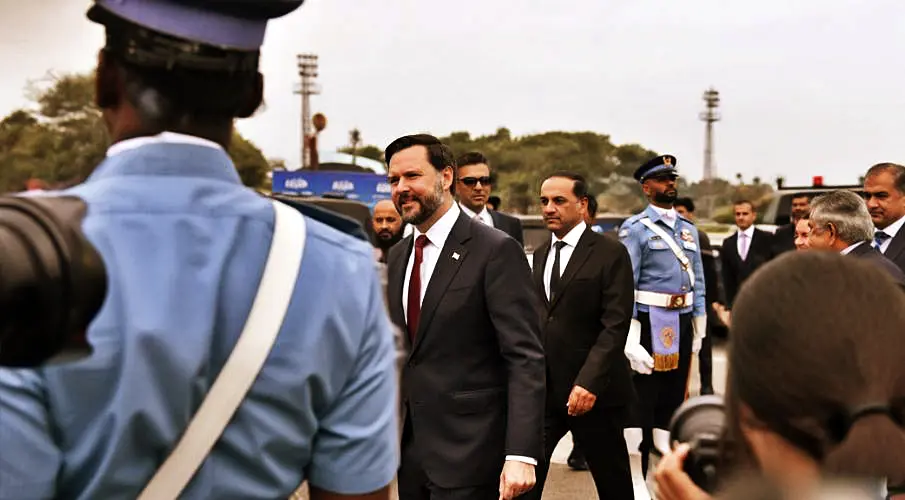
Islamabad – JD Vance is flying back to Islamabad. One week after the first round, which ended after 21 hours without a result, he is set to negotiate again. Same place, same opponents, but a completely changed situation. What began as an attempt to end a war has itself become part of that conflict.
Whether talks will happen at all remains unclear. Only hours after Donald Trump announced the trip, Tehran publicly contradicted it. No meeting had been agreed to. Shortly after, Trump himself reported an attack on an Iranian cargo ship that had tried to bypass the American blockade. The situation is not shifting slowly, it is tipping.
Our current understanding is …
In the background, the threads continue to run, without headlines, but with a sense of urgency that can be felt even if it cannot be seen. China is in contact with Iran and is trying to persuade Tehran at least to resume talks through intermediaries - for now via a phone link to Pakistan, a small step, but in this situation every step that is not backward is progress. Pakistan is working to push Washington toward easing the blockade, or at least toward a monitoring role that sounds less like war and more like control.
What complicates matters further is something no one in Tehran says out loud: there is no unity between the government and the Revolutionary Guard on how far to go and when to stop. Two hands on the same wheel pulling in different directions. Iran’s Foreign Ministry spokesman Esmaeil Baghaei says his country holds no hostility toward the states of the region, and everything Iran has done over the past forty days has been legitimate defense against military attacks by the United States and the Zionist regime. A normalization of traffic through the Strait of Hormuz is not possible as long as the root cause of the crisis persists. Pakistan, Baghaei says, is currently the only official mediator in this process - recognition that sounds like praise, but also means there is no one else picking up the phone.
Vance now stands at the center of a problem larger than any single round of talks. He is supposed to find a way out of a war that neither Washington nor Tehran openly wants to prolong, but that continues nonetheless. At the same time, his own political future is tied to this effort. If he fails again, it will happen in front of a world that has already begun to reassess his role.
He is accompanied by Steve Witkoff and Jared Kushner. Both are part of the delegation, but the responsibility rests with Vance. He is the one expected to deliver. Just weeks ago, he himself was skeptical, warning internally that an attack on Iran could be seen as a break with their own voters. Publicly, he now defends the course.
Donald Trump is increasing pressure at the same time. His messages are clear. A fair agreement is being offered, but if Iran rejects it, every power plant and every bridge will be destroyed. These are words that leave no room, only conditions. Tehran rejects them. The demands are excessive, the positions contradictory, and there is no sign of a serious commitment to diplomacy. Still, the incentive remains for both sides. For Iran, it is about more than political signals. An agreement could release frozen funds, ease sanctions and give a strained economy room to breathe. After months of pressure from war and internal unrest, that would be a turning point. Washington knows this as well.
Substantively, the positions remain far apart. The United States demands a halt to uranium enrichment for twenty years. Iran offers five. It is about timelines, but behind that lies the question of who retains control. The Strait of Hormuz also remains an unresolved point of conflict. Iran has restricted passage through the route that carries a large share of global oil trade. The United States responds with a blockade of Iranian ports. Two lines that block each other. Over the weekend, Iran attacked ships attempting to pass through the strait. For Trump, a clear violation of the ceasefire. For Tehran, a response to the American blockade. Both sides present their version, both stand by it.

In Islamabad, preparations continue. The city was sealed off on Sunday evening, additional security forces are deployed. Everything is ready for talks that may take place - or may not. JD Vance is traveling into a situation where every move is read twice. Progress would be more than a diplomatic success. Another failure would be more than a missed opportunity. It would show that even direct talks no longer open a path. And that is exactly where this effort stands.
Note: The article image is from the first meeting between the United States and IRAN in Islamabad
Updates – Kaizen News Brief
All current curated daily updates can be found in the Kaizen News Brief.
To the Kaizen News Brief In English


Ich wiederhole mich:
Die gleiche Gurkentruppe kommt aus den USA.
Der arrogante Vance, der keine Gespräche auf Augenhöhe führen will/kann
Kushner, die Deal-Hand von Trump und Witkoff, das Anhängsel.
Und Trump der weiter Öl ins Feuer gießt.
Auf der anderen Seite kommt vielleicht Niemand.
Und wenn Jemand kommt, ist er befugt?
Wer hat das Sagen Revolutionsgarden oder Politiker.
Was sagt das Staatsoberhaupt?
Danke, dass Ihr unter Einsatz Eures Lebens recherchiert und berichtet. ❤️
ich danke dir, wir wechseln ja immer durch – gurkentruppe passt zu 100% – die Revolutionsgarde ist mächtig und jede entscheidung ist faktisch von 1 oder 2 stimmen bildmässig abhängig