
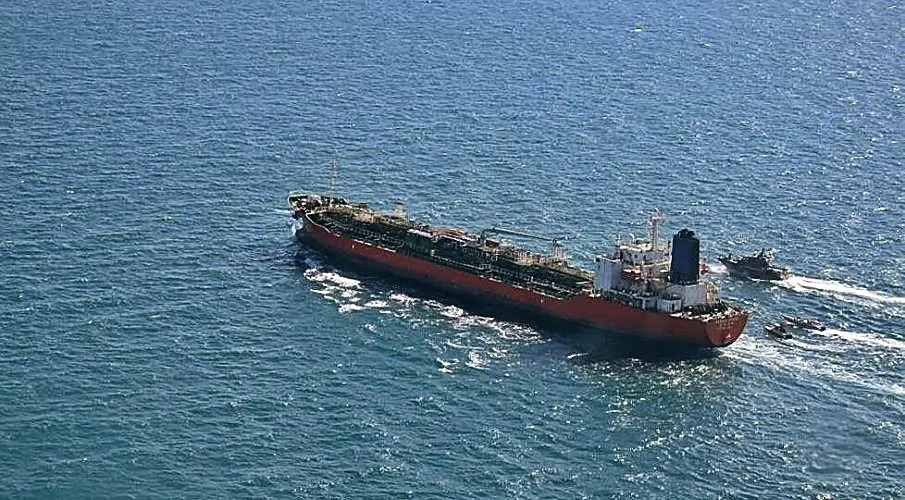
Islamabad - Ships that were still passing through the Strait of Hormuz on Friday turned back again on Saturday. Nineteen had made it after days of waiting, after Iran and the United States agreed to an opening that felt like a window pushed open just a crack. Then Iran struck. Three ships were attacked as they attempted the passage, and U.S. Central Command sent twenty-three more back. The strait through which one fifth of the world’s oil flows is closed again. Hundreds of ships sit on both sides waiting for clearance that comes and goes like a promise no one intends to keep. What read like de-escalation last week has, over the weekend, become what it was before - a bottleneck where power is not negotiated but demonstrated. The global economy feels every day this passage remains closed. But for those involved, that is no reason to hurry. It is leverage.
It is going well, says the man who sees no ships
U.S. Energy Secretary Chris Wright appears on camera and says the talks with Iran are going well. An agreement is not far off. Trump is a creative negotiator who applies pressure in different ways and uses uncertainty as a tool. It sounds like strategy. It sounds like a plan. It sounds like someone describing a chessboard while ships are being fired upon outside. The gap between what Wright says on Fox News and what is happening at the same moment in the Strait of Hormuz is wide enough to sail a tanker through - if one were allowed to sail. But that is exactly the method. The message is not directed at Iran. It is directed at the domestic market, at the stock exchange, at domestic anxiety. A minister projecting confidence while the conflict escalates is not practicing diplomacy. He is practicing reassurance as a form of governance.
Power plants, bridges, and a word meant to carry everything

Trump threatens to destroy every power plant and every bridge in Iran if Tehran does not agree to his terms. A sentence that lands. A sentence meant to land. His UN ambassador Mike Waltz is asked whether targeting civilian infrastructure would be a war crime and responds that it is an escalation ladder. Not yes, not no - a word that sounds like analysis and functions as evasion. Then he adds that Iran hides military facilities in hospitals and schools, so Tehran has no ground to stand on. An argument that shifts responsibility before the bombs fall. The rules of war, Waltz says, allow it. What he does not say is which rules he means and who wrote them. The distance between threat and execution in this war has become so thin that language itself has become a weapon - and the question of whether something is permitted has long been overtaken by whether anyone can stop it.
Tehran says war crime, Washington says nothing
Iran’s Foreign Ministry spokesman Esmail Baghaei says on Sunday what no one in Western capitals says out loud. The American blockade of Iranian ports and coastlines is an act of aggression, a violation of the fragile ceasefire brokered by Pakistan, and a collective punishment of the Iranian population that meets the definition of a war crime. Strong words, easily spoken in Tehran and easily ignored in Washington. But the reality remains. A blockade that affects an entire population is hard to present as a targeted measure, no matter how often it is tried. Baghaei’s statement comes after Iran, in response to the blockade, closed the Strait of Hormuz again - a retaliation that shows that in this conflict every action finds its response, but none finds its solution.
And here we are again - Islamabad keeps open the space in which talking is still possible

As we reported last week, new talks will take place in Islamabad. Pakistan’s Foreign Minister Mohammad Ishaq Dar speaks on Sunday with his Iranian counterpart Abbas Araghchi. The topic is the next round of negotiations between the United States and Iran, which is to take place in Islamabad. Pakistan speaks of the need for continued dialogue, of engagement, of a solution that must come as quickly as possible. Polite diplomatic language that masks how delicate Islamabad’s position is.

Pakistan is mediating between a superpower that threatens to bomb bridges and a neighbor that fires on ships. This is not mediation in the classical sense. It is an attempt to keep open a space between two fires in which talking is still possible. That Iran’s president is expected to speak later in the day with Pakistan’s prime minister shows how tight the timing has become. The talks follow one another like breaths - fast, shallow, and no one knows whether the next one will come.
The same team, the same place, but no new answer


Vice President JD Vance travels again to Islamabad, together with envoys Steve Witkoff and Jared Kushner. The same team, the same goal, the same place. The message in that is not continuity. It is an admission that the first round did not achieve enough to make the second unnecessary. Kushner’s presence alone shifts the tone of the negotiations in a direction that sounds less like diplomacy and more like business. And that is exactly Trump’s signature - foreign policy as transaction, war as bargaining material, peace as a deal. Whether Iran accepts that framework is another matter. One that no one has opened yet.
Missiles with music - Tehran’s answer to its own weakness
Note: We are showing this video for editorial reasons only. We explicitly and without reservation reject the content shown as well as any form of violence.
The world is holding its breath, and it has been holding it so long that it has forgotten what it feels like to breathe freely. A war in the Middle East that opens new fronts every day. A war in Ukraine, triggered by a Russian invasion that has long since become routine in the headlines, as if getting used to the unbearable were an achievement and not a failure. The world does not want to learn. It repeats itself, not out of stupidity, but out of an inertia that runs deeper than any insight. Tomorrow the negotiators travel again to Islamabad, and we can only hope that this conversation shows a small step forward - just one, that is all that is needed for now.
But these are strange times. Power and money are no longer means, they are ends, the defining symbol of these years, the substance from which decisions are made that determine lives without knowing them. And the human being, for whom all of this is supposedly done, has become a part in a chain, interchangeable, movable, replaceable - as long as the chain holds. Pessoa once wrote that life is what we make of it. But sometimes life makes something of us before we even notice.
Updates – Kaizen News Brief
All current curated daily updates can be found in the Kaizen News Brief.
To the Kaizen News Brief In English


Danke für deine Zusammenfassung und eure Arbeit. Der Irrsinn ist nicht mehr auszuhalten für normal denkende Menschen. Passt bitte auf euch auf.
…gerne, gebe dir recht, es ist irre was aktuell auf der welt passiert
Die gleiche „Gurkentruppe“ aus den USA reisen wieder an.
Ein arroganter Vance und Kushner für Deals.
Witkoff… nun ja, der ist dabei.
Die iranische Seite hat keine einheitliche Linie.
Klar ist, dass die Maximalforderungen der USA nicht annehmbar sind.
In den USA unterstützt MAGA weiter Trumps „starken Kurs“, der ja bicht nötig gewesen wäre, wenn Obama und Biden dem Iran nicht so viel Geld gegeben hätten.
Das es iraniscjes Geld aus Danktionen war, wird verschwiegen.
Ebenso die Rolle aus Trumps erster Amtszeit in der er das Atomabkommen aufkündigte.
Die iranische Bevölkerung wird gar nicht gefragt.
Sie zahlen den hohen Preis 😞