
150 seafarers are stranded on six Hapag Lloyd ships. Five and a half weeks in an area where war is being fought. Hapag Lloyd spokesperson Nils Haupt says the company is in daily contact with the captains. They ask how the crews are doing, what can be done. Modern satellite technology at least allows contact with families. Haupt says monotony is the biggest problem. “Five and a half weeks in a war zone - that is something relatively new.”

While these 150 people wait for their return, the rest of the world counts what is left. Fatih Birol, Director of the International Energy Agency, says in an interview on Thursday that Europe has about six weeks of jet fuel left. He calls the situation the biggest energy crisis he has ever experienced. Flight cancellations could soon occur if oil deliveries through the Strait of Hormuz remain blocked. Lufthansa subsidiary CityLine will cease operations on Saturday - high fuel costs and labor disputes make continued operation impossible. 27 older aircraft are being withdrawn from service, earlier than planned.
See our article: Six weeks of jet fuel - and then Europe goes quieter
On Thursday, more than 10,000 American soldiers, marines and pilots are deployed to enforce the blockade of Iranian ports. General Dan Caine, Chairman of the Joint Chiefs of Staff, says at a press conference at the Pentagon that 13 ships made the smart decision to turn around. No ship has yet had to be boarded. Warning shots stand ready as the next level of escalation.
The spectacle:

The Secretary of Defense, or Secretary of War, as he likes to call himself, Pete Hegseth explains that if it is accurate, the United States is using less than ten percent of its naval capacity. “The math is clear. We are using ten percent of the most powerful navy in the world, and you have zero percent of your navy,” he says directly toward Tehran. Hegseth adds in his own cinematic phrasing: “You can move things, but you cannot rebuild anything.” Addressing the Iranian leadership, he says: “I pray that you choose a deal.”
The United States has published a list of what it considers smuggling. Absolute contraband: weapons, ammunition, military equipment. Conditional contraband: oil, steel, aluminum, electronics, heavy machinery - anything that could be used militarily according to the US assessment. The military explains that these goods can be seized anywhere outside neutral territory - regardless of which flag the ship is flying.
China is running out of patience …

China rejects this. Chinese UN Ambassador Fu Cong tells the UN General Assembly that the American blockade is a dangerous and irresponsible step. The Strait of Hormuz must be kept open for international shipping. He calls on Iran to take proactive measures to open the waterway through which about 20 percent of global oil is transported. China and Russia have blocked a resolution in the Security Council supported by the United States and Gulf states that aimed at reopening the strait. Fu Cong says this resolution would have enabled further aggressive actions instead of de-escalating. The man is right.
While counting continues in the Persian Gulf over who still has how much, multiple talks are taking place in the region at the same time, all connected and none of them truly concluded.
What else are they supposed to do …

See also our article: Investigations show: Pakistan, Saudi Arabia and the pact that operates without oversight
Pakistan continues to try to mediate. Prime Minister Shehbaz Sharif travels to Qatar on Thursday, meets Emir Sheikh Tamim bin Hamad Al Thani. From there he continues to Turkey. Army Chief Asim Munir is already in Iran and meets Parliament Speaker Mohammad Bagher Qalibaf. Foreign Ministry spokesperson Tahir Andrabi says at a press conference that a date for a second round of talks between the United States and Iran has not yet been set. Regarding the first round, he says there was no major breakthrough, but also no collapse.
Qalibaf speaks by phone with Lebanese Parliament Speaker Nabih Berri. He says: “A ceasefire in Lebanon is as important to us as a ceasefire in Iran.”
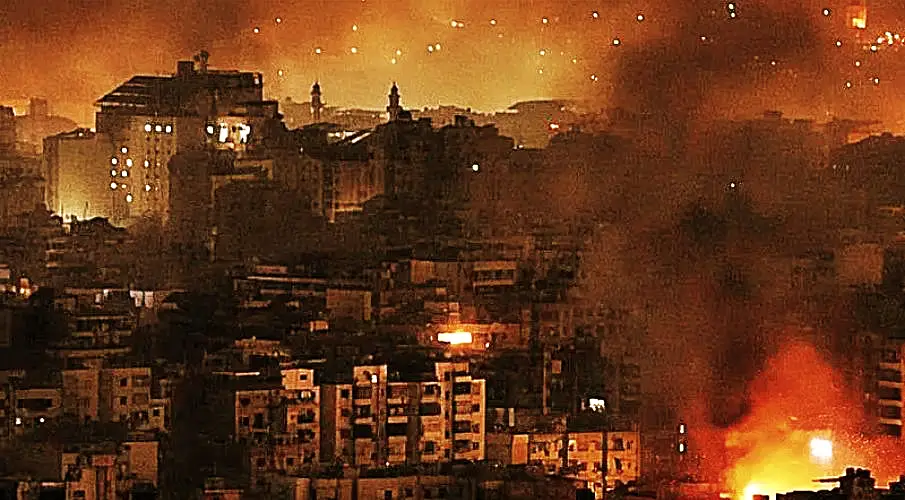
People are dying in Lebanon. The Lebanese Health Ministry reports 2,196 deaths since the beginning of the war between Israel and Hezbollah on March 2 - including 260 women and 172 children, 7,185 injured. Israeli troops are concentrating on Bint Jbeil in the south, where heavy fighting has been ongoing for more than a week. Prime Minister Benjamin Netanyahu says Israel is close to eliminating the city. The military reports that command units destroyed around 70 Hezbollah infrastructure sites in a single minute.
The announcement …
Then, in the afternoon: Donald Trump announces on Truth Social that Israel and Lebanon have agreed to a ten day ceasefire, effective at 5 pm local time. He says he spoke with Lebanese President Joseph Aoun and Netanyahu. He calls it the first meaningful talks between Israel and Lebanon since 1983. Both sides want peace. “Let us get this done,” he writes. Aoun had shortly before still refused to speak directly with Netanyahu. A Lebanese government official says direct talks with Netanyahu are inappropriate given the ongoing attacks and destruction in Lebanon. Washington, it is said, has shown understanding for this position. Trump invites both sides to the White House to continue the talks.

Two municipal leaders from northern Israel say publicly that the ceasefire makes them vulnerable. Moshe Davidovich, head of the Mateh Asher Regional Council, says agreements are made in Washington, but the price is paid in blood, destroyed homes and broken communities. Eitan Davidi, head of Moshav Margaliot, calls it a defeat.

Israeli Defense Minister Israel Katz says Iran is facing a choice between a bridge to the future and an abyss of isolation and destruction. If Iran chooses the abyss, it will be struck with targets more painful than anything hit before.
US Treasury Secretary Scott Bessent had on Wednesday threatened the financial equivalent of a bombing campaign against Iran. Iranian Foreign Ministry spokesperson Esmail Baghaei calls this on Thursday economic terrorism and state sponsored extortion. Houthi leader Abdul Malik al Houthi says in a video address that the United States is making demands in the negotiations that no independent country could accept. The ceasefire is the result of American and Israeli failures.
“Iran’s UN Ambassador Amir Saeid Iravani stated before the UN General Assembly on April 16 that his country has always maintained freedom of navigation. The partial mining of the Strait of Hormuz remains unmentioned - as do the human rights violations against its own population.”
In Paris, heads of state and government are preparing for a conference taking place on Friday. France’s President Emmanuel Macron and British Prime Minister Keir Starmer have convened it. Germany’s Chancellor Friedrich Merz will travel. Norway’s Prime Minister Jonas Gahr Støre will join virtually. The topic: the Strait of Hormuz, how it can be reopened, what it will cost and who will ensure it.
Brothers in Arms …
Fatih Birol says the longer the blockade lasts, the worse the consequences for economic growth and inflation worldwide will be. He calls the Strait of Hormuz a “Dire Dtrait” - a desperate narrowing. There used to be a rock band with that name. Today it is a description of the situation.
And right now …
Trump says before his departure to Las Vegas that four dollars per gallon of gasoline is not particularly high - compared to what is necessary to prevent Iran from obtaining a nuclear bomb. The nationwide average price at the pump stands at 4.09 dollars, 29 percent higher than a year ago. Netanyahu releases a video shortly afterward and says he agreed to the ten day ceasefire in Lebanon to advance peace efforts. “We have the chance for a historic peace agreement with Lebanon,” he says. Hezbollah, which has been fighting Israel for six weeks, rejects the ongoing talks in Washington.
Six weeks of war. Six weeks of jet fuel. And 150 seafarers who look at their families every day - through satellite signals, because the ship is not allowed to move.
Updates – Kaizen News Brief
All current curated daily updates can be found in the Kaizen News Brief.
To the Kaizen News Brief In English


Es wird geredet, gedroht, eskaliert, deeskaliert.
So viele Ego, so viele unvereinbare Positionen.
Trump und Hegseth drohen dem Iran und beleidigen ihn.
Ein stolzes Volk wird das nicht ignorieren.
Die Mullah schon gar nicht.
China ist ungeduldig, verständlich.
Russland soll die Klappe halten.
Der andauerne völkerrechtswidrige Ukrainekrieg führt jede Äußerung Russland ad absurdum.
Europa sollte abwarten.
Vor allem den USA nichts versprechen.
Sondern eine eigene Strategie entwickeln. Aber ausschließlich wenn ein echter Waffenstillstand erreicht ist.