
Prices rise first. Even before the night ends, the markets react. US oil jumps to over 102 dollars, Brent to more than 108 dollars. Just a few weeks ago, the price was around 70. Since Iran has restricted passage through the Strait of Hormuz, it is clear why. One fifth of global oil transport passes through this narrow waterway. Whoever controls it moves the market.
While numbers rise, the war continues to escalate.
Iran fires missiles at Israel again. Sirens sound in Beersheba. Impacts remain limited, the message does not. Israel responds with airstrikes, more than 120 munitions hit targets in Tehran within a single day. Facilities for research, development, production of weapons. At the same time, Iran reports power outages in the capital, shortly afterward supply is restored.

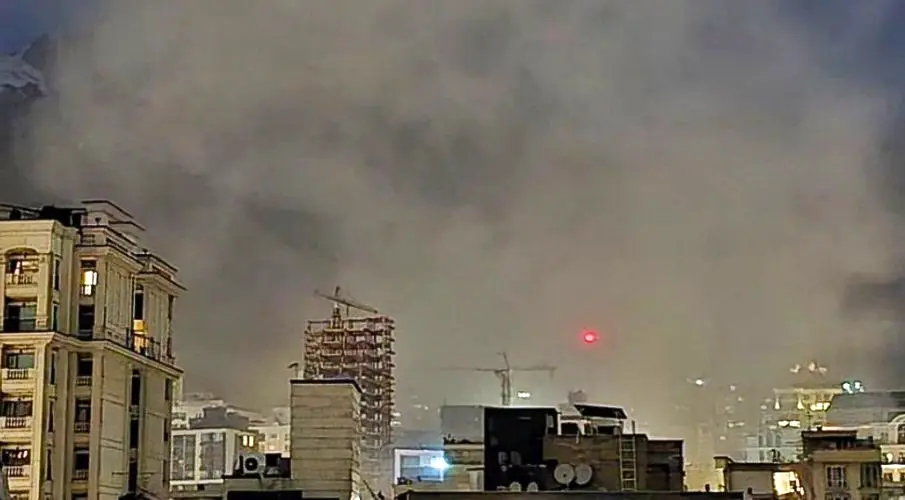
In Tabriz, a petrochemical facility is hit. No release of hazardous substances, it is said. In Tehran, black smoke rises, visible across large parts of the city. Images that repeat themselves.
The war does not remain limited to this front.
The Revolutionary Guard takes a further step. Residential buildings of US and Israeli military personnel and political officials in the region are declared legitimate targets. The justification: Iranian residential areas have also been attacked. This pushes the development further. No longer only infrastructure, no longer only military installations.

Not only people suffer - Tehran is definitely a “cat city.”
At the same time, the conflict is becoming geographically broader.
Israel reports drone attacks from Yemen, launched by the Houthis. Two are intercepted. These are no longer isolated actors, but a network of fronts. Lebanon, Iraq, Yemen. In Israel, after a rocket strike, a facility of the company ADAMA, a plant for pesticides, is on fire. The incident is classified as a hazardous materials situation. Evacuations follow, there are no injuries.
In Lebanon, more than one million people are displaced. Benjamin Netanyahu announces an expansion of the offensive, an enlargement of the security zone. For many, this sounds like another step toward a permanent presence. For those already living in tents or schools, it is another reason not to return.
In Iraq as well, the situation is becoming more uncertain. The US embassy warns of possible attacks on universities with American connections. Students switch to online formats. At the same time, militias linked to Iran attack US bases. The conflict creates circles that are no longer clearly separable.
And yet there is still one place where people are talking.
Pakistan brings together foreign ministers from Turkey, Egypt and Saudi Arabia. Ishaq Dar says both sides have confidence in the mediation and that there is readiness to host talks between the United States and Iran. Direct or indirect, that remains open. Weeks of quiet diplomacy have already preceded this attempt.
Tehran reacts with contradictions.
On the one hand, talks are dismissed as a façade. Mohammad Bagher Qalibaf calls American proposals wishful thinking and announces they are waiting for ground troops in order to burn them. On the other hand, Iran deliberately allows ships to pass through the Strait of Hormuz, this time under the Pakistani flag. A signal that economic connections remain selectively open as long as pressure does not increase further.
The demands are far apart.
Iran demands guarantees against further attacks, reparations and full control over the Strait of Hormuz. The United States relies on conditions that are understood in Tehran as capitulation. Between them stands the question of whether any common ground still exists.
At the same time, the situation is tightening at a point that had long been avoided.
Universities are becoming targets. After attacks on Iranian facilities, the Revolutionary Guard threatens to treat Israeli universities and US universities in the region as legitimate targets if there are no security guarantees. This brings into focus an area that had previously been considered protected.
The numbers of the war continue to grow.
More than 3,000 dead in total. Over 1,900 in Iran, 19 in Israel. In Lebanon more than 1,200. In Iraq 80 security forces. In the Gulf states 20. In the West Bank four. Thirteen US soldiers have also been killed. And while these numbers rise, two movements are running in parallel. On one side troops, missiles, drones, attacks on infrastructure and increasingly also on civilian areas. On the other side talks that are not even confirmed, that can fail at any moment, but that represent the last possibility before this war expands further.
The markets react immediately. Politics hesitates. And the fronts are moving faster than any negotiation.
Updates – Kaizen News Brief
All current curated daily updates can be found in the Kaizen News Brief.
To the Kaizen News Brief In English


Danke für die umfassende Information. Mir macht dieser unkontrollierbare Krieg Angst. Es war/ist ein gr. Unrecht der USA und Israels diesen Krieg zu beginnen (der falsche Zeitpunkt, um gg den Iran vorzugehen), der letztendlich so viele Staaten weltweit aufs Übelste betrifft.
Um afrikanische arme Staaten z. B. kann man bes. besorgt sein. Wenn Dünger usw. fehlen, dann sind Hungersnöte die Folge. Und jetzt? Wie kann der eitle Trump gesichtswahrend aussteigen? Gar nicht. Bald werden Bodentruppen eingesetzt werden und die Eskalation wird weitergehen. Grauenvoll! Unfähige und autoritäre Herrscher setzen die Welt in Brand und was machen wir Europäer?
..es ist schlimm was aktuell passiert und besonders der vorwand, die bevölkerung zu befreien einfach nur ein witz. europa, nicht viel was da kommt und so lange europa schweigt und sich nicht trump in den weg stellt, ausnahmen spanien und leicht macron, mach der powerclown was er will …
Trump und Netanyahu haben eine Lunte angezündet.
Ob ihnen bewusst war, was sie wirklich damit anrichten?
Friedensgespräche nur zwischen Iran und USA…. Israel muss beteiligt sein, damit es da nicht weiter eskaliert.
Da US-Truppen schon zum Teil auf Hotels ausweichen mussten, sind diese ebenso im Visier vom Iran.
Darüber sollten die Golfstaaten nachdenken.
Danke für den hervorragenden Bericht.