
The threat is clear and it comes without detour. Mohammad Bagher Qalibaf, Speaker of Parliament in Iran, directs it straight at the United States. They are waiting for American ground troops in order to “set them on fire” and to “punish their partners forever.” Then comes the next sentence, showing how far the situation has escalated: the fire will continue, the missiles are ready, determination and faith have grown.

While these words are spoken, reality continues to shift toward an open ground war. Around 2,500 US Marines have arrived in the region. The Houthis continue their attacks and are now a fixed part of this conflict. Israel says many targets remain, particularly in the production of ballistic missiles. At the same time, the United States and Israel are working closely together, including militarily.
Pressure is rising on multiple fronts at once.
In the United Arab Emirates, 16 missiles and 42 drones were intercepted within 24 hours. Air defense operated continuously. The sounds over the country were not exercises, but interception attempts. At the same time, the tone in the region is hardening. An adviser to the Emirates, Anwar Gargash, calls Iran the “central threat” to security in the Gulf and demands clear guarantees that attacks on neighboring states will not be repeated.
And while the military situation continues to escalate, one country is trying to take the opposite path.
While missiles and troops are being discussed, a different reality is visible at the border. After a nighttime airstrike near the Iranian side of the Shalamcha crossing, power went out and trade came to a halt for hours. In the morning, much resumed, but disruptions have now become part of daily life. Several dozen people continue to cross the border into Iraq, obtain cheaper food, use the internet, briefly visit family and then return to cities like Abadan or Ahvaz. The attacks are constant and frightening, many say, but they do not want to leave. There is hardly any security left, no one knows when their own home will be hit. Fear has become normal.
Pakistan has brought foreign ministers from several key states to Islamabad. Hakan Fidan from Turkey, Badr Abdelatty from Egypt and Faisal bin Farhan from Saudi Arabia are sitting at the same table. The host is Foreign Minister Ishaq Dar. The goal is to find a way out while the war continues.

The talks are not coming out of nowhere. Prime Minister Shehbaz Sharif had shortly before spoken with Iran’s President Masoud Pezeshkian. Intensive talks, as they are described. At the same time, there are indications that Iran is deliberately sending a signal to Pakistan. 20 additional ships under the Pakistani flag were allowed to pass through the Strait of Hormuz. A step that shows Tehran is placing selective trust, even as the overall situation continues to escalate.
The Strait of Hormuz remains the most sensitive point.

Iran controls access. Any intervention there immediately affects markets. Oil, gas, transport routes. The consequences are already visible. Prices are rising, supply chains are slowing, flight routes are being adjusted. In many countries, fuels must be rationed or subsidized to prevent social unrest.
An energy economist from the United States puts it plainly. Just a few days ago, the long term consequences would have been assessed as limited. Now facilities are being destroyed. Refineries, pipelines, terminals. This means the economic damage will not disappear in the short term. It will remain.
At the same time, political and religious tensions are emerging that reach far beyond the region.

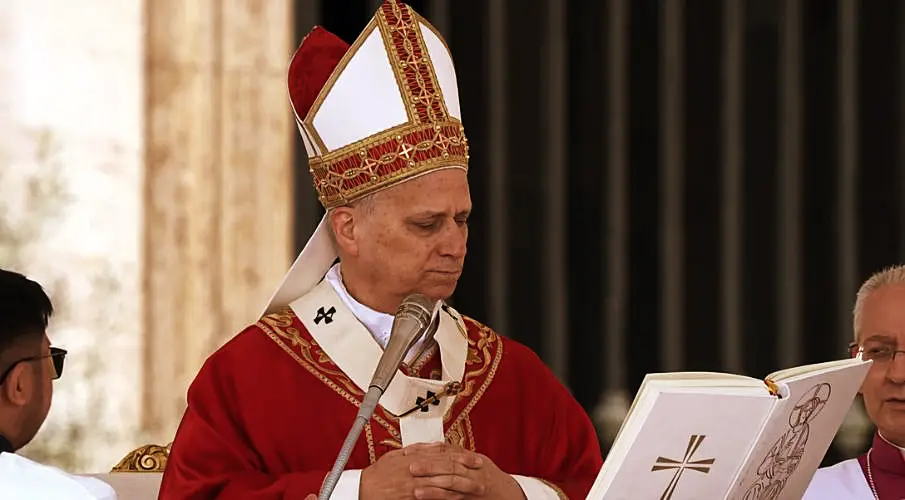
In Rome, Pope Leo XIV openly contradicts the idea that war can be religiously justified. God is a king of peace, not of war, he says. Prayers of people who wage war will not be heard. At the same time, reports from Jerusalem state that Catholic church leaders were, for the first time in centuries, not allowed to attend Palm Sunday mass at the Church of the Holy Sepulchre. An incident that shows how strongly even religious spaces are now under pressure.
At the same time, rhetoric between the main actors continues to intensify.
Qalibaf rejects the 15 point plan put forward by the United States and calls it nothing more than wishful thinking. As long as Washington insists on capitulation, Iran will not give in. Humiliation will not be accepted. This leaves two lines standing side by side that could hardly be further apart.
Here, the threat of a ground war and open violence against American soldiers. There, talks in Islamabad, carried by states that know further escalation could destabilize the entire region. The question is no longer whether the situation is intensifying. That has already happened.
The question is who is faster.
The troops that have already arrived, who still do not know what their mission is. Or diplomacy, which is still trying to catch up.
Updates – Kaizen News Brief
All current curated daily updates can be found in the Kaizen News Brief.
To the Kaizen News Brief In English


Danke für diesen Bericht.
Ungewöhnlich klare Worte vom Papst.
Eindeutig an den evangelikalen Zirkus gerichtet.
Auf dem Treffen in Islamabad, wo es um die Zukunft des Nahen Osten geht, lachen mir die Teilnehmer zu sehr.
Ich hoffe, dass das täuscht und sie das nicht auf die leichte Schulter nehmen.
Und wieder frage ich mich : Warum? Warum ist es uns Menschen nicht möglich in Frieden zu leben? Ich bin traurig für alle Opfer dieses sinnlosen Tötens auf dieser Welt. Alle Opfer, egal welcher Herkunft, welches Glaubens. Das ist alles so unnötig.