
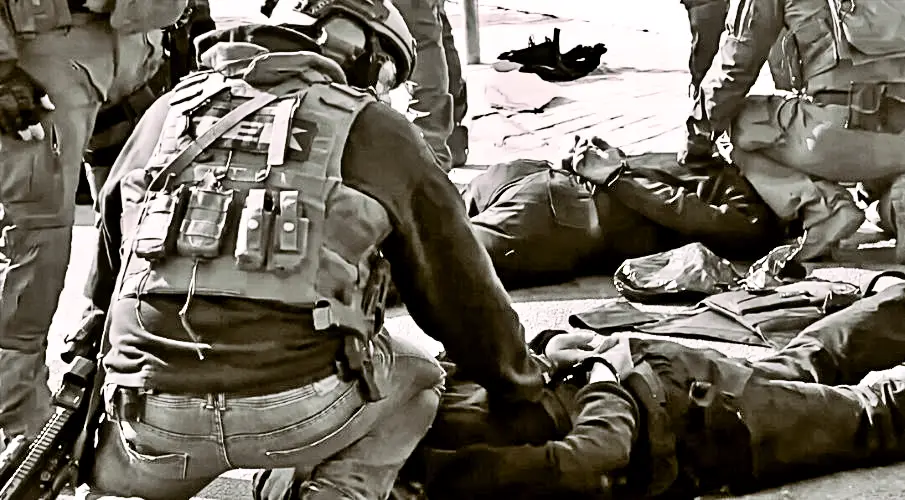
Hungary’s anti-terror unit stops two armored vehicles, seven men are detained, millions in cash and gold are seized. What looks like an operation against organized crime falls apart upon closer inspection. Documents in order, transports authorized, no weapons. And yet an operation follows that holds neither legally nor was it cleanly prepared operationally. On March 5, a convoy of the state-owned Ukrainian Oschadbank is first checked at the border on its route from Vienna toward Ukraine. The Hungarian tax authority NAV reviews the papers and lets the vehicles continue. Shortly afterward, the anti-terror unit TEK moves in. The operation takes place during a stop on the M0 near Alacska. Seven employees are detained, questioned, without legal counsel, some blindfolded and restrained.

“These kinds of investigations are complex and expose what affects people and would otherwise remain hidden.”
In the background, another story is unfolding, Hungarian services have been monitoring the transport route since January. Hotels in Vienna are identified, routes mapped, movements tracked. The operation is directed by Örs Farkas, state secretary for civilian intelligence services and a close confidant of Antal Rogán, who within Viktor Orbán’s system combines both communication and intelligence. Officially, it is about counterintelligence related to a former SBU employee in the convoy’s security team. Internally, a different plan is running. The goal is to produce a finding that can be used politically. Weapons would have been ideal. From that, a narrative could have been constructed that can be used against Kyiv and Western support.
The plan fails
No weapons, no illegal goods, no basis for arrests or seizure. What follows is improvisation. The tax authority is brought in afterward, a money laundering investigation is launched to give the operation a legal framework. Within the authority, this causes resistance because the responsible units were not involved beforehand. At the same time, it becomes clear how poorly prepared the operation was. The unit does not even have sufficient transport capacity to remove the seized vehicles. Military vehicles have to be requested. The Ministry of Defense only learns of it once the operation is already underway. Military intelligence services remain excluded.

The seven Ukrainians are held for over 24 hours and then deported. A particularly serious allegation is raised. One of the men, a diabetic, is given an injection during questioning against his will. His lawyer Lóránt Horváth confirms the incident. Later, traces of a substance are detected that, according to security sources, can be used to influence statements. The man suffers a crisis, loses consciousness and is only then given medical treatment. Oschadbank confirms that regular treatment would have been necessary, but was initially not provided.
The timing is no coincidence
Hungary faces parliamentary elections on April 12. The ruling party Fidesz has been building its communication for months around the conflict with Ukraine. The operation delivers the material that is needed. At the same time, the media staging is underway. Government-aligned media speak of illegal money, of connections to an alleged war mafia. Evidence is lacking. Nevertheless, the story continues to be pushed.

Within Viktor Orbán’s circle, the operation is considered a success despite all inconsistencies. Within hours, the news reaches Kyiv. President Volodymyr Zelenskyy comments publicly and speaks of passing on the address of the person blocking EU aid. Whether the statement is directly related to the incident remains unclear. In Budapest, it is immediately used. The campaign shifts within days. The operation becomes a political argument. At the same time, alleged links between the seized money and the opposition are constructed. Parts of this are created through manipulated content and deepfake videos.

Legally, the situation is sensitive. If it is confirmed that the operation took place without basis, those involved face consequences. Hungarian media already report that responsible officials could face prison sentences. The NAV officer in charge is now on sick leave. The Ukrainian side has filed a complaint for abuse of office and a possible act of terrorism.
What remains is an operation that says more about political power than about security. A seizure without basis, an accusation built afterward, an incident that was escalated outward. Not because something was found, but because something was needed.
Updates – Kaizen News Brief
All current curated daily updates can be found in the Kaizen News Brief.
To the Kaizen News Brief In English


Wenn man gleichzeitig liest, dass der ungarische Außenminister Informationen von EU Außenministertreffen direkt an Russland weitergegeben hat, fragt man sich, was Ungarn noch in der EU zu suchen hat. Auf wessen Seite die Regierung steht, ist ja nun kein Geheimnis mehr.
Richtig, wir hatten uns auf den Teil der geschichte konzentriert, die andere, mal schauen, werden wir kaum schaffen, mal noch genauer anzuschauen.
Ihr kommt ja so schon gar nicht mehr hinterher. Danke für eure unermüdliche Arbeit. Wir leben in herausfordernden Zeiten.
danke dir, ja es sind schon aussergewöhnliche zeiten, wir schauen was bei uns geht, es ist auch immer eine sache von ressourcen, und da müssen wir echt kämpfen
Trump’sches Muster der Beeinflussung und „problemlösung“ es ist sowas von ekelig aber auch durchsichtig was momentan in rechtslastig geführten Länder abgeht
…. das stimmt, es sind sehr bedenkliche zeiten, wo mehr gegenwehr notwendig wäre
Und das ist in einem EU Land passiert.
Einem Land, dass durch Orban Russland so nahe ist, wie seit Ende des Kalten Krieges nicht.
Orban tanzt der EU auf der Nase rum.
Inszeniert und konstruiert etwas, was nicht der Realität entspricht.
Aber, wie auch in den USA, wird es in der Orban-Bubble gelaubt und verbreitet.
Wo war der Aufschrei aus der EU?
Wieso wurde da keine Untersuchung angeordnet.
Vor allem auch wegen der mangelnden medizinischen Versorgung.
Wir sind in der EU, nicht im russischen Gulag.
Aber wie so oft, keine nennbare Reaktion aus Brüssel oder den anderen EU Staaten.
Die einzige Frage, die ich mir stelle:
Warum fährt man mit solch einer sensiblen Fracht durch ein „feindliches“ Land?
…weil die die kürzesten routen wählen, so naiv das klingt