
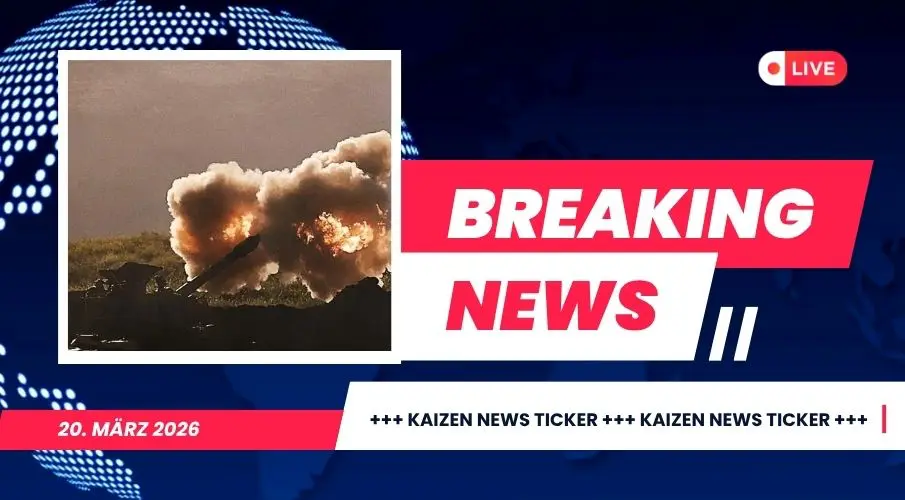
Trump declares Iran’s military defeated - but the war tells a different story!
Donald Trump speaks of complete control. Iran’s navy is finished, the air force disabled, even air defense no longer a factor. American jets would fly wherever they want, without resistance. It sounds like a victory that is already decided. The reality remains more unsettled. While Washington speaks of open airspace, rockets continue to strike across the region, energy facilities are under attack, and allies react nervously to each new escalation. Who really has the upper hand cannot be defined by a single sentence.
“Their navy, their air force, their air defense are gone. We fly where we want. Nobody shoots at us.” That is how Trump describes the situation. It is a clear message, but also a risky one. Because statements like this raise pressure, create expectations and leave little room for setbacks. At the same time, internal assessments show that the conflict is far more complex. Israel is pursuing its own goals, relying on targeted killings and political weakening of the leadership in Tehran. The United States is focusing more on military infrastructure and preventing a nuclear program.
These differences are not new, but they are becoming more visible. The longer the war continues, the clearer it becomes that there is no simple line. Decisions are made in parallel, not always coordinated. Trump himself appears more cautious than at the beginning. A regime change in Iran is no longer seen as a short-term goal. Doubts are growing as to whether the population would even be capable of rising against the existing system. In the end, a contradiction remains: maximum military strength on one side, growing uncertainty about the outcome on the other. Anyone who speaks of complete control must also be able to maintain it. That is exactly what this war will be measured by.
Water cut off - how an attack in Ukraine affects an entire country

An attack on a hydroelectric power plant in Ukraine has consequences far beyond the border. In Moldova, tens of thousands of people are suddenly without water. Oil enters the Dniester, a river that supplies a large part of the population. President Maia Sandu holds Russia responsible and speaks of a threat to the water supply of an entire country. The situation is serious enough that an environmental alert is declared. Authorities shut down water lines to protect the population. Balti, the country’s second largest city, is particularly affected. There, military vehicles deliver drinking water while people have to carry buckets into their homes.
For many, this means an abrupt disruption of daily life. Schools close, classes are moved online. Even basic things become difficult. Fetching water becomes a daily task, especially for older people. The contamination is confirmed, but many details remain unclear. Where exactly the pollutants come from and in what quantities they are spreading is still under investigation. At the same time, emergency teams are working to clean the river and contain the spread.
Initial measurements show slight improvements, but there is no all-clear. The contamination comes in waves, making forecasts difficult. Authorities want to restore the supply only when several tests show stable values. Politically as well, the case is spreading. The prosecutor’s office is preparing proceedings, Russia denies any responsibility. Meanwhile, the ecological damage is already visible. Small animals are dying, the balance in the river is destabilized. What becomes visible here is the direct consequence of an attack on infrastructure. Not at the front, but in everyday life. Without water, an entire country becomes vulnerable.
Schedule stays, reality ignored - FIFA draws the line in favor of the USA

The world football federation is sticking to its course, even though the situation has long changed. Iran had demanded that its group matches not be played in the United States, but in Mexico. The reason is obvious: military attacks, escalating tensions, an environment that makes normal entry practically impossible. A boycott is not on the table, but the conditions are. FIFA rejects the request and sticks to the plan. Two matches in Inglewood, one in Seattle, everything remains as scheduled. The decision does not look like weighing options, but like holding on to a structure that no longer fits reality. Infantino speaks of the unifying power of football, but avoids any clear position on the current situation. It is a sentence that sounds good and at the same time changes nothing. While states confront each other, the federation sticks to organizational logic. Security, political signals, actual conditions on the ground are declared secondary. In the end, a tournament schedule stands that seems more important than the question of whether it is even viable under these conditions. Football is supposed to go on, even if the world has long stopped standing still.
Complaint postponed, conflict remains - FIFA refers to complexity instead of making a decision
The same pattern appears in the Palestinian complaint. The case has been on the table since 2024, concerning clubs from settlements in the West Bank that play in the Israeli league system. For the Palestinian association, this is a clear violation of the rules, for FIFA a case it does not want to decide. The reference to an unresolved status under international law serves as justification, not as a solution. The federation declares the conflict a legal gray zone and thereby withdraws from any clear assessment. At the same time, a fine is imposed on the Israeli association, justified by discrimination and racist incidents. 150,000 francs, combined with requirements and programs to be implemented over one season. It is a step that is visible, but misses the core of the dispute. The central question remains unanswered. FIFA thus deliberately separates structural conflict from disciplinary behavior. One is postponed, the other sanctioned. This creates the image of a federation that acts without addressing the decisive point.
Trust shifts - why even close partners trust the USA under Trump less than China

In several close allies of the United States, a larger number of people prefer China as a partner over the United States under Donald Trump. In Canada, China stands clearly ahead with 57 percent compared to the United States at 23 percent, in Germany 40 to 24 percent and in France 34 to 25 percent. Even in the United Kingdom, China leads with 42 percent over the United States at 34 percent. At the same time, the share of undecided respondents is high, especially in France and Germany.
The numbers are clear and difficult to explain away. In Canada, 57 percent would rather rely on China, only 23 percent on the United States under Donald Trump. In Germany, China stands at 40 percent, the United States at 24. France shows a similar picture, in the United Kingdom the gap is smaller, but China also leads there. This is not a meaningless snapshot. It shows how much perception has shifted. Countries that were closely tied to Washington for decades are beginning to rethink. Trust is not a fixed condition. It develops over years and can be lost in a short time.
The high level of uncertainty is also striking. In France, 40 percent say they do not know, in Germany 36. This does not mean indifference, but doubt. Those who would previously have clearly chosen the United States are now hesitating. The reasons are obvious. Unclear decisions, shifting goals in dealing with conflicts and a tone that puts pressure on partners rather than involving them. At the same time, China appears more predictable, at least in the perception of many respondents. This development cannot be reversed quickly. Trust does not return just because a course is corrected. It takes time, reliable policy and the sense that commitments hold. That is exactly what will determine in the coming years whether the United States can stabilize its role among its closest partners again.
Journalist detained and isolated - case in Tennessee raises questions about ICE

Estefany Rodríguez Flórez is finally free. For more than two weeks, the reporter for a Spanish language outlet was held in detention after being arrested during a traffic stop. The court set bail at 10,000 dollars, which enabled her release. The case raises serious questions. Rodríguez has lived legally in the United States for five years, has a work permit, no criminal record and a family. She has applied for asylum and is awaiting a decision. Her lawyers say she was deliberately targeted because she reported critically on the immigration authorities.
Authorities deny this and refer to their discretion to initiate deportation proceedings. At the same time, they argue that fundamental rights may not even apply in her case. This is exactly where the dispute begins. The circumstances of the arrest are unusual. Her vehicle was surrounded, she was taken away and initially held in Alabama. Later she was transferred to an ICE facility in Louisiana. For days she had no contact with her lawyer.
Particularly serious are the allegations regarding her treatment in detention. Isolation for several days, a forced procedure with a chemical liquid that irritated her eyes. The defense speaks of clear legal violations. Several press organizations that have not yet collapsed under Trump warn of the consequences. When journalists are detained because of their work, it affects not only individuals, but reporting as a whole. The case is not over. Rodríguez continues to fight to remain in the United States. And to clarify what really lies behind her arrest. We will all continue to support Estefany.
Gold, immortality and the small problem with the mirror

There are people who make history. There are people who write history. And then there are people who shape history - in the most literal, metallurgically verifiable sense of the word. America turns 250. That is, admittedly, a significant age. For nations as well, there comes a point when one asks whether there is still something to do, or whether one simply issues commemorative coins.
They have chosen both. Exemplary.
The coin is to be made of 24 carat gold. The purest of metals. Imperishable. Light reflecting. And on it - the face of a sitting president. As if the responsible commission had thought: what better symbolizes continuity, dignity and national greatness than a selfie in precious metal? The vice chairman - a man who gives the impression that restraint has never really been his strength - demands a diameter of three inches. Three inches. A coin you no longer carry in your pocket, but tuck under your arm. A coin that, if thrown, does not ring, but thunders. A coin heavier than the conscience of those who commissioned it.
The Treasury is planning a dollar coin in parallel. Also with the face of the president. One dollar. The more modest brother of the gold colossus. As if to say: for those who cannot afford the big gold - here, take the small face. What is happening here? Nothing unfamiliar, if one is honest. Rulers have stamped their likeness on coins for millennia. Caesar. Augustus. Louis XIV. It is the oldest form of branding. The message has always been the same: I am real. I am here. The money comes from me and returns to me.
What is new - the matter of factness. The relaxed, institutionally approved honking of one’s own horn. The commission approves. The deputy demands more size. The ministry follows. And somewhere in this machinery of enthusiasm and decisions, the question quietly disappears whether anyone else might think this is a good idea. In the end, it is not about metal. It is about a man who already lives in every headline now wanting to live in people’s pockets as well. Eternity, calculated in cents and grams. Immortality in loose change.
Smaller, it has been decided, it will not be.
Orbán blocks Ukraine aid - Europe loses patience and exposes the conflict

In Brussels, patience has run out. Several heads of government openly attack Viktor Orbán and accuse him of blocking key financial aid for Ukraine for domestic political reasons. What was jointly agreed in December is suddenly in question again. Specifically, it concerns a loan package of around 90 billion euros, intended to stabilize the Ukrainian economy and support the military. Part of the money must be released by early May at the latest, otherwise new disruptions threaten in a country that has been at war for years.
Orbán initially agreed to the package, but later stopped it. Finland’s prime minister Petteri Orpo speaks of a clear breach of trust. Clear criticism also comes from Germany. Chancellor Friedrich Merz demands that joint decisions must be upheld. Belgium and Austria join in and openly question whether national election campaigns are sufficient justification. Orbán himself remains firm. He links his blockade to another point of dispute: the halted oil deliveries through the Druzhba pipeline. As long as no Russian oil flows to Hungary, there will be no money for Ukraine. “If there is oil, there is money. If there is no oil, there is no money,” he says.
The conflict runs deeper. Hungary and Slovakia remain dependent on Russian energy and benefit from lower prices. Other EU states have largely moved away from it. These differences are now becoming openly visible. In the end, 25 states adopt a joint declaration, without Hungary and without Slovakia. The goal remains to make the first payments in April. But the dispute shows how vulnerable the EU is when unanimity is required. What began as a joint decision has turned into an open power struggle. And it will not be decided in Kyiv, but in Europe itself.
At the End a Kaizen Moment of the War:

At the end, a Kaizen moment of war:
The smoke is still drifting. Minutes, not hours. Minutes. And then the flower seller is standing there again.
As if nothing. As if everything. He sets up his stand, arranges the hyacinths, lines up the tulips - red, yellow, white - and waits for customers. The customers come. They always come. The street fills, at first hesitantly, then no longer hesitantly, then completely naturally, as if the city had simply kept breathing the whole time, for the Persian New Year that begins on Friday. That is Tehran.
Not the Tehran of the news channels, not the Tehran of rockets and regime and speeches. The other one. The real one. The city that knows bombs and still buys flowers - not despite it, but exactly because of it, exactly now, exactly today, on Nowruz, because the New Year does not ask and does not wait. The regime is still there. Unfortunately. It was promised and not delivered - promises first, rockets after, in that order, with that logic. It is still there.
These people never wanted anything from anyone.
Just to set the table. Celebrate the New Year. Let the children run. Seven things on white cloth, seven initial letters, seven wishes for a new year that might, might this time come true. The flower seller is no longer afraid. Or he is, and sells anyway. Which in the end is the same.
Nowruz Mobarak - Happy New Year


Die EU hat sich von Orban viel, viel zu lange auf der Nase rumtanzen lassen.
Er nimmt das Geld der EU und zeigt der EU ansonsten den Stinkefinger.
Und nun hat er zusätzlich Fico an seiner Seite, was es der EU noch schwerer macht.
Man kann auch sagen, dass die EU ihre Chance mehrfach verspielt hat.
Nun steht da Orban und blockiert alles in Putins Sinne.
Fico springt ihm zur Seite.
Umweltkatastrophe als Kriegswaffe 😞
Und es gibt keinen Aufschrei.
Putin will Moldau auch unterwerfen/sich einverleiben.
Moldau hat kaum nennenswertes Militär und könnte, insbesondere innenpolitisch destabilisiert, Putin nichts entgegen setzen.
Auch für die Ukraine eine Katastrophe.
Wasser ist essentiell.
Jetzt ist es mehr noch ein Kampf um Rohstoffe.
Aber der Kampf um (sauberes) Wasser wird kommen.
Trumps Wahn sich Denkmäler zu setzen.
Nun soll es eine groooooooooße Goldmünze mit ihm sein.
Wobei ich mich frage, ob er da kurz vorm 🤮 ist oder gerade eine rektal Untersuchung bekommt. 🙈🤣
MAGA wird schon kaufen.
Es wird sogar genug MAGA geben, die darauf sparen.
24k Gold… könnte man einschmelzen und was nützliches draus machen 🤣
Nur mit der 1$ Münze wird das nichts lieber Donny.
Das Gesetz verbietet das Konterfei eines Präsidenten bis 3 Jahre nach seinem Tod.
Mal sehen, wie er das umgehen will…
Migranten in den USA mit gültigen Dokumenten oder Greencard werden die konstituionellen Rechte von Trumps Regierung und all den MAGA abgesprochen.
Die gelten selbstverständlich nur für geborene US-Amerikaner … aber am Besten nur, wenn sie MAGA sind.
Und so trifft es „dank“ racial profiling weiter Menschen, wie Florez.
Auch wenn sie keine kritische Journalistenstimme wäre, wäre es vielleicht über kurz oder lang auch passiert 😞
Das sie eine kritische Journalistin ist, macht es noch brisanter.
Freier Journalismus ist in demokratischen Staaten essentiell.
Wer das einschränkt oder eliminiert, ist eine Autokratie oder Diktatur.
Danke, dass Ihr Estefany eine Stimme gebt.
…ja sicher, geht gar nicht, wie die vielen anderen Fälle auch.
Infantino und die FIFA sind ein corrupted menschenverachtender Haufen.
„Fußball verbindet“
Aber sicher doch.
Das Gastgeberland bombardiert das Land eines Teilnehmers.
Aber Fußball verbindet. 🤬🤮🤬🤮
Und wie schon in Katar, wird kaum einer die WM boykottieren.
Die Zuschauer hätten es in der Hand Trump und Infantino den Stinkefinger zu zeigen.
Von den völlig überbezahlten Fußballern ist diesbezüglich bichts zu erwarten.
Das ist das Traurigste daran
…eine komplette Farce, diese ganze WM wird zu einer einzigen Peinlichkeit und schade, wie sich die Verbände verhalten
Trump verkündet, wieder einmal, das faktische Ende des Krieges.
Nur fallen weiter Bomben, der Iran schlägt weiter zurück.
Aber das sind wahrscheinlich die berühmten Fake News.
Kein Wunder, dass China -trotz Autokratie- als zuverlässiger empfunden wird.
Wenn mir das Einer vor 10 Jahren gesagt hätte, hätte ich es wohl nicht geglaubt
…er ist einfach ein Fall für die Klapse
Danke für den kleinen Einblick in einen Tag in Teheran.
Ein Leben zwischen Angst, Notwendigkeiten und kleinen Hoffnungen
Gerne