
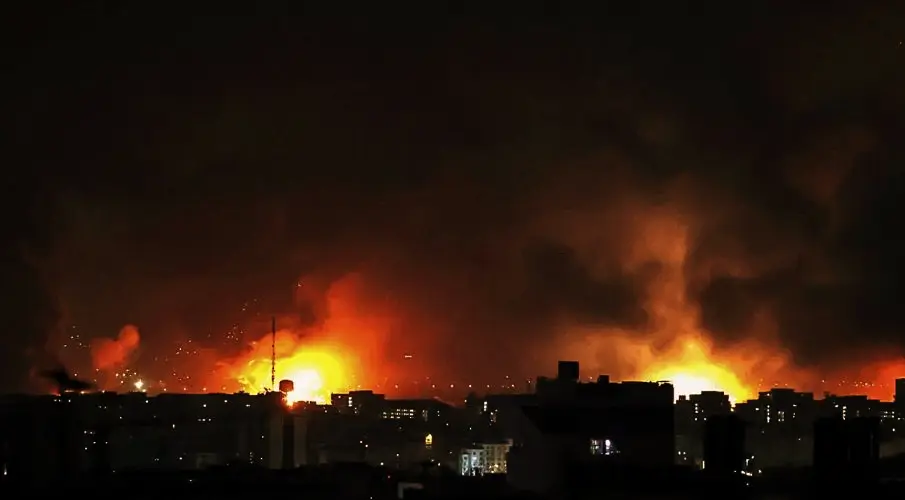
Tehran - During the night into Saturday, a new wave of Israeli airstrikes hit the Iranian capital. The military spoke of broad attacks against state infrastructure. Shortly afterward, Iranian media reported impacts in the area of Mehrabad Airport. Residents described massive explosions, a fireball over the runway, smoke spreading between residential buildings. Two residents near the airport wrote that it looked as if parked passenger aircraft were in flames. Official confirmation of whether the airport was directly hit was initially not provided.
Heavy airstrikes on Tehran over the past several hours no longer appear to follow any discernible coordinated pattern. What stands out, however, is that a significant share of the attacks has been concentrated in western Tehran.

Mehrabad is more than a transportation hub. Since 1938 it has shaped the history of Tehran and until 2007 it was the country’s international gateway. Iran Air and the civil aviation authority are headquartered there. Generations said goodbye here with bouquets of flowers to loved ones. Now the name of the airport stands for a night of fire and sirens. The strikes came only hours after reports that Russia may have supported Iran during the war with reconnaissance data, including satellite images showing the locations of warships and military personnel. Official sources downplayed the significance and pointed out that Moscow had previously supplied information to Tehran. Yet the mere possibility of closer coordination between Russia and Iran heightens tensions far beyond the Middle East.
At the same time, Israel continued its offensive. More than 400 targets in western Iran were reportedly struck on Friday, including missile positions and drone depots. In Beirut, new airstrikes hit the southern suburbs, followed by further evacuation warnings. Around 300,000 people in Lebanon have fled since the bombings began. Mohamed Hjoula, 35 years old, sought refuge with about 40 relatives along Beirut’s waterfront. "We civilians are paying the price of the war," he said. Iran responded with a new wave of drones and rockets against Israel. Sirens wailed in Tel Aviv. The Israeli military reported rocket launches from Iran, but major damage was not initially reported. Gulf states were again drawn into the line of fire. The United Arab Emirates said it intercepted nine ballistic missiles and more than 100 drones. Saudi Arabia reported three intercepted missiles near Riyadh, and Qatar reported an attack in Bahrain without injuries.
The economic consequences are already visible. The price of the U.S. benchmark crude oil jumped nearly ten dollars in a single day and closed near 91 dollars per barrel, the highest level since 2023. Gasoline in the United States averages 3.32 dollars per gallon, eleven percent more than at the start of the war. The combination of military escalation and rising energy prices is weighing on an already fragile global economy.
At the White House, Donald Trump defended the military course. He demanded Iran’s unconditional surrender and at the same time stated that the United States possesses virtually unlimited ammunition supplies. After a meeting with defense industry executives, he announced that production of high quality weapons systems would be rapidly multiplied. Lockheed Martin confirmed an expansion of manufacturing, including PAC-3 interceptor missiles. At the same time, concern is growing in Washington that a prolonged war could noticeably reduce stocks of precision weapons, cruise missiles, and interception systems.
In the Persian Gulf, the situation remains tense. According to analyses of satellite imagery, Iran’s regular naval forces lost several ships in the first days of the war, including units in Konarak and Bandar Abbas. Bases of the Revolutionary Guards on Qeshm Island and near Jask also show heavy damage. Nevertheless, experts warn that fast boats, unmanned systems, and remaining missiles continue to pose a threat to shipping, particularly in the Strait of Hormuz. At least ten commercial vessels there or in the Gulf of Oman were struck by projectiles that have not yet been clearly identified.
U.N. emergency relief coordinator Tom Fletcher spoke of a region in serious danger. Ten million people are trapped between the fronts. In Iran, more than 1,000 people have been killed since the start of the war, including at least 175 in the bombing of a girls’ school. Around 100,000 Iranians have been displaced within a week. UNICEF reported more than 190 children killed in Iran, Lebanon, Israel, and Kuwait. Fletcher warned that the closure of the Strait of Hormuz threatens supply chains for energy, food, and medicine. When sea routes are blocked, prices rise, health systems come under pressure, and aid supplies become scarce.
The war, which began with targeted strikes, has developed into a conflict that simultaneously encompasses military, economic, and humanitarian levels. Smoke hangs over Tehran. Families sleep outdoors in Beirut. In Washington, discussions focus on ammunition production. And in the Strait of Hormuz, it will be decided whether the conflict continues to push deeper into the daily life of the global economy.
Updates – Kaizen News Brief
All current curated daily updates can be found in the Kaizen News Brief.
To the Kaizen News Brief In English


Ich frage mich, ob das auch einer der Pläne von Projekt 2025 ist?
Man hört ja immer wieder: Auf dem Planeten leben zu viele Menschen.
Was machen Eliten dagegen?
Guckt man sich dieses Muster an wird deutlich, Eliten wollen die „Masse“ los werden.
Den reichen Eliten machen diese Teuerungen nichts aus, sind auf Kriegsschauplätzen niemals persönlich anzutreffen – die sitzen warm und trocken und feiern bei Champagner und Kaviar, tanzen, lachen – und spielen ihre Spielchen – wie man „hört“ auch hier immer mal wieder mit Minderjährigen.
Diese Eliten haben die Länder der Erde und deren Bevölkerung vermutlich mit Punkten versehen.
Einfach ausgedrückt: Wie Trump schon sagte: Diese hier sind Müll, jene sind weniger wertvoll weil nicht ganz weiß, die anderen sind zu arm…. Es wird gesiebt bis nur noch das übrig bleibt was man BRAUCHT um Eliten zu dienen – oder eben die Eliten an sich!
Der „Witz“ an der Sache: Die sogenannten Eliten wollen alle ihr eigenes Zuchtprogramm in Gang setzen!
Musk faselte so einen Blödsinn,
die Tage las ich selbes vom Epstein …. und wer weiß schon wer noch mit solchen Gedanken schwanger geht!?
Die, die hinter dem Projekt 2025 stehen, die scheinen eine echte Gefahr für die Menschheit zu sein.
Das Menschen ohne Gewissen – es können sich nur um Soziopathen handeln.
Tragisch – man erkennt es und kann nichts bis wenig dagegen tun!
The Hunger Games, The Handmaids Tale ….. sind wohl die Anleitungen 😞
Gerade gefunden… und nein, mal wieder kein Fake Vido.
Das hat das Weisse Haus soeben gepostet

Das offizielle Weisse Haus hat echte Bombenangriffe auf den Iran mit Call-of-Duty-Spielszenen zusammengeschnitten. Killstreak-Animationen aus einem Videospiel. Über echten Toten. Als Propaganda. Auf X. Zum Feiern.
165 tote Mädchen unter einer Schule. 18 Mädchen in einer Sporthalle. Über 1’000 Tote in sechs Tagen. Sechs eigene Soldaten tot. Und das Weisse Haus macht daraus ein Highlight-Reel. Wie ein Teenager, der seine Kills auf Twitch streamt. Nur dass hier echte Kinder sterben.
Das ist kein Meme. Das ist kein Trolling. Das ist die Regierung der Vereinigten Staaten, die Krieg als Content verpackt. Für Likes. Für Klicks. Für die MAGA-Basis, die Bomben feiert wie Touchdowns.
Das dümmste, kränkste, abartigste Zeitalter der Menschheitsgeschichte. Und das Weisse Haus ist sein Content Creator.
https://x.com/whitehouse/status/2029741548791853331?fbclid=IwY2xjawQY2NRleHRuA2FlbQIxMABicmlkETBONnJtT3EyYkdRRkxLVFBHc3J0YwZhcHBfaWQQMjIyMDM5MTc4ODIwMDg5MgABHuoWownHqt5yZuq_FCuQWzdcKqL_9zEp_Vqu_TvLPBVK3Wt8p1nVlHqIuuHg_aem_IppPum5mfL9qFf5-xM5giw
….hatten wir gestern gesehen, fanden es aber zu armselig, es auf unsere Seite unterzubringen, es gibt grenzen der geschmacklosigkeit
Schlimm, dass diese Grenze nicht der Präsident inne hat. – Zumindest aber die offiziellen Kontrollen was an die Öffentlichkeit gelangen darf / kann…
Was sagt so was über ein Land? Was über einen amerikanischen Präsidenten und seinem Stab?
Kann man solch einen Präsidenten noch ernst nehmen?
Mit ihm Verträge abschließen?
Nur in diesem Kontext sehe ich dieses ( solche) Video.
Absoluter Tiefpunkt!
Den Tod, das Leid als Videospiel darzustellen.
MAGA bleibt recht still.
Stattdessen kommen Postings über Jane Fonda und Vietnam 🙈🙈
Russland liefert Daten, der Iran hat offenbar noch genug Kapazitäten Angriffe zu starten.
Der ganze Nahe Osten ist nicht sicher.
Kein Anreiner.
Aber all die Reichen, wie Sonja schrieb, sitzen weich und bequem.
Sie zahlen nicht den Preis für den Krieg.
Sie sitzen in ihren Prunkpalästen und sinieren über mehr Macht.
Den Preis zahlen all die Menschen, die hunger, verletzt oder getötet werden.
Auch die restliche Welt wird es merken.
Erstmal in Form von hohen Energiepreisen.
Vielleicht spekuliert Trump darauf.
Das andere Staaten in den Krieg einsteigen um ihre Wirtschaft am Laufdn zu halten und die Menschen mit Energie zu versorgen.
Völkerrecht ist nur noch ein Wirt.
Mit Trump ist es endgültig zerstört worden.