
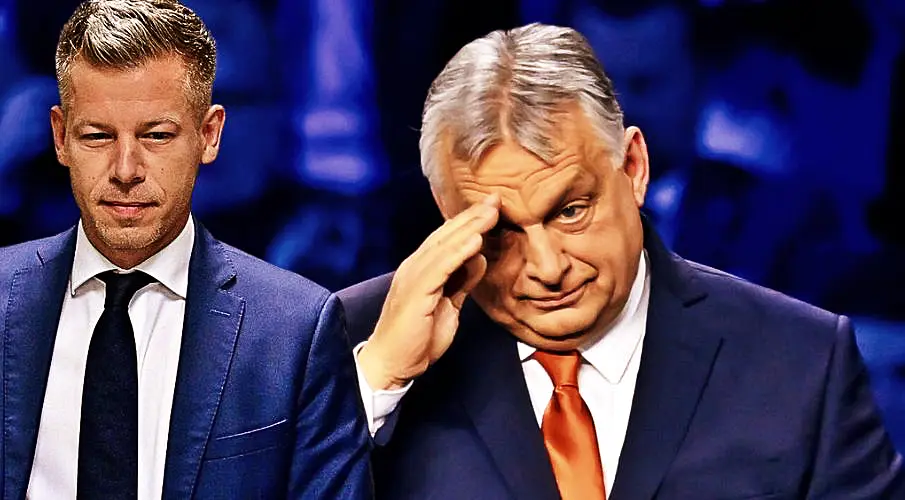
Viktor Orbán stands in the evening in Budapest before his supporters and says a sentence that changes everything. The result is understandable and clear, he says, it is painful but unmistakable. After 16 years, his time at the head of Hungary is over. He congratulates the winning party and announces that he will in the future serve the country from the opposition. At the same time, he adds that they will not give up. A transfer of power that had become apparent early and was confirmed more clearly over the course of the evening.

On the other side of the city, Péter Magyar celebrates with thousands of supporters along the Danube. His party Tisza is clearly ahead after a large portion of the votes has been counted. More than half of the votes go to him, while Fidesz lags far behind. In seat projections, this means a clear majority, in some cases even a two-thirds majority. Magyar publicly thanks the voters and calls on them to remain calm and enjoy the moment if the expectations are confirmed.

Turnout is high, as high as never before since the end of communism. More than three quarters of eligible voters have cast their ballots. That too is a signal. Orbán’s chief of staff Gergely Gulyás speaks of a strong democracy, while at the same time both camps report irregularities and announce that they will review possible violations.
The political break goes deeper than a simple change of government. Orbán was for years one of the defining figures in Europe, at the same time a constant point of conflict within the European Union. He blocked decisions, including a multibillion aid package for Ukraine, and maintained close contacts with Vladimir Putin. Allegations that content from EU discussions reached Moscow further intensified tensions. Hungary increasingly moved into a special position within the EU.
Internationally, this election was closely watched. Donald Trump openly supported Viktor Orbán, and shortly before the vote JD Vance also traveled to Hungary as a high-ranking representative from the United States. There was also interest from Russia in Orbán remaining in power. Conversely, many in Europe have for years seen him as a risk to joint decisions and fundamental political principles.
Péter Magyar represents the countermodel, at least in the perception of many voters. The 45-year-old was long part of the system before breaking with Fidesz in 2024 and founding his own party, Tisza. His campaign focused on concrete problems in the country, on the healthcare system, on infrastructure, and on allegations of corruption against the government. In a short time, he managed to establish a presence nationwide. At times he visited several cities in a single day. In the 2024 European elections, his party already achieved a strong result and entered the European Parliament.
At the same time, the path for him was anything but easy. Orbán controlled large parts of the media landscape, both public and private. The electoral system was changed several times in recent years, constituencies were redrawn. For a simple majority, the opposition would have mathematically needed more votes than the ruling party. In addition, Hungarian citizens abroad were also able to vote, who traditionally tend to support Fidesz.
Magyar himself describes this election as a decision between two directions. Between East and West, between propaganda and open debate, between corruption and a clean public life. A 21-year-old voter in Budapest puts it similarly. He voted so that Hungary could finally become a European country again and to overcome the division in the country.
Not all votes have been counted yet, and both sides keep open the possibility of contesting the results. But the picture is already clear enough to identify a political turning point. A long-serving head of government loses power, a former ally takes over leadership. For Hungary, a new phase begins, whose direction will only now become clear.
Updates – Kaizen News Brief
All current curated daily updates can be found in the Kaizen News Brief.
To the Kaizen News Brief In English


Hoffen wir, dass es für Ungarn und Europa besser wird.
…das wäre so wichtig
Erstaunlich, dass Orban seine Niederlage eingesteht.
Ich hatte was in Richtung „gestohlene Wahl“ oder „Wahlmanipulation durch due Ukraine und die EU“ erwartet.
Irgendwie sagt mir mein Gefühl, da kommt noch was.
Magyar ist auch konservativ.
Aber mehr pro EU.
Ich hoffe, dass er den Kurs, mit der Macht die er nun hat, auch einschlägt.
Für Europa und Ungarn wird es hoffentlich besser.
Putin hat seine EU-Marionette verloren.
Nun wird er Fico aufbauen… und ein oder zwei Andere sind für Putin auch gute Kandidaten.
Die EU täte gut daran, schnell diese Einstimmigkeitsregelung gegen eine 2/3 oder 3/4 Mehrheit zu tauschen.
Damit nicht ein Land alles blockieren kann.
…bei dem brett, da helfen auch keine erlasse mehr, oder versuche es zu drehen