
There are crimes executed so deliberately that at some point one must stop speaking of isolated cases. The abduction of Ukrainian children is one of them. It is systematic, planned, and built over years. 19,546 children are considered abducted, over one million live under Russian control without any legal path home. 2,245 are missing, nearly 700 have been killed, more than 2,000 injured. And only 1,850 have been brought home so far – each one after months of diplomacy, covert routes, and international assistance.
Maksym Maksymov of Bring Kids Back UA describes the goal without detours: “Identity erasure is designed to create a future population in the occupied territories that is politically aligned with Russia and disconnected from Ukraine.” This defines the structure of this system. Children are torn from families, distributed across 57 Russian regions, placed in more than 210 facilities – homes, camps, centers for reeducation. Some end up in Siberia, others in the Far East, on the Kuril Islands, in regions like Mari El. Some even 9,000 kilometers away in North Korea. At a special UN session and in hearings in Canada and the United States, what has long been obvious was stated openly: Russia is committing mass abduction, forced adoption, reeducation, and militarization of Ukrainian children. All of this falls under the definition of genocide in international law. The reaction was unusually clear: 92 states demand the immediate and unconditional return of all Ukrainian children. But Russia and eleven other countries voted against it.

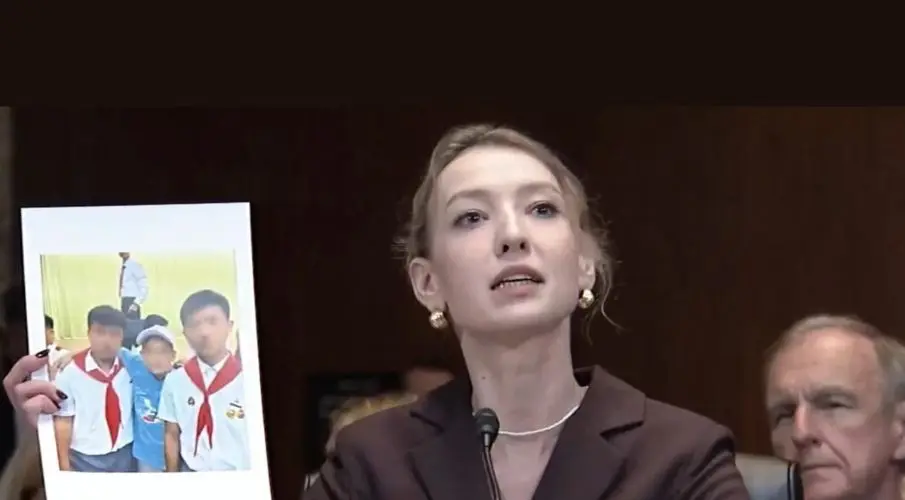
One of the most distressing statements came from human rights lawyer Kateryna Rashevska. She showed the photo of a twelve-year-old boy and a sixteen-year-old girl from the occupied territories. Both were taken to North Korea, far from any possibility of return. Later they received draft notices for the Russian army. Rashevska put it this way: “The goal is for Ukrainians to shoot at Ukrainians.” It is difficult to describe the intention of this system in harsher words.
The scale becomes even clearer through the work of the Yale Humanitarian Research Lab. Its director, Nathaniel Raymond, explained how the investigations began: Russian local officials posted selfies with Ukrainian children – including location data. This carelessness exposed what Russia wanted to hide. Investigators mapped a network of more than 210 facilities stretching from the Black Sea coast to regions closer to Japan and Alaska than to Kyiv. According to their data, at least 6,000 Ukrainian children were in such camps at the beginning of 2023. Their internal estimate, however, is around 35,000 – almost twice the number officially stated.

Raymond’s team documented four major groups of affected children: those in Russian “reeducation camps”, children whose parents were killed by Russian attacks, minors separated from their families during filtration, and children taken from Ukrainian institutions who later appeared on Russian adoption websites. One discovery was particularly shocking because of a detail: a specific wallpaper color that appeared in a Russian “orphanage” had previously appeared in footage from a Ukrainian institution that had been emptied during the occupation. The message was clear: the children were not hidden – only their origin.
And then came a message that shows how fragile such investigations are. Raymond explained that his project’s funding had been cut. “We have four to six weeks left,” he said. If that period passes, a darkness threatens in which many traces will become untraceable.
At the same time, there are small signs of hope. Seven children were brought home this week. Among them nine-year-old Inna. At six she was seriously injured, taken to Russia, placed in a home near Moscow to be prepared for adoption, while her relatives did not know whether she was still alive. Now she is back with her family. But her return is an exception – and a reminder of how large the gap is between 1,850 rescued children and the tens of thousands abducted. Melania Trump had nothing to do with the return of these seven children. Her portrayal was politically motivated and distasteful.
Ihre Darstellung war politisch motiviert und geschmacklos.

In the United States there was another moment that highlighted the gravity of the situation. The Republican chairman of the Foreign Affairs Committee, Michael McCaul, described scenes from the film “Children in the Fire”: children tortured with electric shocks under their fingernails and in their genital area. “I cannot imagine, as a father, that something like this would happen to my children,” he said. It was not a political sentence, but a human one. The world is responding, but too late and too slowly. Ninety-two states have taken a position. Others remain silent. And Russia continues its system because it knows what is at stake. A people can only survive if its children belong to it. Whoever abducts them wants more than territory. They want the future.

The photos show two Ukrainian boys who were listed on Russian adoption portals under anonymized profile pages (“anketa”) as though they were regular orphans. In reality, many of these children are minors who were abducted from Ukraine during the occupation and then systematically transferred into the Russian adoption system by Russian authorities.
Such advertisement lists are among the most important pieces of evidence that Russia presents abducted Ukrainian children as “ready for adoption”, renames them, alters their identities, and then places them with Russian families.
This is why this attack is so dangerous. And this is why it must be named for what it is: it is an attempt to destroy a generation. What Russia is doing is identity theft on a massive scale. An attack on language, culture, family, and origin. A crime the world cannot ignore. Ukraine is not only fighting on front lines. It is fighting to bring each of these children home. To ensure that their names, their language, their memories are not erased. That they are not put into uniforms forcing them to fight against their own country. And that their lives are not turned into instruments of violence.
Every child who returns home is a victory. Every child who is still missing is a mandate. There must be no doubt: all must return.
Investigative journalism requires courage – and your support.
Support our work against right-wing populism, disinformation, and violations of human and environmental rights. Every contribution goes directly into our daily reporting – we operate without advertising, without subscriptions, without corporations, without political parties. Our journalism is meant to remain freely accessible. For everyone.
Independent – Critical – For Everyone
Thank you for making our independent work possible.
Updates – Kaizen News Brief
All current curated daily updates can be found in the Kaizen News Brief.
To the Kaizen News Brief In English


Wieso lehnen soviele Länder die Rückführung entführter Kinder ab? Ich verstehe sowas einfach nicht.
es sind länder wie der iran, mali oder auch nigeria zum beispiel, also nicht grade die paradedemokratien
Es ist so bösartig und unmenschlich, was die Russen da mit den ukrainischen Kindern machen. Kinder, die veletzlichsten menschlichen Wesen aus ihrer Umgebung zu reißen, ihnen ihre Bezugspersonen wegzunehmen, ihr Leben, ihre Kultur und vielleicht auch ihre Erinnerungen. Sie irgendwo hinzuverfrachten ohne Chance auf Rückkehr – wenn ich daran denke, sehe ich gleichzeitig meine Enkelkinder vor mir und es bricht mir das Herz.
…mit worten ist das kaum noch zu beschreiben, es ist die unterste stufe jeglicher menschlichkeit und man kann es nur noch als barbarisch bezeichnen