
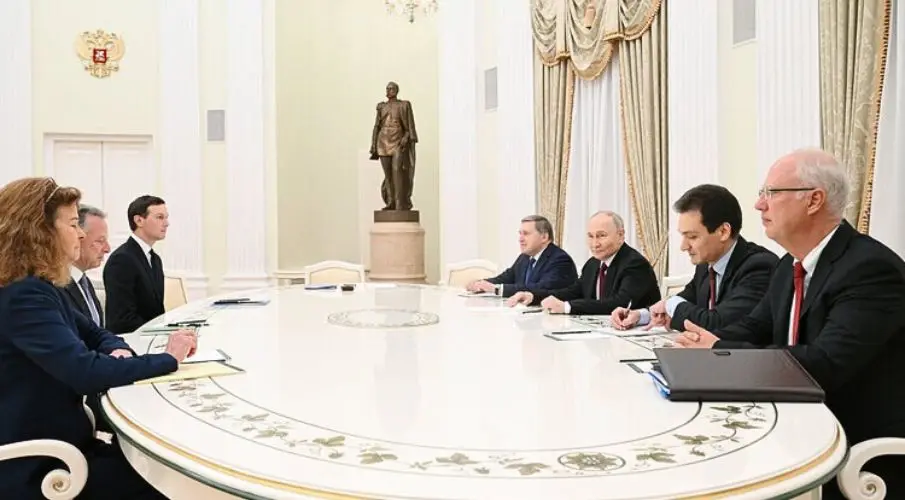
The world is watching as talks in Moscow attempt to create a peace that is not a peace. For five hours, Donald Trump’s special envoy Steve Witkoff, his son-in-law Jared Kushner and Vladimir Putin sat together – and in the end, one sentence sounded as cold as it was revealing: there is no breakthrough. Yuri Ushakov, Putin’s most important foreign policy adviser, said afterwards that the meeting had been long but solved very little. They were “no closer to a solution”. On territorial issues there was no movement. These are the very points that have been the open wound of all negotiations for months. Russia wants the entire Donbas, although Ukraine still controls parts of it. Kyiv rejects that, and so does Europe. And even in Washington it is far from clear how far Trump would go.

The context of these talks is remarkable. Just a few days ago, Volodymyr Zelensky said in Dublin that the United States and Ukraine had agreed on a revised peace proposal with 20 points. A kind of counterreaction to the 28 point plan from the Trump circle that Europe perceived as an invitation to Russia. Zelensky said the new version looked “better”, without explaining what exactly had been changed. Now it becomes clear how fragile that hope is. Ushakov indicated that some American proposals seemed “acceptable”, but much of it was simply “unsuitable”. The work would continue. That means: there is no agreement and no tangible line that both sides could converge on.
Witkoff and Kushner left the Kremlin shortly after midnight and drove to the U.S. Embassy. It was a symbolic image: two men who are supposed to influence a war that has gripped Europe and the world for four years – without a discernible strategy, without diplomatic experience, without the backing of international partners. Europe stands by in disbelief. French President Emmanuel Macron emphasizes that peace can only come about if Europe is at the table. The Europeans have submitted their own proposals to prevent the United States from shaping an agreement that could, in the worst case, give up Ukrainian territory.
Meanwhile, Trump’s administration appears like a mesh of competing lines. Secretary of State Marco Rubio is missing from the current NATO meeting – officially due to scheduling, unofficially because the Moscow talks have political priority. NATO Secretary General Mark Rutte tries to play down the absence, but in European capitals the concern is growing that Washington is making decisions behind closed doors that Europe will have to deal with later. A senior NATO official also said that the situation at the front is dramatic: Myrnohrad is almost encircled, Pokrovsk is more than 95 percent under Russian control, and supplies are in some cases only possible by drone. The military situation intensifies the political one. The more Ukraine is under military pressure, the easier it becomes for Moscow to make demands.
Zelensky warned on Tuesday that he feared “games behind Ukraine’s back”. A quiet but clear message to Washington. His comment in Dublin that America showed “interest in the diplomatic path” sounded less like praise than an attempt to dampen pressure. Rarely has Ukrainian American coordination appeared so fragile. During the talks, Putin struck a tone that set off alarms in Europe. They did not want a war with Europe, he said. But if Europe started one, “there would be no one left to negotiate with”. It was a threat that cuts deep into Europe’s internal debates: how long can one support Ukraine while Trump’s administration simultaneously tries to shape a deal that ignores Europe’s security interests.
“Europe has taken itself out of the solution for Ukraine” – this was Putin’s comment. He emphasized that the Europeans had no peace agenda of their own and were currently hindering American efforts toward an agreement.
At the same time, new reports of attacks emerged: a Russian tanker was said to have been hit by a drone off the Turkish coast. No casualties – but another sign of how far this war has expanded. And in Italy there is tension. Giorgia Meloni’s government postponed a decree on new military support because coalition partners were questioning aid for Ukraine. The war is grinding its way through governments, budgets, and election programs.
In all this pressure, a dangerous space is opening. Trump described the war on Tuesday as “a total mess” and spoke of 25,000 to 30,000 deaths per month. It sounded like a president who no longer wants to carry the burden and at the same time barely understands the position Europe is in. He sends envoys whom Putin has known for decades, but who are not diplomats. People like Witkoff and Kushner, sitting at long Kremlin tables and representing a mandate that changes by the day. It remains unclear whether they are negotiators – or merely messengers of a president who dreams of a deal he can sell as a triumph.
After the five hour meeting between Vladimir Putin and Trump’s special envoy Steve Witkoff in the Kremlin, Putin’s foreign policy adviser Yuri Ushakov said that Moscow had received four additional documents that go beyond Trump’s original 28 point plan. Russia considers some American proposals discussable, but others unacceptable. No breakthrough was reached, but both sides do not rule out progress.
Ushakov emphasized that Russia and the United States are “no farther apart” than before and that the talks were constructive and substantively useful. Territorial issues were addressed but not resolved. Putin sent friendly messages to Trump through Witkoff, while the U.S. side conveyed greetings from Trump. Putin also criticized Europe’s role as destructive and spoke with the U.S. delegation about possible economic cooperation. Further talks are to follow, and a potential meeting between Trump and Putin depends on progress at the working level.
Europe now fears exactly that: a peace that is not a peace. A pact that rewards violence, blurs borders, and undermines international treaties. Sam Kiley, the international editor of a major European outlet, wrote on Tuesday that Europe must “finally break into these talks”. He describes a president negotiating with Putin as if Ukraine were a dispute between two real estate companies. And a Kremlin that knows exactly how to use such negotiations to its advantage.
Putin said: “We do not intend to wage war against Europe, but if Europe wants to fight and begins with it, we are ready from now on.” He threatened that a war with Europe “would end very quickly” – with defeat for Europe.
After five hours in the Kremlin, one thing is clear: there is no agreement, no shared line, no way out. But there are unresolved spheres of power. And whoever fills them in the end will determine what Europe will look like later.
Investigative journalism requires courage – and your support.
Support our work against right-wing populism, disinformation, and violations of human and environmental rights. Every contribution goes directly into our daily reporting – we operate without advertising, without subscriptions, without corporations, without political parties. Our journalism is meant to remain freely accessible. For everyone.
Independent – Critical – For Everyone
Thank you for making our independent work possible.
Updates – Kaizen News Brief
All current curated daily updates can be found in the Kaizen News Brief.
To the Kaizen News Brief In English


