
Tehran – Donald Trump sets a new time window and calls it an opportunity. Five days in which no attacks on Iranian power plants are to take place. Five days in which it could be decided whether this war will see further escalation or whether talks might open a path after all. At the same time, the president claims that Iran wants “to make a deal.” In Tehran, this is firmly rejected.
The statements stand in direct opposition. Trump speaks of contacts, of conversations with a “respected” Iranian representative. He does not name names, remains vague, but suggests that his envoys Steve Witkoff and Jared Kushner are already negotiating. Iran reacts immediately. Foreign Ministry spokesperson Esmail Baghaei declares via the state news agency IRNA that there have been no talks with the United States. Parliament Speaker Mohammad Bagher Qalibaf goes further and openly speaks of “fake news” being deliberately used to influence oil and financial markets.

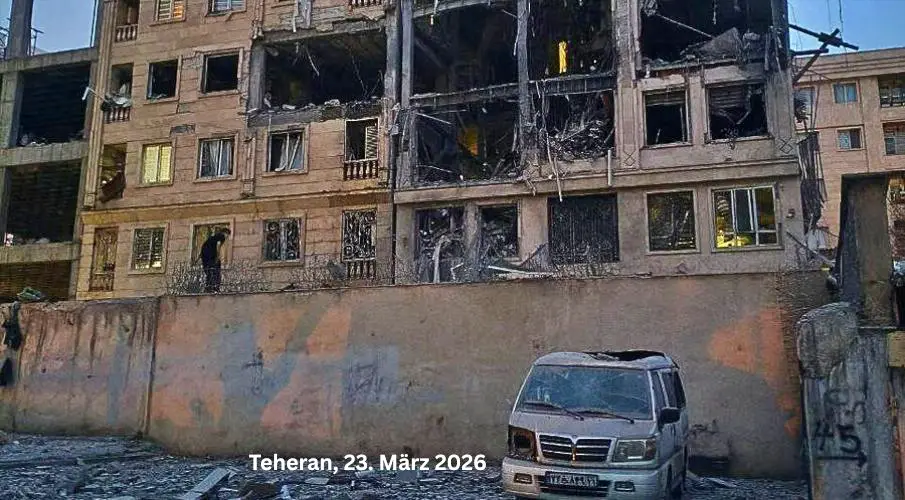
March 23, 2026 – Tehran – Makran Street, 13th Alley. A residential building, torn open, apartments exposed, rooms destroyed, the life inside turned outward. Not a military target, but a house where people lived, hit and ripped apart, what remains is rubble.
While these contradictory signals collide, the markets react faster than politics. Oil prices fall, stock markets rise. Before clarity emerges, trading begins. A single sentence from Washington is enough to move billions. At the same time, the situation remains fragile. US Energy Secretary Chris Wright speaks of temporary disruptions, but the numbers tell a different story. Oil prices above 100 dollars, gasoline prices near 4 dollars, supply shortfalls worth millions. Fatih Birol of the International Energy Agency openly warns of a global crisis. Already, around 11 million barrels of oil per day are missing. A scale that surpasses historical oil crises.
Politically, the picture is also shifting. Friedrich Merz confirms that he has communicated his concerns to Trump about possible attacks on Iranian energy infrastructure. At the same time, he welcomes the delay. Kaja Kallas, the EU’s High Representative, calls the decision “very welcome” and warns against further attacks on critical infrastructure. She states what others only imply: every strike on energy facilities drives this war further.
In the background, hectic diplomatic contacts are underway. Pakistan and Turkey are speaking with each other, Egypt is holding talks with several sides at once. Foreign ministers in Ankara, Islamabad, Cairo and Brussels are on the phone in the rhythm of a conflict that has long extended beyond the region. Saudi Arabia and Pakistan have already concluded a defense agreement. Every step has consequences across borders.
While negotiations take place above, or at least are being spoken about, people continue to die below. In Lebanon, the death toll rises to over 1,000. Among them at least 118 children and 79 women. Airstrikes hit residential areas, most recently also an apartment in a suburb of Beirut. The international community takes note, but reacts with little visibility.
The International Committee of the Red Cross becomes more direct. President Mirjana Spoljaric warns that targeted attacks on civilian infrastructure could constitute war crimes. She speaks of a point beyond which there may be no return. Words that at this moment do not sound like a warning, but like a sober description of the situation.
At the same time, the way this war is conducted is changing. Israel has, according to intelligence findings and analyzed data, used Iranian surveillance cameras to identify targets. Systems intended to control the population are becoming military tools. Millions of networked cameras, poorly secured, are turning into data sources. Access to these systems shows how vulnerable modern infrastructure has become.
Militarily, the situation remains tense. The United Kingdom is deploying the destroyer HMS Dragon toward Cyprus to protect bases. The United States now has only one aircraft carrier in the area of operations after the USS Gerald R. Ford remained in port following an incident in the Red Sea. Russia begins withdrawing personnel from a nuclear power plant in Iran, while at the same time warning of severe consequences if such facilities are attacked.
And in the middle of it all, the central question remains. Are there talks or not. Trump says yes. Iran says no. Both sides know that words in this moment are more than communication. They are part of the strategy.
Five days of delay do not change anything fundamental. They only postpone the decision.
Updates – Kaizen News Brief
All current curated daily updates can be found in the Kaizen News Brief.
To the Kaizen News Brief In English


Es ist genau das passiert, was ich gesagt habe.
Trump hat die Frist am Sonntag, alleine zwischen zwei Golfrunden und dem Mittagessen, auf Truth Social gepostet.
Am Montag wird man ihn von allen Seiten diesbezüglich gewarnt haben.
Nun verlängert er die Frist…..
Ausgerechnet Witkoff und Kushner, die unfähigsten Verhandler, sollen mit einem „respektierten“ Mitglied des Iran sprechen.
Das ist dann sicher kein Mitglied des derzeitigen Regime.
Ich vermute einfach, dass Trump einen Grund brauchte um seine Drohung nicht umzusetzen zu müssen.
Mein Gefühl sagt mir, dass es keine echten Gespräche gibt.
5 Tage … werden die Menschen im Iran 5 Tage zur Ruhe kommen können?
Oder gehen die Bombardierungen trotzdem weiter, nur eben nicht auf Kraftwerke?
Fakt ist, es sterben weiter Menschen die sich diesen Krieg nicht ausgesucht haben. 😞
Genau meine Gedanken dazu 👍
…kann ich nur voll ganz zustimmen
T.A.C.O
👍