
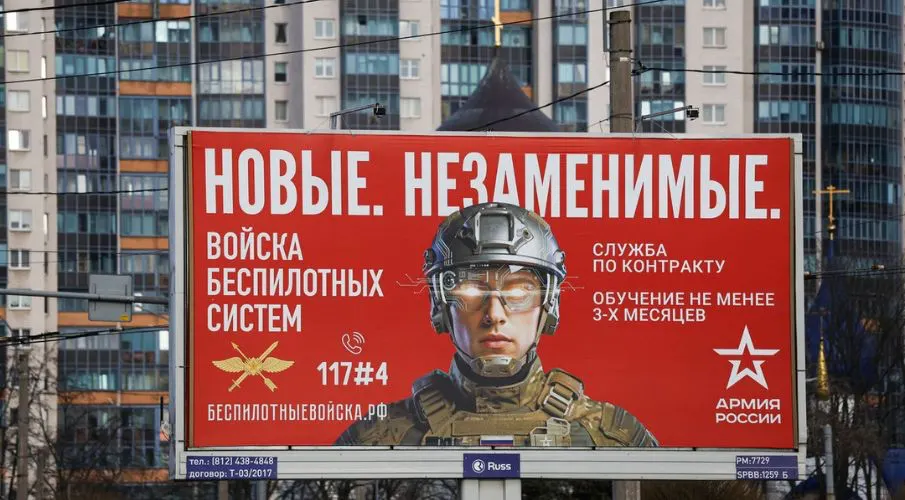
At first, there is a job contract, or at least that is what the men believe. Security guard, driver, construction worker, IT, good money, sometimes a Russian passport on top of it. Then they arrive in Moscow or Ufa, someone takes their passport away, puts Russian documents on the table and pressures them to sign. Buried among those papers is suddenly a contract with the army. Amnesty International interviewed men from Brazil, Colombia, Cuba, Egypt, Sierra Leone, Sri Lanka, Somalia and South Africa who say this is exactly how they ended up in Russia's war. One man from Sri Lanka arrived in Moscow with 58 fellow Sri Lankans after being promised work as a security guard. Nothing was translated, they had to sign quickly, and shortly afterward, following brief training, he was sent to the front. Two other Sri Lankans told almost the same story and said they never received the money they had been promised. A South African believed he only had to pick up a truck in Moscow and drive it to Poland; after he landed, the recruiter disappeared, everything was taken from him and he was told Poland was off the table, he was a soldier now.
Amnesty International report: https://www.amnesty.org/en/documents/eur46/1361/2026/en/
A Brazilian IT specialist expected a well-paid job and ended up at the Avangard training center. His phone, laptop and passport were taken away, and he was not allowed to leave. When he tried to get out, a commander allegedly told him: If you run, you either go to prison or we kill you ourselves. According to his own account, he spent 11 months in the Russian army before ending up in Ukrainian captivity; he says he was never paid. A Colombian came to Ufa via Istanbul for what was supposedly a civilian job, signed papers he did not understand while people kept telling him "quick, quick," was driven around in a bus for three days and was eventually handed a uniform and an assault rifle. Another Colombian said his passport had already been taken at the airport. Together with seven fellow Colombians and 35 Africans, he was taken to a military training ground, where people said that men who refused to go to the front simply disappeared. When his group was sent forward, the men from the previous group were already lying there dead. The order stayed the same: keep going.

Recruiters are apparently making money off this too. Peruvian lawyers say they were paid around $2,000 for every newly recruited man and describe powers of attorney that some men were also made to sign, in some cases for 15 years or with no expiration date at all. The lawyers represent 200 families and know of at least 300 more cases. Other men did not even have to be lured to Russia with fake job ads. Foreigners with expired visas or uncertain immigration status were allegedly faced with the choice of being detained or deported, or signing a military contract and getting residency or citizenship in return. Prisoners were also offered the army instead of serving the rest of their sentences. After signing, many had their passports and phones taken away, some were woken up at night, put on buses and driven for days to places whose names they did not know. Training often lasted only around two weeks, and in some cases the men could not even communicate with their commanders.
By April 2026, Ukraine said it had identified at least 28,391 foreigners from 136 countries who had fought on Russia's side, not including regular North Korean units; Amnesty was unable to independently verify that number. After six visits to two Ukrainian prisoner-of-war camps and numerous additional interviews, however, its assessment is still serious. Amnesty says the extent of deception, coercion and exploitation in several cases could amount to human trafficking under the United Nations Palermo Protocol. Units of Russia's Interior Ministry dealing with migration and the Defense Ministry could also be directly involved. Exactly how foreign recruiters and Russian authorities work together has not yet been fully established. For those who came because they were promised a job and eventually found themselves in a trench holding a Russian rifle, however, that unanswered question changes very little.
Updates – Kaizen News Brief
Alle aktuellen ausgesuchten Tagesmeldungen findet ihr in den Kaizen Kurznachrichten.
To the Kaizen News Brief In English


